
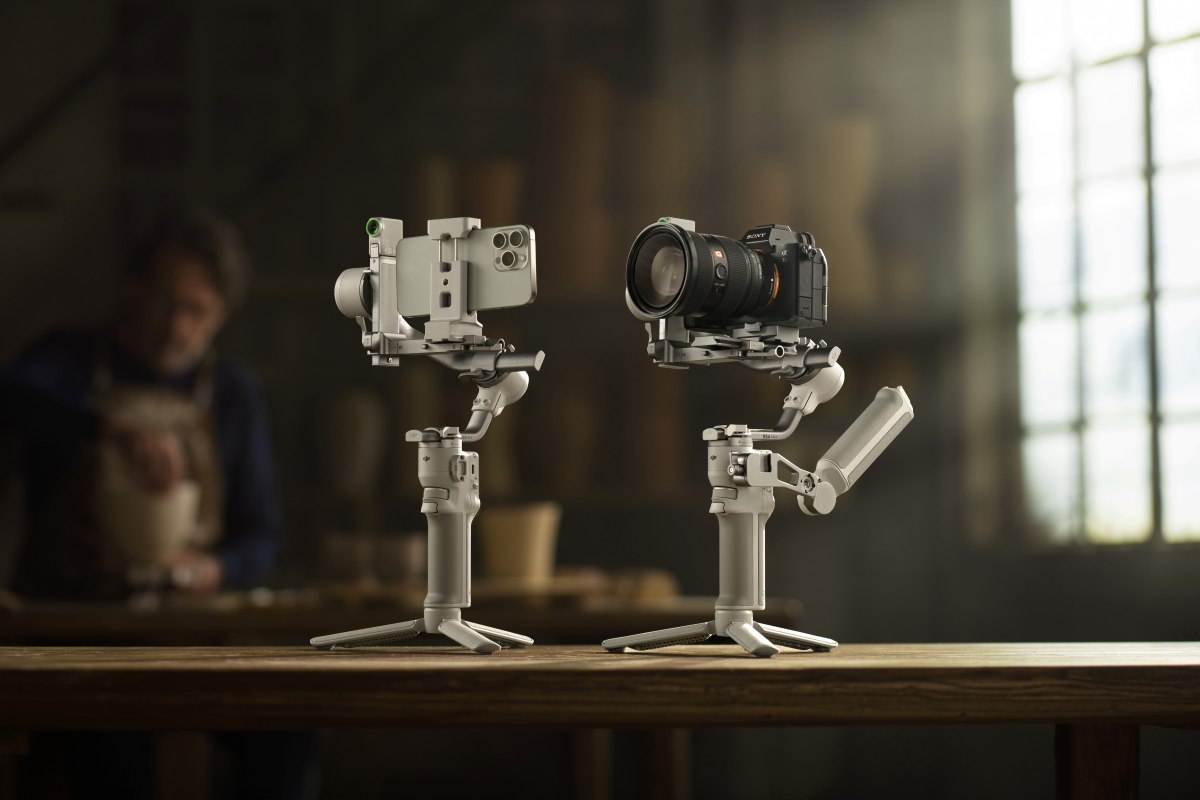
If you’re a content creator, vlogger, or filmmaker, you know that a reliable gimbal can make or break your shots. DJI has been leading the pack in stabilization tech, and with the launch of the RS 4 Mini, many are wondering: Is it worth upgrading from the RS 3 Mini? Let’s find out which one’s the right choice for you…
The RS 4 Mini refines the formula set by the RS 3 Mini gimbal, introducing improved stabilization algorithms, longer battery life, and an even smoother user experience. While its payload capacity remains unchanged, DJI has fine-tuned its balance and responsiveness, making it a more reliable tool for smartphones and mirrorless camera users alike.
Moreover, the RS 4 Mini Combo comes with the new DJI RS Intelligent Tracking Module for intelligent framing and composition. Enabling ActiveTrack on any camera system or phone with or without the DJI Mimo app, it can keep a person in frame up to 10 meters, even in complex environments.
Now, let’s dive into how the RS 4 Mini stacks up against its predecessor.
Quick specs: Side-by-side comparison
| Feature | DJI RS 4 Mini | DJI RS 3 Mini |
|---|---|---|
| Weight | 890g (2 lbs) | 795g (1.75 lbs) |
| Max payload | 2kg (4.4 lbs) | 2kg (4.4 lbs) |
| Stabilization tech | 4th-gen stabilization | 3rd-gen stabilization |
| Battery life | 13 hours | 10 hours |
| Charging time | 30 min for 5 hrs of use | 2.5 hours full charge |
| Auto-Axis Locks | Yes (2nd-Gen) | No |
| Vertical shooting | 3rd-gen Native Vertical Switch | Native Vertical Mode |
| Intelligent tracking | RS Intelligent Tracking Module | No |
| Price | $369 (Standard) / $459 (Combo) | $237 |
Why upgrade to the RS 4 Mini?
- Auto-Axis Locks for faster setup
- The RS 4 Mini introduces 2nd-Gen Auto-Axis Locks, meaning you can unlock all three axes in one second. No more fiddling around before getting the perfect shot!
- Smoother and more precise balancing
- Thanks to Teflon interlayers and a fine-tuning knob, achieving millimeter-level precision is easier than ever.
- Better battery life
- With a 30% increase in battery efficiency, the RS 4 Mini runs for 13 hours, compared to the RS 3 Mini’s 10-hour limit.
- Next-gen stabilization
- DJI has upgraded to 4th-gen stabilization, providing even better results for action shots, walking footage, and vertical shooting.
- Intelligent tracking for hands-free framing
- The RS 4 Mini’s RS Intelligent Tracking Module enables seamless ActiveTrack for both cameras and smartphones, making it a great tool for solo shooters.
- New Responsive Mode for faster camera movements
- The RS 4 Mini introduces a new mode that reacts instantly to hand movements, great for tracking fast-moving subjects.
Why stick with the RS 3 Mini?
- Lighter weight for better portability
- At just 795g, the RS 3 Mini is slightly lighter than the RS 4 Mini, making it a better option for ultra-light travel setups.
- Still handles the same payload
- If you’re using a mirrorless camera setup that doesn’t exceed 2kg, the RS 3 Mini can still get the job done.
- Cheaper option for budget creators
- If you don’t need advanced tracking or the latest stabilization, the RS 3 Mini at just $237 is still an excellent deal.
- Reliable 3rd-gen stabilization
- While not as advanced as the RS 4 Mini, the RS 3 Mini’s stabilization still delivers professional-grade results.
Which one should you buy?
- Go for the RS 4 Mini if you want the latest stabilization, auto-axis locks, intelligent tracking, and improved battery life.
- Stick with the RS 3 Mini if you’re on a budget, prioritize portability, and don’t need advanced tracking features.
Either way, DJI continues to dominate the gimbal game, and both models offer excellent stabilization for creators of all levels!
More: DJI just made the Osmo Action 5 Pro even more tempting


FTC: We use income earning auto affiliate links. More.



Comments