
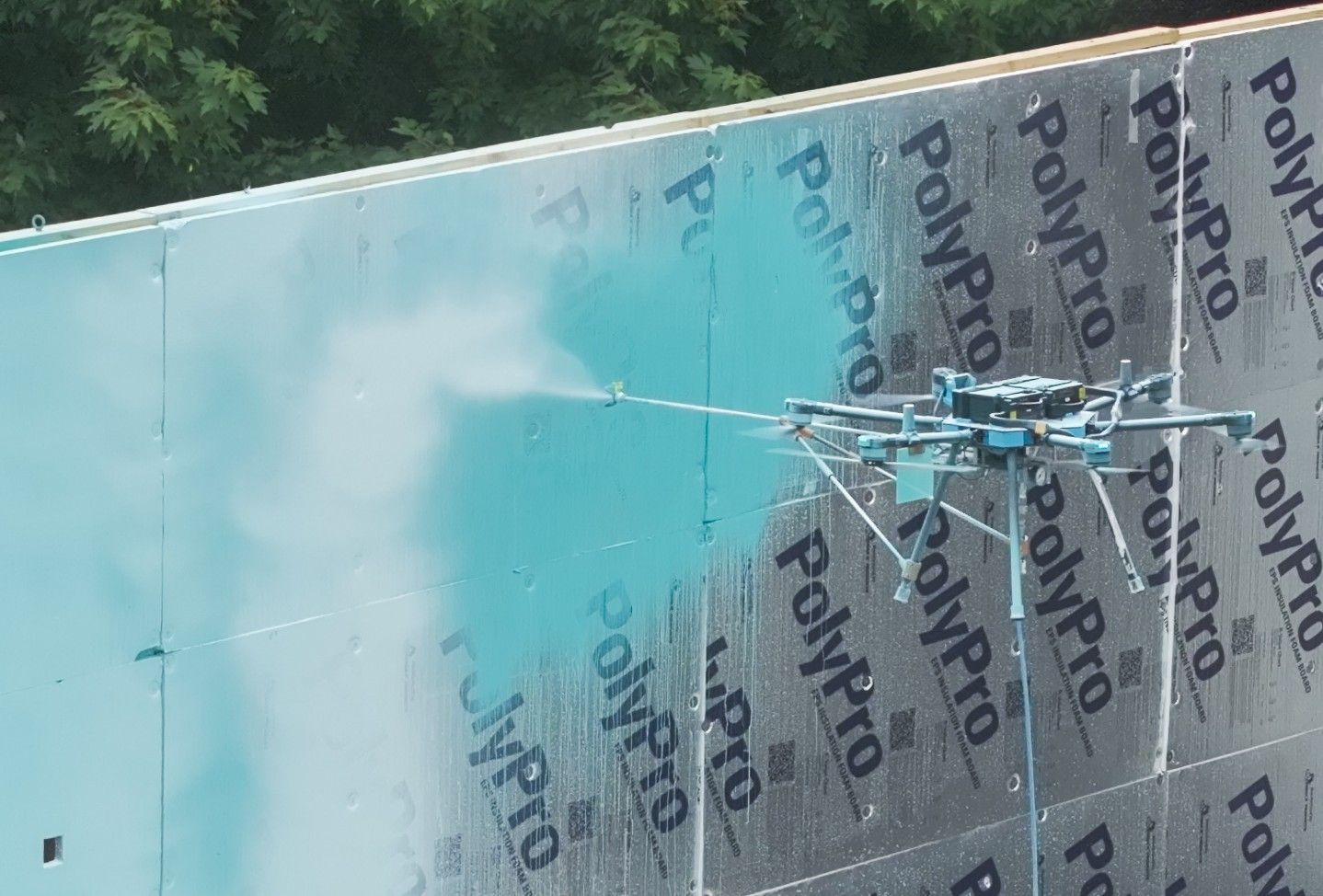
A drone that can paint buildings? It’s not sci-fi anymore. Lucid Bots, the robotics company behind the Sherpa drone that already cleans building exteriors and windows, has unveiled a new painting and coating module, turning its flying workhorse into a full-fledged construction site partner.
Basically, a commercial robotic system can now automate exterior painting at scale, marking a significant leap in how high-risk, labor-intensive work gets done.
The Sherpa drone has already proven itself as a reliable tool for façade cleaning and maintenance, capable of reaching up to 160 feet and operating continuously via a power tether. Now, Lucid Bots has given it a fresh layer of innovation, literally. With its new paint-spraying module, the Sherpa can uniformly coat more than 200 square feet per minute.
One operator can manage the entire operation using simple controls, completing projects up to three times faster and at roughly half the cost of traditional methods. Think of it as an aerial painter with precision, consistency, and none of the fatigue — or the safety harness.
“Modular robotics is redefining how essential work gets done,” says Andrew Ashur, founder and CEO of Lucid Bots. “The pace required to restore and expand our infrastructure demands automation that can do, not just sense and observe. Robots are the arms and legs of AI. Done right, they raise productivity, improve safety, and increase human prosperity.”
New: One US state is letting drones answer 911 calls; here’s why
The timing couldn’t be better. The US is currently experiencing one of the largest infrastructure buildouts in generations, even as the construction industry faces a severe labor crunch. As Lucid Bots explains, more than 40% of skilled workers are expected to retire by 2031, and finding replacements for jobs that involve height, hazard, and repetitive strain has been a long-standing challenge.
That’s where embodied AI — artificial intelligence integrated into physical systems like robots — comes in. Unlike AI that just analyzes data, embodied AI enables machines to interact with and manipulate the real world. In Sherpa’s case, that means navigating complex surfaces, adjusting for wind and texture, and applying an even coat of paint where a human painter might struggle.
In other words, the Sherpa drone doesn’t just “see” the job—it does it.
Rather than creating an entirely new product, Lucid Bots built the painting module as an addition to its existing Sherpa platform. Customers who already use Sherpa drones for cleaning can simply attach the new module — no major equipment overhaul required. That modular approach makes upgrading easy and keeps costs predictable for facility managers and contractors.
The company recently surpassed 500 robots deployed across the US, and the new painting capability has already been used on projects like waterproofing stadiums and removing graffiti along highways.
The demand? Off the charts. According to Lucid Bots, interest in the new painting module has already exceeded expectations. And considering the commercial painting and coating market is valued at a staggering $237 billion, the opportunity for disruption is massive.
So the next time you walk past a freshly painted building, look up — you might just see a drone doing the brushwork.
More: Apocalyptic scenes as drone show rains fire on China crowd


FTC: We use income earning auto affiliate links. More.

Comments