
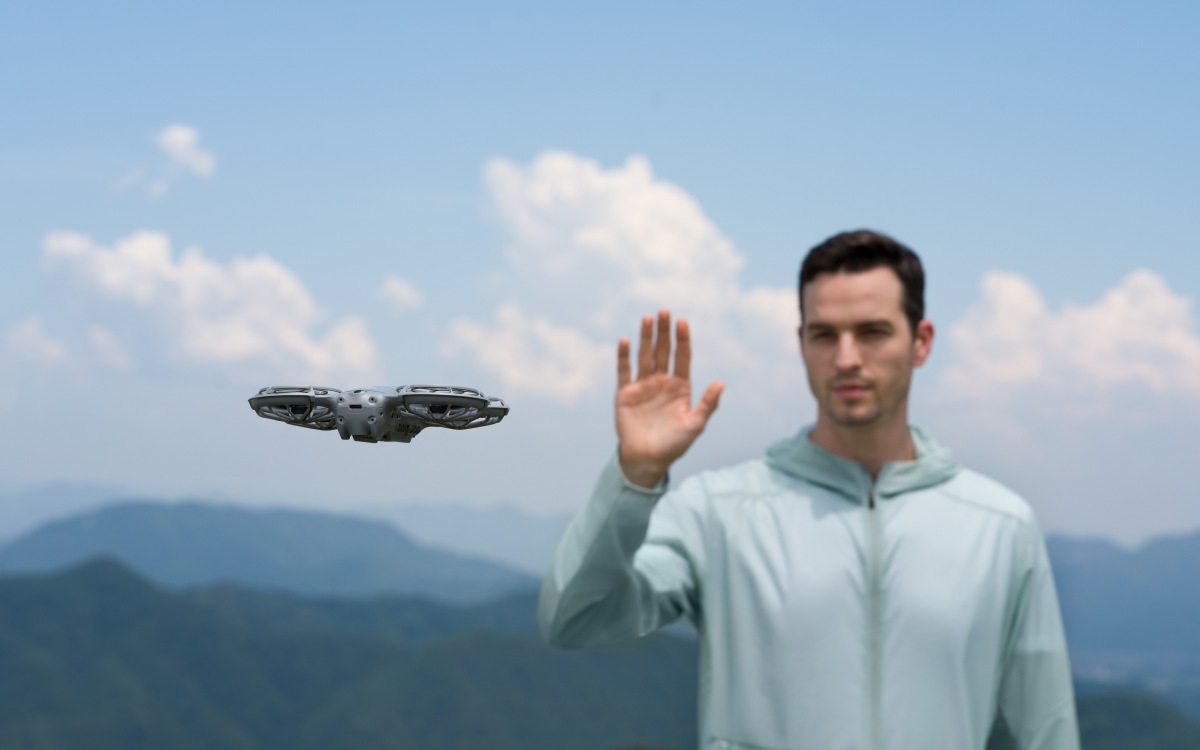
DJI’s latest mini drone, Neo 2, has just launched globally, and it’s already stealing attention for what it can do without a remote. Weighing only 151 grams, the new entrant in the Neo drone lineup is light enough to toss into a backpack but smart enough to take off from your palm, follow you using gestures or voice commands, and then land back on your hand when you’re done. It’s the ultimate pocket-sized flying camera built for travelers, families, and first-time drone users who want cinematic footage without fumbling with joysticks.
Neo 2 is DJI’s lightest drone yet with omnidirectional obstacle sensing, meaning it can detect objects from every direction for safer flying. It’s perfect for travel, family outings, and outdoor adventures.
What makes this drone extra special is gesture control. You can fly it using just your hands: raise your palm to move it up, swipe to the side to make it glide, or move both hands apart to make it back away for a wider shot. When your filming session ends, a new Return-to-Palm function brings it back to your hand, landing neatly without needing to touch the ground.
And for those who prefer voice commands, the Neo 2 supports voice control through a smartphone or Bluetooth headphones, so you can shout out flight instructions even while cycling or running.
For extended range, DJI offers optional pairing with the DJI RC-N3 remote controller, boosting video transmission distance up to 10 km — a huge leap for such a small drone. The Neo 2 can also be connected to DJI’s motion controller and goggles for an immersive FPV (first-person view) flying experience.
Under the hood, the Neo 2 packs a 12-megapixel, 1/2-inch CMOS sensor with an f/2.2 aperture, powered by a high-performance image processor for crisp, low-noise shots. The footage is stabilized by a new 2-axis gimbal, and it can shoot 4K video at up to 100 fps for cinematic slow-motion, or 2.7K vertical video perfect for social media.
New: Can Osmo Action 6 become DJI’s most creative camera yet?

DJI’s signature ActiveTrack returns with faster response and smoother tracking, allowing the drone to follow subjects running, biking, or even skateboarding — now at speeds up to 12 m/s. It can track from eight different directions, switching intelligently to rear tracking when needed to keep the subject framed.
For hands-free selfies, DJI introduces SelfieShot, which automatically composes waist-up, full-body, or wide shots — perfect for birthdays, picnics, or travel memories.
Add to that the familiar creative modes — Dolly Zoom, QuickShots, and MasterShots — and the Neo 2 is ready to turn any ordinary day into a cinematic highlight reel. QuickShots like Dronie, Rocket, Helix, and Boomerang return, making it effortless to capture viral-worthy clips.
For safety, Neo 2’s omnidirectional vision system combines monocular vision sensors, forward-facing LiDAR, and downward infrared sensors to detect obstacles in real time. A new integrated propeller guard design offers 360-degree protection, which is great for kids or first-time flyers.
DJI says the Neo 2 can hover more stably and navigate challenging spots such as indoor spaces, near buildings, or above water. With Level 5 wind resistance, it’s tougher than it looks. And when it’s time to store footage, the drone’s 49 GB of internal storage holds plenty — up to 105 minutes of 4K/60 fps video — with Wi-Fi transfers to your phone at speeds up to 80 MB/s, no cables required.
Battery life clocks in at 19 minutes, which may sound modest, but it’s in line with the Neo 2’s compact size and purpose: short, spontaneous, creative flights that capture moments as they happen.

Why DJI Neo 2 is not releasing in the US
But if you’re based in the US, you’ll be watching from the sidelines. The Neo 2 is officially launching across Canada, Europe, and other markets, but not in the United States. And it’s not the first time this has happened. Recent DJI products like the Osmo Mobile 8 and Mini 5 Pro have launched internationally — weeks or months before (or instead of) a US release.
The reason for this continued delay is more political than technical. Headquartered in China’s Shenzhen, DJI is currently under intense scrutiny from US lawmakers and regulators.
The Department of Defense has reaffirmed concerns that DJI technology could pose national-security risks, primarily around potential links to Chinese military supply chains. On top of that, US Customs and Border Protection has been intermittently detaining DJI imports for inspection under the Uyghur Forced Labor Prevention Act, complicating logistics for the company. Meanwhile, pending legislation under the FY25 National Defense Authorization Act could eventually restrict DJI’s access to Federal Communications Commission authorizations altogether, effectively banning new DJI products from being sold in the US.
Caught in this storm, DJI appears to be playing it safe: continuing global rollouts but avoiding the US until the political climate stabilizes. For American consumers, that means the latest drones are arriving everywhere else first, even in Canada just across the border.
But while there’s no official US release for the Neo 2, it would not be surprising if units start appearing through third-party resellers on e-commerce platforms such as Amazon. The same happened with other DJI products, such as the Mavic 4 Pro, Osmo 360, OM 8, and Mini 5 Pro.
In any case, Americans still have access to Neo 2’s predecessor — the DJI Neo, launched in 2024. That compact 135-gram drone lacks some of the new drone’s advanced sensors and higher frame-rate video, but it still offers effortless palm-launching, gesture-based flight, and DJI’s signature flight stability — all at a lower price.
In other words, while the Neo 2 may currently be out of reach via official US channels, domestic buyers still have a door into the DJI ecosystem. Either way, one thing is clear: for US drone fans, the skies remain complicated. DJI continues to soar globally; it’s just less certain if a new aircraft will ever fly home to America.
More: DJI drops old drone geofencing rules: What pilots need to know


FTC: We use income earning auto affiliate links. More.


Comments