
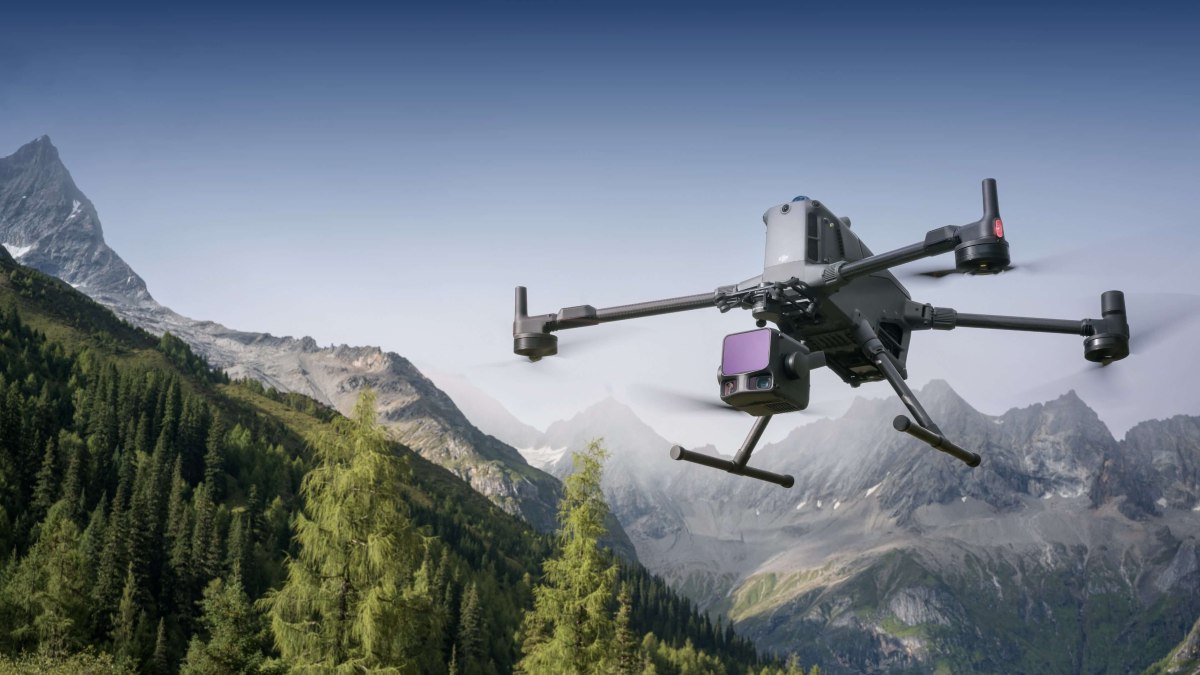
DJI has rolled out a fresh firmware update for the Matrice 400, bringing a series of under-the-hood improvements aimed squarely at enterprise operators who depend on precision, stability, and reliability in demanding environments. While this isn’t a flashy feature-packed update, it addresses some of the most critical aspects of professional drone operations: positioning accuracy, sensor performance, and battery safety.
The update spans nearly the entire Matrice 400 ecosystem, including the aircraft, remote controller, DJI Pilot 2 app, batteries, RTK stations, and multiple Zenmuse payloads. The aircraft firmware has been updated to v16.01.08.09, alongside corresponding updates for the remote controller, Manifold 3 onboard computer, TB100 batteries, BS100 battery station, and payloads such as the Zenmuse P1, L-series LiDAR sensors, and H30/H30T.
The Matrice 400 sits firmly in DJI’s heavy-duty enterprise lineup, designed for complex missions such as surveying, inspection, public safety, and infrastructure work. Like other Matrice platforms, it’s built around modular payload support, high-precision positioning, and compatibility with RTK systems and advanced sensors. Operators typically deploy it in environments where GPS conditions aren’t ideal — urban corridors, industrial sites, or areas with electromagnetic interference — making positioning accuracy and system reliability especially critical.
New: How to safely operate DJI Dock 3 during harsh winter conditions
One of the most notable additions in this update is support for dirt detection on LiDAR sensors. The system can now detect when dust or debris may be affecting LiDAR performance, prompting operators to clean the sensor before data quality is compromised. For teams relying on LiDAR for mapping, modeling, or inspection, this feature helps prevent bad datasets and costly re-flights.
DJI has also optimized positioning performance across all scenarios, improving accuracy and stability in complex environments. While DJI doesn’t detail the exact algorithms involved, the update is aimed at reducing drift and improving confidence when operating near structures, terrain, or signal-challenged areas.
Another key fix addresses a known battery issue, with DJI stating that the update enhances overall flight safety. Battery-related firmware tweaks are especially important for enterprise drones that carry heavier payloads or operate for extended periods, where power stability can directly affect mission success.
In addition to the aircraft itself, DJI has updated both D-RTK 2 and D-RTK 3 Mobile Stations, ensuring tighter integration with the Matrice 400. The DJI Pilot 2 app is updated automatically through the remote controller firmware, while batteries and the intelligent battery station can be updated directly through the app.
As always, DJI recommends using DJI Assistant 2 (Enterprise Series) or the DJI Pilot 2 app and ensuring all components are updated together to avoid compatibility issues.
More: Lowest ever: DJI Mini 3 drone deal slashes prices by $144


FTC: We use income earning auto affiliate links. More.





Comments