
For nearly two decades, DJI has defined what most people think of when they hear the word “drone.” From the Phantom that helped popularize aerial photography to the Mavic series that made folding camera drones mainstream, the Chinese company has dominated the global civilian quadcopter market. Now, DJI is taking its biggest step beyond that familiar formula.
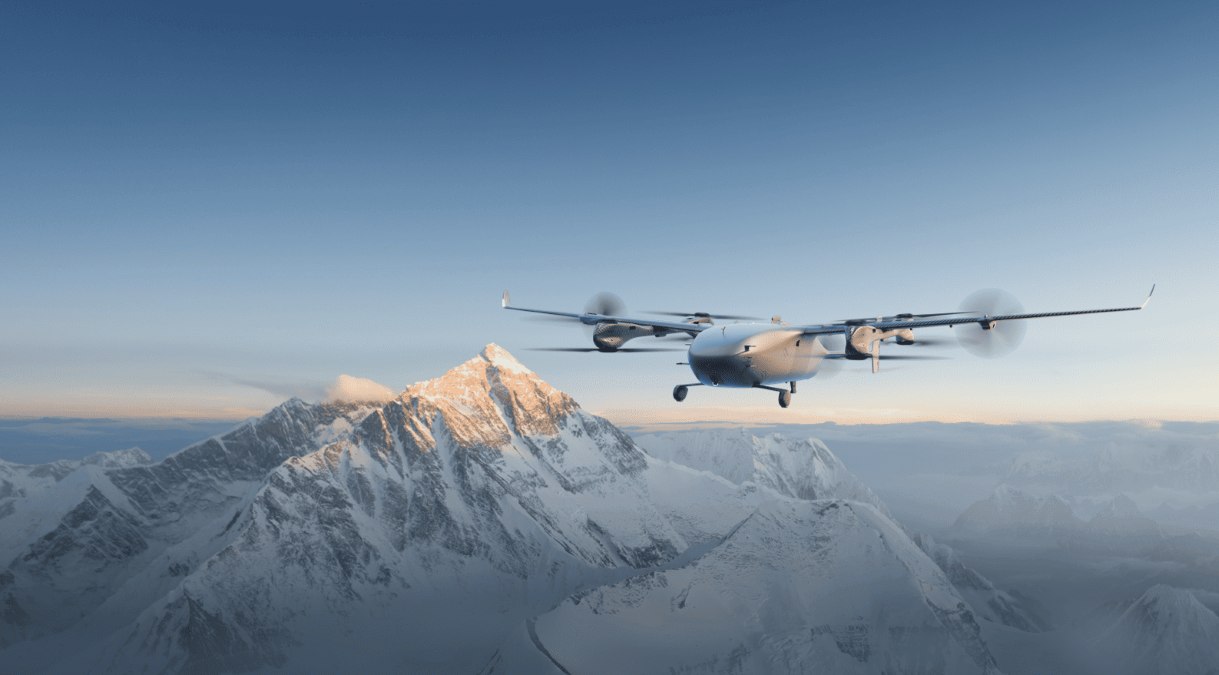
The company has officially unveiled its first electric vertical takeoff and landing (eVTOL) drone, the DJI EV50, using one of the world’s toughest proving grounds: Mount Everest.
Rather than launching the aircraft with flashy marketing videos, DJI revealed the EV50 after it completed a series of scientific missions on Everest’s north slope in China, where it helped researchers collect atmospheric data at altitudes approaching the mountain’s summit. At the same time, DJI showcased how two of its other enterprise drones supported routine logistics and mapping operations on Everest’s south slope in Nepal, highlighting the company’s broader push into industrial and public-service applications.
Unlike DJI’s familiar quadcopters, the EV50 is a hybrid vertical takeoff and landing aircraft. It combines the ability to lift off like a multirotor drone with the long-range efficiency of a fixed-wing aircraft. That design allows it to operate in remote locations where there are no runways while covering much greater distances than traditional multirotor platforms.
According to DJI, the EV50 can carry payloads of up to 50 kilograms (about 110 pounds), features a 270-liter cargo compartment, and has a maximum no-load range of 150 kilometers. Those specifications position it for missions such as emergency response, mountain logistics, island deliveries, and scientific expeditions rather than aerial photography.
Its first public assignment was anything but ordinary.
Working alongside a Chinese scientific expedition, the EV50 supported atmospheric research in the Qomolangma National Nature Reserve by carrying ozone-measuring equipment into the upper troposphere. Scientists have long struggled to collect accurate atmospheric samples above 8,000 meters because helicopter exhaust and rotor wash can contaminate sensitive instruments, while conventional fixed-wing aircraft require runways that simply don’t exist near Everest Base Camp.
Because the EV50 is fully electric, it produces no exhaust emissions during flight. Over a 12-day expedition, the aircraft completed 32 takeoffs and landings, including 12 research flights carrying scientific instruments. Its highest flight reached an altitude of 8,861 meters (29,072 feet), with a continuous climb of 3,730 meters (12,238 feet). DJI says the mission marked the first time researchers from Peking University used drones to conduct detailed atmospheric observations in the ultra-high-altitude troposphere.
New: DJI just made European BVLOS drone approvals much easier
While the EV50 grabbed most of the attention, DJI’s latest Everest campaign also demonstrated how its enterprise drone lineup is beginning to move beyond experimental testing into routine operations.
On Everest’s south slope, the new FlyCart 100 cargo drone transported more than 10 metric tons of climbing supplies and waste between Base Camp and Camp 1 during the 2026 climbing season. The flights included oxygen cylinders, ropes, ladders, and other expedition equipment, while return trips removed nearly 2.9 metric tons of trash from the mountain.
A delivery that traditionally requires Sherpas to spend six to eight hours crossing the dangerous Khumbu Icefall now takes roughly eight minutes by drone.
DJI says the FlyCart 100 demonstrated payloads of up to 47 kilograms at altitudes exceeding 6,300 meters. Looking ahead, the company expects the aircraft to help transport thousands of oxygen cylinders each climbing season while supporting Nepal’s efforts to reduce waste on Everest.
Meanwhile, the Matrice 4E mapping drone completed centimeter-level 3D mapping of more than three square kilometers of the Khumbu Glacier in just 3.5 hours. The resulting digital model gives climbing teams detailed information about crevasses and hazardous terrain before guides enter the icefall, helping improve route planning and search-and-rescue operations.
The Everest operations also reflect a much longer story for DJI.
The company has been testing drone technology on or around the world’s highest mountain since 2009, when it flew an unmanned helicopter equipped with one of its early flight controllers. In 2010, DJI tested its Ace One flight control system above 4,700 meters. More recently, a Mavic 3 captured the first drone footage from Everest’s 8,848.86-meter summit, while the FlyCart 30 completed the mountain’s first drone cargo delivery tests in 2024.
Each milestone has built toward increasingly practical applications rather than simply chasing altitude records.
That’s significant because DJI’s dominance has historically come from camera drones, a market where it continues to hold a commanding global position despite increasing competition and ongoing political scrutiny in the United States. The EV50 suggests DJI is now investing just as heavily in larger commercial aircraft designed for logistics, infrastructure, emergency response, and scientific work.
For US readers, it’s worth noting that the EV50 isn’t headed to American customers anytime soon. DJI says the aircraft is currently available for preorder only in mainland China, and the company has not announced international pricing or launch plans.
Still, the debut offers a glimpse of where DJI believes the commercial drone industry is headed. As camera drones become increasingly mature, the next frontier may be aircraft capable of moving cargo, supporting first responders, enabling climate research, and operating in places where conventional aircraft simply can’t go.
If the EV50’s first assignment is any indication, DJI intends to compete in that future just as aggressively as it reshaped the consumer drone market over the past decade.
More: New DJI parachute helps protect Matrice 400 drone during emergencies


FTC: We use income earning auto affiliate links. More.


Comments