
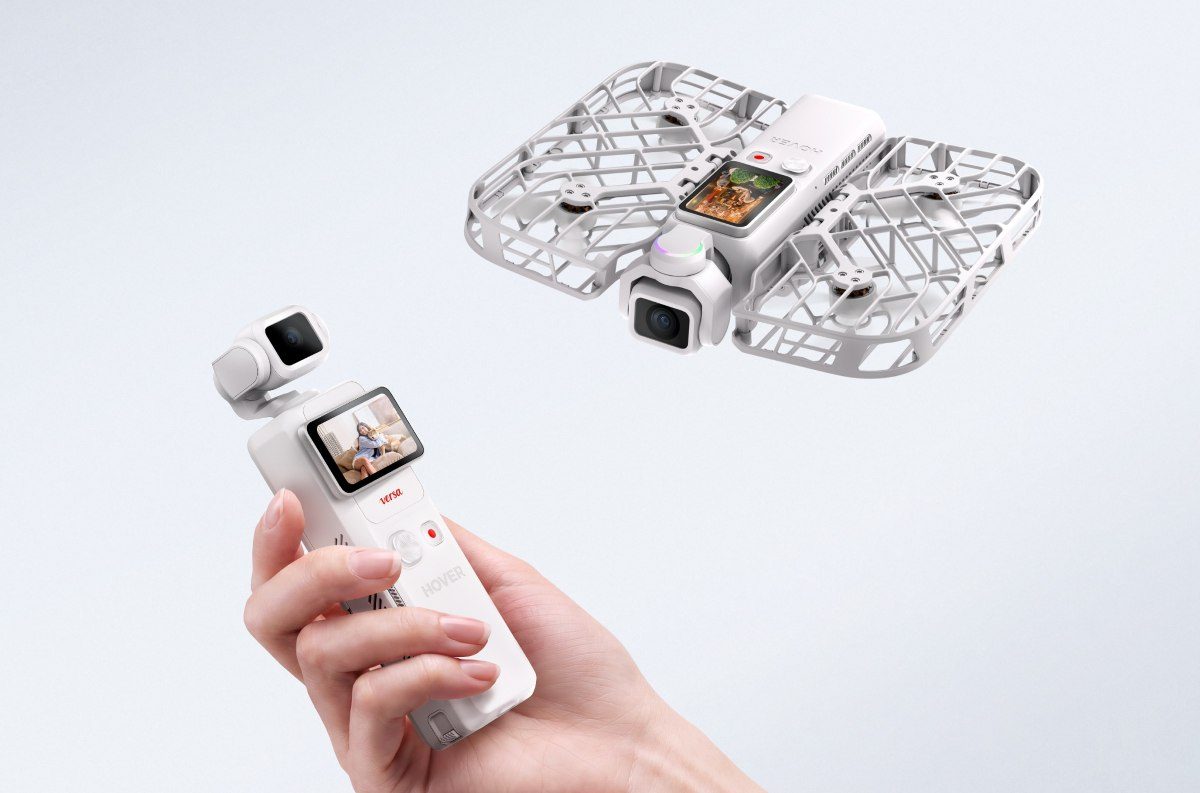
For years, creators have had to choose between carrying a pocket camera with a gimbal or packing a separate drone for aerial shots. Follow-me drone specialist HoverAir thinks they shouldn’t have to. Its newly unveiled Versa is designed to do both, transforming from a handheld, pocket-sized camera into a self-flying AI camera with snap-on propeller modules.
Set to launch on Indiegogo in mid-August, Versa represents HoverAir’s latest attempt to simplify content creation by combining two devices into one. Whether you’re filming yourself on the ground or capturing cinematic overhead footage, the company says Vera lets you switch perspectives without switching gear.
A pocket gimbal camera first
In its standard form, Versa is a compact handheld camera built around a 3-axis mechanical gimbal, delivering stabilized footage for everything from travel videos and family moments to vlogs and everyday adventures.
HoverAir says the camera pairs that stabilization with advanced AI shooting features and a new image processor designed to preserve detail in challenging lighting. The company claims Versa delivers industry-leading dynamic range, capturing rich colors in sunsets, city lights, and other high-contrast scenes while retaining detail in darker shadows. The result, according to HoverAir, is cleaner low-light footage with more natural-looking colors.
The camera also introduces AI-powered framing assistance. Instead of leaving composition entirely up to the user, Versa analyzes the scene, suggests an ideal camera position, and intelligently crops the frame to create a more balanced, professional-looking shot.
Then it becomes a flying camera
The real differentiator is what happens next. Attach HoverAir’s lightweight propeller modules, and Versa transforms into an autonomous flying camera. Rather than requiring a remote controller or manual piloting, the company says users can simply launch the device and let its AI tracking system handle the rest.
HoverAir says VERSA supports more than 10 intelligent flight modes, allowing it to automatically follow subjects and capture aerial footage that would normally require a traditional drone and an experienced pilot.
The idea is simple: start filming from your hand, then switch to an elevated perspective whenever the story calls for it.
By combining handheld stabilization and autonomous flight into one device, HoverAir is targeting creators who regularly switch between ground-level and aerial footage.
Instead of carrying a pocket gimbal, an action camera, and a drone, Versa aims to cover multiple shooting styles with a single compact system. HoverAir says the camera is designed for handheld selfies, immersive POV footage, AI-powered follow shots, and cinematic aerial perspectives without adding complexity.
That approach continues the company’s broader philosophy of removing traditional barriers to aerial photography. Rather than focusing on manual flying, HoverAir’s products emphasize AI-powered automation that lets users capture footage with minimal setup or piloting experience.
A new way to capture memories
One of Versa’s more unique features is something HoverAir calls 3D Worlds. The feature has the flying camera perform an automated 360-degree flight around a scene before reconstructing it into an interactive 3D image. Instead of viewing a traditional photo, users can explore the captured scene from different angles on compatible devices and share those immersive memories with others.
While HoverAir has revealed the overall concept behind Versa, several key details, including camera resolution, battery life, flight time, pricing, and availability, remain under wraps.
Those answers are expected when the company launches its Indiegogo campaign in mid-August.
Returning to Indiegogo is familiar territory for HoverAir. The company has successfully used crowdfunding to launch previous products, including the original HoverAir X1 and the X1 Pro drone series, building a loyal community of early adopters while raising millions of dollars in the process. That said, prospective backers should remember that crowdfunding campaigns don’t always follow their original schedules. HoverAir itself has adjusted shipping timelines before, most recently for its Aqua flying camera, whose launch was pushed back to allow additional product refinements before production.
Nonetheless, Versa stands out for a reason that’s easy to understand. Instead of asking creators to choose between a stabilized pocket camera and a flying camera, HoverAir is betting they’ll want a single device that can seamlessly switch between the two.
More: DJI’s newest gadget may outshine its new camera


FTC: We use income earning auto affiliate links. More.

Comments