
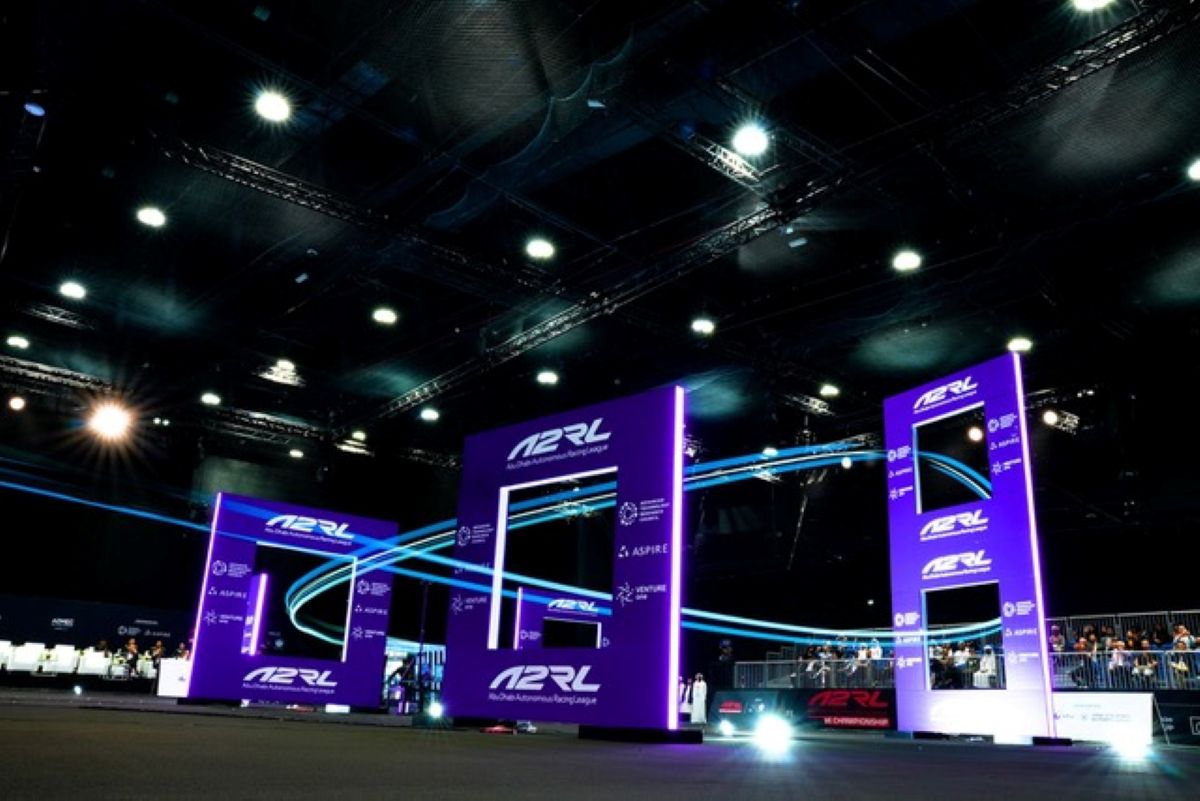
What happens when the world’s fastest human drone pilots line up against AI systems built to think, react, and fly at extreme speed — using almost no sensors? You get the A2RL Drone Championship, where split-second decisions, not flashy hardware, decided who ruled the sky.
Now in its second year, the Abu Dhabi Autonomous Racing League (A2RL) Drone Championship pushed autonomous flight to new limits, pitting elite first-person-view (FPV) pilots against cutting-edge AI racing teams. With a $600,000 prize pool on the line, the stakes were high, and the results showed just how close machines are getting to human instinct.
This wasn’t AI on easy mode. Every autonomous drone competed with the same bare-bones setup: a single forward-facing monocular RGB camera and an inertial measurement unit. No GPS. No LiDAR. No stereo vision. No external positioning systems. In other words, the AI had to “see” the world almost exactly the way a human pilot does — through one eye, at racing speed.
That constraint is what makes A2RL stand out. Instead of rewarding expensive sensor stacks, the championship forces teams to squeeze every ounce of performance out of software, perception algorithms, and decision-making under pressure.
In the AI Speed Challenge, Technology Innovation Institute’s TII Racing delivered the fastest autonomous lap of the entire championship, clocking in at a blistering 12.032 seconds. It was the quickest run achieved across all competitors and set a new benchmark for vision-based autonomy at high speed.
MAVLAB followed closely with a 12.832-second lap, highlighting just how tight the competition has become at the top. Compared to the inaugural season, AI teams showed clear gains — not just in speed, but in stability and consistency.
According to ASPIRE CEO Stephane Timpano, those improvements didn’t come from better hardware. They came from software. Teams are learning how to extract more reliable perception and control from limited data, which is exactly the kind of progress needed for real-world autonomous systems.
TII Racing’s technical leadership echoed that sentiment, noting that winning the AI Speed Challenge was the result of disciplined development and relentless testing of vision-led autonomy pushed to its limits.
But while speed is impressive, it’s coordination that’s harder, and that’s where the multi-drone races raised the bar even further.
In races where multiple autonomous drones shared the same airspace, MAVLAB claimed victory in the Multi-Drone Gold Race, showing strong real-time planning, collision avoidance, and consistency under pressure. FLYBY took first place in the Multi-Drone Silver Race, underscoring the growing depth of talent across the championship.
These formats tested some of the toughest problems in autonomy: predicting the behavior of others, adapting trajectories on the fly, and staying robust in chaotic environments. These aren’t just racing challenges; they’re the same issues faced by future delivery drones, emergency responders, and air mobility systems.
The most dramatic moment came in the Human vs AI finale. World FPV Champion Minchan Kim faced TII Racing’s autonomous drone in a best-of-nine showdown that stayed deadlocked at four wins each.
In the decisive final run, Kim held his lead as the AI drone clipped a gate and failed to recover — handing victory to the human pilot by the narrowest of margins. It was a powerful reminder: AI is fast, precise, and improving rapidly, but human instinct still matters, especially when things go wrong at full speed.
The championship followed A2RL Summit 3.0, where policymakers, researchers, and industry leaders discussed how lessons from autonomous racing can translate into real-world deployment. Topics ranged from regulation and simulation-to-reality transfer to scaling autonomy for logistics, emergency response, and future air mobility.
By compressing years of research into days of visible competition, A2RL functions as a public testbed — one that exposes what AI can do when pushed to extremes. The takeaway is clear: the gap between human and machine is shrinking fast, and the software driving today’s race drones could soon power tomorrow’s autonomous systems in the real world.
More: Antigravity A1 drone gets first-ever discount with new flight simulator feature


FTC: We use income earning auto affiliate links. More.



Comments