
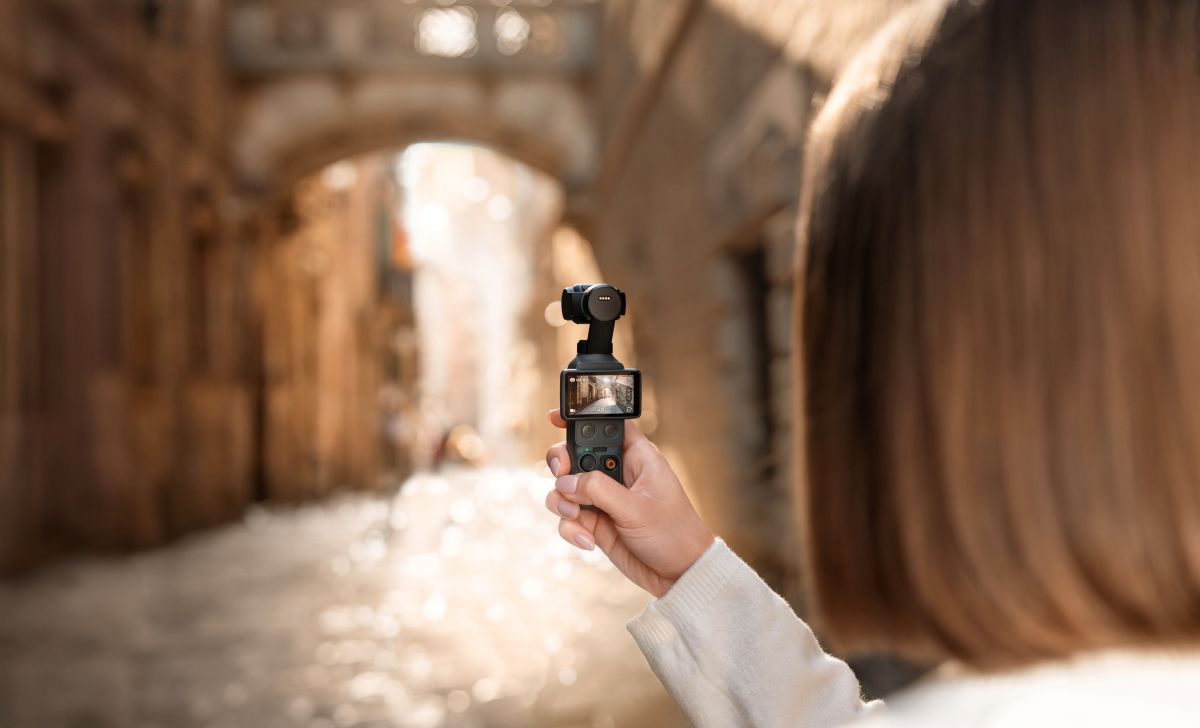
DJI has unveiled the Osmo Pocket 4, a new-generation pocket gimbal camera that builds on the runaway success of the Pocket 3. But right now, it’s effectively locked out of the US market with no clear path forward. And that’s because, unlike some of DJI’s latest drones, like the Avata 360, or action cameras such as the Osmo 360, even importing one through third-party sellers may not be a reliable workaround anymore.
On paper, the Osmo Pocket 4 looks like exactly the upgrade creators were hoping for. It builds on the momentum of the hugely popular Pocket 3, a device that quietly became one of DJI’s most culturally relevant products — not drones, but storytelling tools that showed up everywhere from travel vlogs to street photography reels.
This new model keeps the same pocket-sized, three-axis stabilized design but pushes performance into territory that starts to rival much larger cameras. At its core is a 1-inch CMOS sensor, paired with improvements that feel aimed squarely at serious creators. The camera can shoot 4K video at 240 frames per second, opening the door to ultra-slow-motion footage without sacrificing resolution. DJI is also promising 14 stops of dynamic range and 10-bit D-Log, which gives editors far more flexibility when color grading.
But specs only tell part of the story. Where the Pocket 4 really seems to stand out is in real-world usability — especially in low light. DJI has focused heavily on improving how the camera handles darker scenes, with more natural skin tones and better highlight retention. For the kind of evening street footage and indoor vlogging that dominates social media today, that’s a meaningful upgrade.
Part of what made the Pocket 3 so widely adopted was how easy it made solo shooting. The Pocket 4 leans even further into that strength with upgraded tracking powered by ActiveTrack 7.0. In practical terms, the camera is better at sticking with a subject as they move through busy environments, even when zoomed in. A feature called “Subject Lock Tracking” allows users to tap a person on the screen and trust that the camera will hold focus and framing without constant adjustments.
There’s also gesture control, which lets you start recording or activate tracking without touching the device — something that sounds small until you’re filming yourself in public. The result is a camera that behaves less like a tool and more like a second set of hands. For creators who work alone, that distinction matters.
DJI has also paid attention to the smaller frustrations that come with shooting on the go. The Osmo Pocket 4 introduces a series of usability tweaks that don’t sound dramatic individually but add up to a smoother experience. You can start recording simply by rotating the screen. There’s a dedicated zoom button that lets you quickly jump between focal ranges. A customizable preset button allows you to save and recall your preferred settings instantly. And the redesigned joystick offers more precise control over camera movement.
One of the more quietly significant upgrades is 107GB of built-in storage. For many users, that eliminates the need to think about memory cards at all. Combined with fast transfer speeds, it shifts the experience closer to using a smartphone — just point, shoot, and deal with files later. Battery performance also sees a boost, with DJI claiming up to four hours of recording and rapid charging that gets you back up and running in under 20 minutes.
As expected, the new camera supports DJI’s wireless audio solutions, such as the Mic 3 and Mic Mini, enabling multi-channel recording for interviews and more complex shoots. It also introduces built-in creative tools such as film tone presets, slow-shutter video for motion blur effects, and optional accessories like a clip-on fill light.
Under normal circumstances, this would be an easy recommendation for US buyers looking for a compact, high-quality video tool. But these aren’t normal circumstances.
Why DJI Osmo Pocket 4 is not coming to US
To be sold legally in the United States, any consumer device that uses wireless communication — Wi-Fi, Bluetooth, or radio frequencies — must be authorized by the Federal Communications Commission (FCC). This process ensures that devices don’t interfere with other electronics, comply with spectrum rules, and meet safety standards. In simple terms: if a gadget connects to your phone, the internet, or even just transmits data wirelessly, it needs FCC clearance before it can be marketed or widely distributed in the US.
That’s where DJI is running into trouble.
The company has been placed on the FCC’s so-called “Covered List,” a designation tied to national security concerns. While that doesn’t automatically ban existing DJI products, it creates a major hurdle for new ones. In simple terms, being on the Covered List means new DJI devices face significant hurdles in obtaining FCC approval. And without that approval, they can’t be legally marketed or widely distributed in the country.
Timing is critical here. Products that secured authorization before regulatory tightening can still be sold, though DJI has chosen not to do that through its official channels. Nonetheless, newer drone models such as the Avata 360 and Neo 2 remain available in the US through independent importers.
The Pocket 4, however, appears to have missed the FCC approval window. Which means, even third-party resellers cannot bring the Pocket 4 to the US since non-compliant wireless devices can face customs and legal distribution barriers.
For American consumers, this creates an unusual dynamic. The latest and most capable version of DJI’s pocket camera exists, but is effectively out of reach as of today.
That said, the situation isn’t entirely static. DJI is currently challenging its inclusion on the FCC’s Covered List in court, arguing that the designation is unfair and lacks sufficient evidence. The outcome of that legal battle could, in theory, reshape how future DJI products are treated in the US, including whether devices like the Osmo Pocket 4 ever get a path to authorization.
But that’s the optimistic scenario. While regulatory cases like this tend to drag on for years, in a memo released earlier this month, the Department of Defense has urged strict rejection of DJI’s petition for reconsideration of its Covered List status.
In the near term, the reality remains unchanged: the Pocket 4 sits on the outside looking in, and the DJI Osmo Pocket 3 is back in the spotlight. It may not have the newest features, but it comes with the same 1-inch CMOS sensor, is legally authorized, available, and still widely regarded as one of the best compact video tools on the market. More importantly, it may represent something else: the last generation of DJI’s pocket cameras that US buyers can buy without uncertainty.
More: GoPro is no longer just an action camera company


FTC: We use income earning auto affiliate links. More.


Comments