
One of the biggest trade-offs in the enterprise drone world has been choosing between power and automation. If you wanted a heavy-lift aircraft capable of carrying advanced sensors like LiDAR, thermal cameras, and zoom payloads, you usually needed a crew on-site. If you wanted a drone that could launch itself from a docking station, you often had to settle for a smaller aircraft with fewer capabilities. A new product launching in Canada aims to change that.
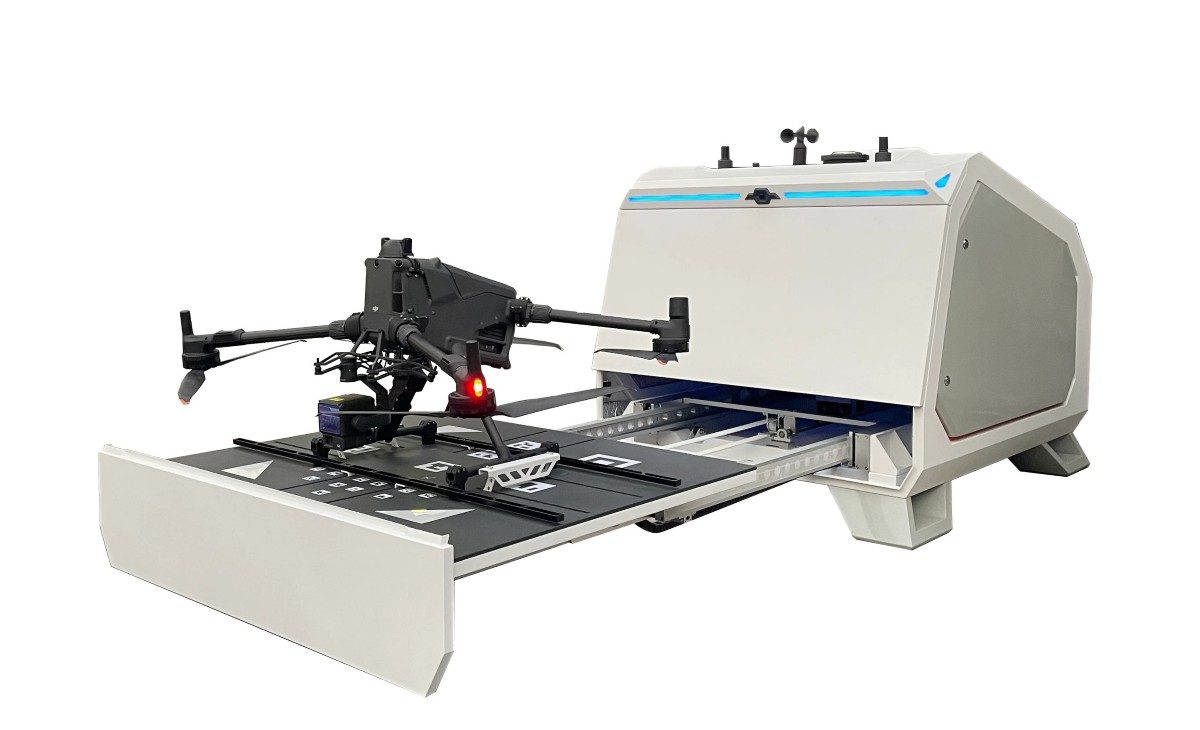
Canadian enterprise drone company Infinit Drones has introduced the Dock M400, an autonomous docking platform built specifically for DJI’s flagship Matrice 400 drone. Developed with SB Innovation, the system allows operators to remotely launch, recover, recharge, or automatically swap batteries and redeploy the aircraft without sending personnel into the field.
The launch is particularly significant because the DJI Matrice 400 is designed for demanding industrial work. Introduced in 2025 as DJI’s flagship enterprise platform, the M400 can stay airborne for up to 59 minutes, carry payloads weighing up to 6 kilograms, and supports multiple sensors simultaneously, including thermal cameras, LiDAR scanners, mapping cameras, spotlights and loudspeakers. It also features LiDAR- and mmWave radar-based obstacle sensing, intelligent automation tools, and up to 40 km of enterprise video transmission, making it a popular choice for public safety, utility inspections and infrastructure mapping.
Until now, however, deploying such a capable aircraft generally required people on location. That’s the gap Infinit Drones says the Dock M400 fills.
The dock comes in two versions: one with automatic charging and another capable of automatically replacing depleted batteries in about two minutes. It can store up to four Matrice 400 batteries, helping organizations keep drones mission-ready around the clock.
It also supports the M400’s full range of payloads, whether operators need thermal imaging for emergency response, LiDAR for surveying, high-resolution mapping cameras, or zoom sensors for inspections. Other features include dock-to-dock relay missions for long-distance operations, fixed or vehicle-mounted installations, cloud or private-network connectivity with integrated 4G/5G support, edge computing, RTK positioning, environmental monitoring, and an IP55-rated enclosure capable of operating in temperatures ranging from -20°C to 50°C.
The target customers are industries where rapid aerial intelligence can save both time and money. These include electric utilities, oil and gas companies, mining operations, railways, ports, pipeline operators, police departments, firefighters, and emergency management agencies.
For example, after a storm knocks out power, a utility could automatically dispatch a Matrice 400 equipped with thermal or LiDAR sensors to inspect damaged infrastructure before deciding whether crews even need to be sent. That could reduce unnecessary truck rolls while speeding up restoration efforts.
According to Infinit Drones CEO Pedram Nowroozi, customers have been asking for a way to combine the Matrice 400’s payload capacity with fully autonomous deployment, eliminating the need to send a flight team every time a mission arises.
The timing may also work in the company’s favor. Interest in Drone as First Responder (DFR) programs continues to grow, while Canada’s evolving regulations for certain lower-risk beyond visual line of sight (BVLOS) operations are opening the door for more remotely operated drone deployments. Together, those trends could make autonomous heavy-lift systems like the Dock M400 increasingly attractive for organizations looking to scale aerial operations without scaling headcount.
More: DJI’s upcoming Osmo 360 II camera films historic rocket launch


FTC: We use income earning auto affiliate links. More.




Comments