
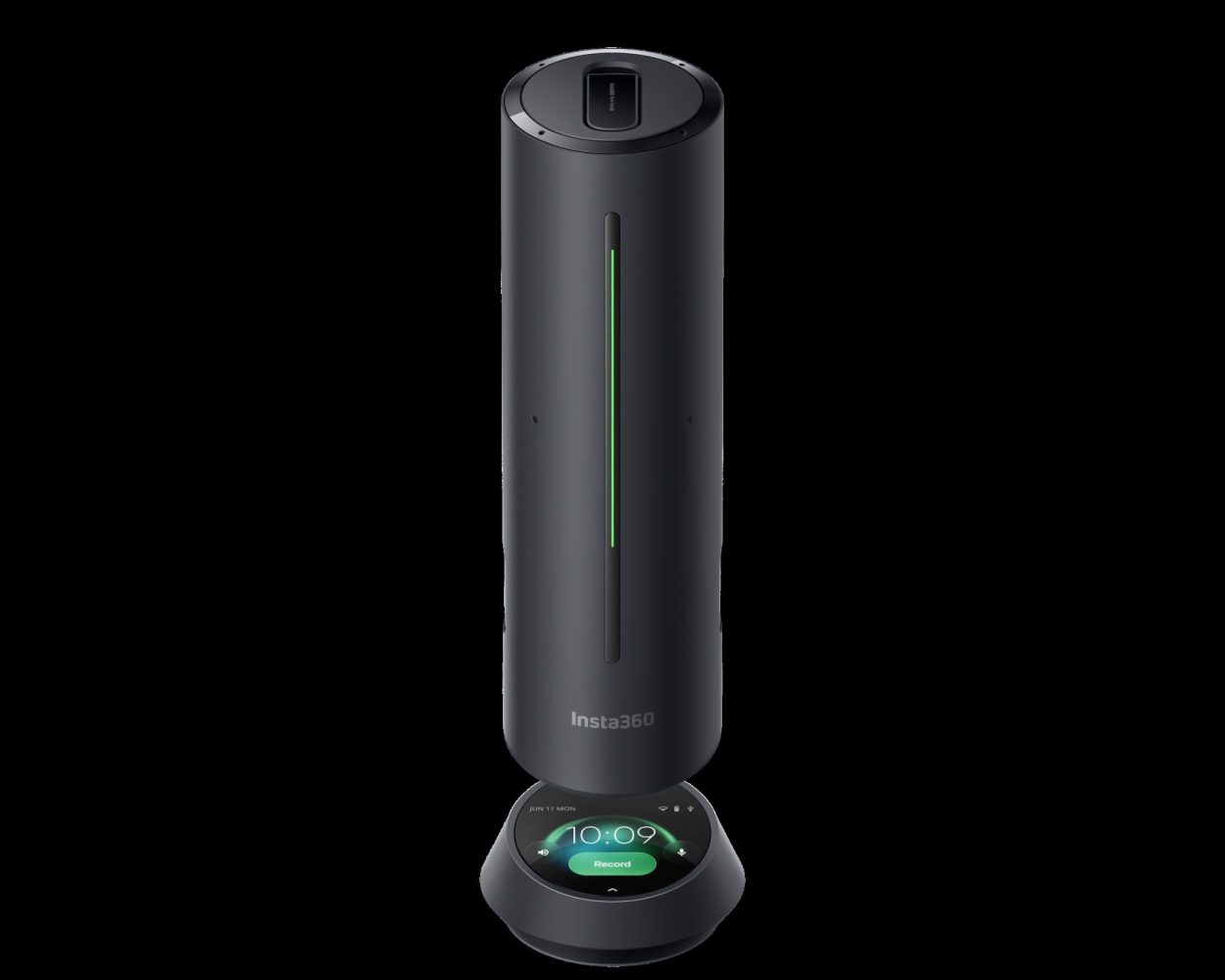
Insta360, long celebrated for its wearable and handheld imaging gear, is formally entering the professional audio hardware space with Insta360 Wave — a levitating, AI-enabled speakerphone designed for meetings, podcasts, and creator workflows. While the company previously offered a compact mic/transmitter solution (Mic Air) for use with its cameras, the new Wave marks its boldest move yet into pro audio.
Wave is engineered to capture conversations not just clearly but intelligently. Centered around an 8-microphone 3D array, the device records audio in Hi-Fi 48 kHz quality from distances up to 16 feet, while using AI to suppress over 300 kinds of ambient noise, from traffic rumble to keyboard clicks.
Additional features include acoustic echo cancellation, automatic gain control, and AI-based dereverberation to eliminate hollow or distant-sounding voices. Full-duplex operation ensures smooth two-way conversations without dropouts or delays.
The upright, “levitating” design differentiates Wave from conventional puck-style speakerphones. A touchscreen on the base lets users mute, adjust volume, pick pickup patterns, or start recordings with a tap.
Five beamforming modes (Omni, Cardioid, Supercardioid, Figure-8, Stereo) let users optimize the capture pattern for boardrooms, podcast setups, interviews, or ambient audio work.
Wave is tightly integrated with Insta360 InSight, an AI meeting assistant that transcribes conversations in up to 99 languages, labels speakers via voiceprints, and generates smart summaries and to-do lists. Post-meeting, users can ask questions (via ChatGPT or Gemini backends) that link to specific timestamps in the audio.
Built-in 32 GB of storage allows local recording (up to 1,000 hours of MP3 audio), and there’s an AI “pre-recording” feature that captures the last five minutes before you hit record — ideal for unplanned moments.
For early adopters, Insta360 offers free InSight Basic access (300 minutes of monthly transcription). For power users, a Pro tier raises the cap and unlocks advanced AI features.
Wave also nests neatly with Insta360’s Link 2 AI webcam: mount the camera atop Wave to get synchronized video and audio, and directional cues from Wave help Link 2 automatically shift focus between speakers.
Why this matters: Imaging brands expanding their ecosystem
Insta360’s move underlines a broader trend: companies once confined to action cams or drones are branching into adjacent domains tied to content creation — namely, audio, AI, and hybrid hardware ecosystems.
- Insta360’s earlier mic entry: In June 2025, Insta360 launched the ultralight Mic Air — a coin-sized wireless mic weighing just 7.9 grams, offering up to 10 hours of battery life and a 300-meter wireless range. This small step into audio suggested the brand’s ambition beyond cameras.
- DJI’s expansion trajectory: DJI has long dominated in drones and gimbals, but lately it has pushed further. In September 2025, DJI unveiled the 52-gram Osmo Nano wearable camera, signaling its entry into body-mounted, everyday video capture. Meanwhile, DJI’s audio ecosystem (Mic 3, Mic Mini) already complements its imaging gear, and new camera products continue to emphasize tight integration with audio accessories.
- GoPro’s diversification: Once narrowly focused on rugged action cameras, GoPro in 2025 is stretching outward. Its Fluid Pro AI gimbal is designed to work with various devices (smartphones, compact cameras, not just GoPros), making it a flexible content tool. Further, GoPro’s subscription and software ambitions, especially AI-assisted content workflows, suggest a push away from pure hardware dependency.
These moves reflect the reality that content creation today is multimedia, cross-modality, and AI-driven. Video-only or audio-only tools risk being islands — platforms that combine optics, audio, AI, and software have more staying power. With Wave, Insta360 stakes a claim in a new vertical: turning a meeting mic into a “memory engine” that listens, organizes, and surfaces insights. If successful, it nudges hardware makers toward more holistic, combative ecosystems rather than stand-alone products.
More: Skydio expands drone lineup with indoor R10, long-range F10


FTC: We use income earning auto affiliate links. More.




Comments