
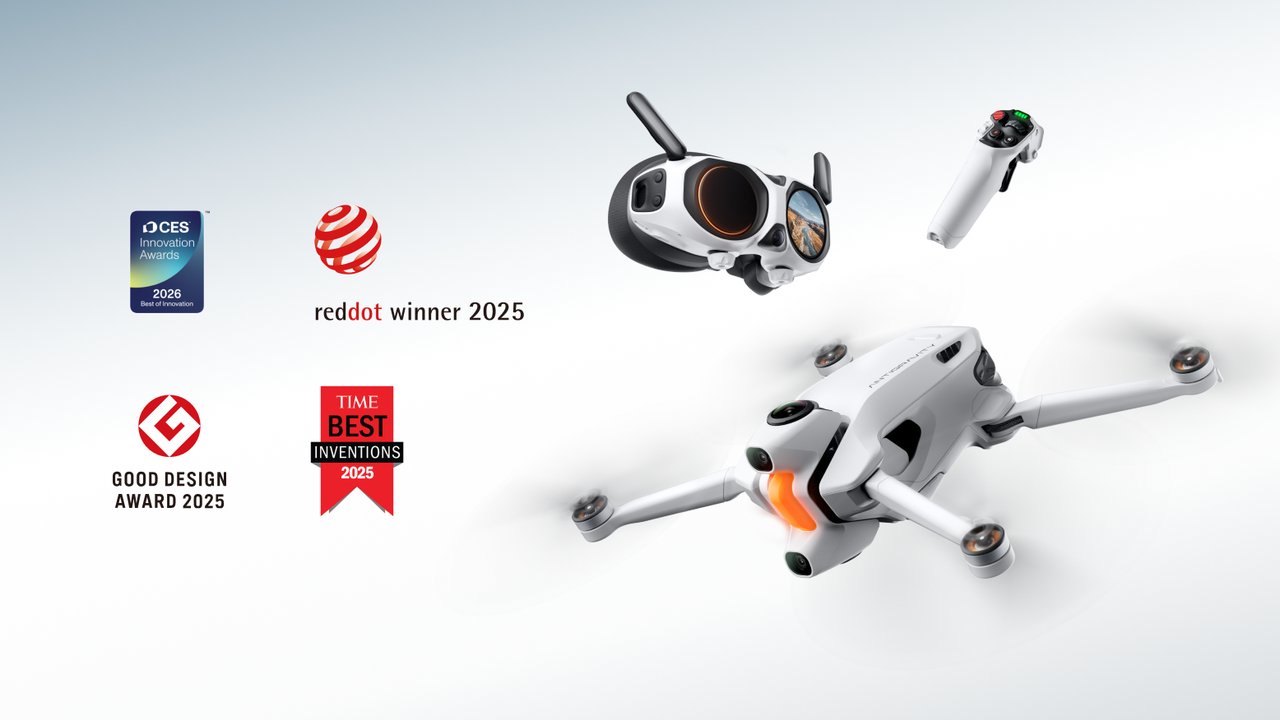
While DJI braces for a potential US ban, a new player has quietly taken flight, and it’s already scooping up global innovation awards months before launch. The drone in question isn’t from Shenzhen’s reigning giant but from Antigravity, a newcomer incubated by Insta360 that’s now turning heads across the tech world.
The company’s debut product, the Antigravity A1, hasn’t even reached store shelves, yet it’s already one of the most decorated drones ever made. The A1 recently captured the CES 2026 “Best of Innovation” award, adding to a trophy shelf that already includes TIME’s Best Inventions 2025, the Red Dot Design Concept 2025, and the Good Design Award 2025. It also racked up 20 media awards at IFA 2025 — not bad for a product still awaiting its first customer delivery.
Antigravity was founded to make flight feel instinctive: “as natural as moving your hand.” Backed by Insta360 and third-party partners, the startup set out to answer one question: what if drones felt like an extension of ourselves?
New: 5 DJI drone deals you can’t miss this Black Friday weekend
With 35 patents already filed, the Antigravity A1 represents that vision in miniature form: a 249-gram, palm-sized drone built around a dual-lens 8K 360° camera. Instead of simply strapping a 360 camera onto a drone, Antigravity designed the entire aircraft around the camera system.
TIME magazine, which featured the A1 among its Best Inventions of 2025, praised that decision, noting,
“Antigravity isn’t the first company to affix a 360 camera to a drone, but it’s the first to design a drone around one from the outset.”
At the core of the A1 is a top-and-bottom lens setup that captures everything around it — no blind spots, no compromises. Advanced stitching software removes the drone from the footage entirely, producing clean, “invisible drone” imagery that feels like you’re gliding through the scene yourself.
Flying the A1 is designed to be just as seamless. The included Vision goggles offer full head-tracking immersion, while the Grip controller replaces traditional sticks with intuitive hand gestures. Pilots can look freely in any direction while steering the drone with one hand — a first for consumer drones.
Footage is recorded in 8K 360 at 30 fps, stabilized in-camera, and enhanced by AI-powered editing tools that transform clips into share-ready stories within seconds. It’s cinematic, immersive, and, most importantly, accessible to everyone, not just FPV pros or aerial filmmakers.
Design institutions have been quick to recognize what Antigravity is attempting.
- Red Dot 2025 applauded the A1’s minimalist 249 g form, replaceable lenses, and retractable landing gear.
- Good Design 2025 commended its user-centric approach that “enriches lives and creativity.”
- CES 2026 judges called it “a leap forward in accessibility,” highlighting its lightweight construction and safety-first features such as payload detection and return-to-home.
Together, these accolades underscore a shift: drones are no longer only about flight specs; they’re about human experience.
Antigravity’s rise comes at a moment of uncertainty for DJI, the global leader in civilian drones. In the United States, DJI faces heightened scrutiny after the FCC’s October 2025 vote enabling the agency to retroactively restrict DJI certifications on national-security grounds.
Under the FY 2025 National Defense Authorization Act, a US audit of Chinese-made drones — including DJI’s — must be completed by December 23, 2025. If that review doesn’t occur, DJI risks being placed on the FCC Covered List, which would effectively block new product approvals and limit imports.
Top comment by OrangeMustache
Not sure why this is getting so much praise as its very limited on who can legally use it. It requires the use of the goggles which means in the US you have to have a spotter. That totally limits who will buy this as not everyone has a friend to use as a spotter all the time and it can't be used by itself. If rather strap the Osmo 360 to my 2S.
That looming deadline has created a fog of uncertainty for US operators who rely on DJI hardware for mapping, public safety, and creative work. And it’s precisely in this vacuum that companies like Antigravity are finding opportunity.
The Antigravity A1 is scheduled for a global launch in January 2026, with final pricing and bundles to be announced closer to release. In the meantime, the company has launched a co-creation program inviting global creators to test pre-production units and share feedback, with a $20,000 reward pool for standout ideas.
Whether DJI weathers the US storm or not, the Antigravity A1 has already achieved something remarkable: global recognition before its first flight. That said, awards and hype can only go so far. What really matters is how it performs once it finally takes to the skies. If Antigravity can deliver on its ambitious promises of effortless control, 8K 360 capture, and immersive flight, it could become one of the most exciting new entrants the drone industry has seen in years. Until then, we’ll be watching closely to see whether this rising star truly lives up to the buzz.
More: DJI drops old drone geofencing rules: What pilots need to know


FTC: We use income earning auto affiliate links. More.



Comments