
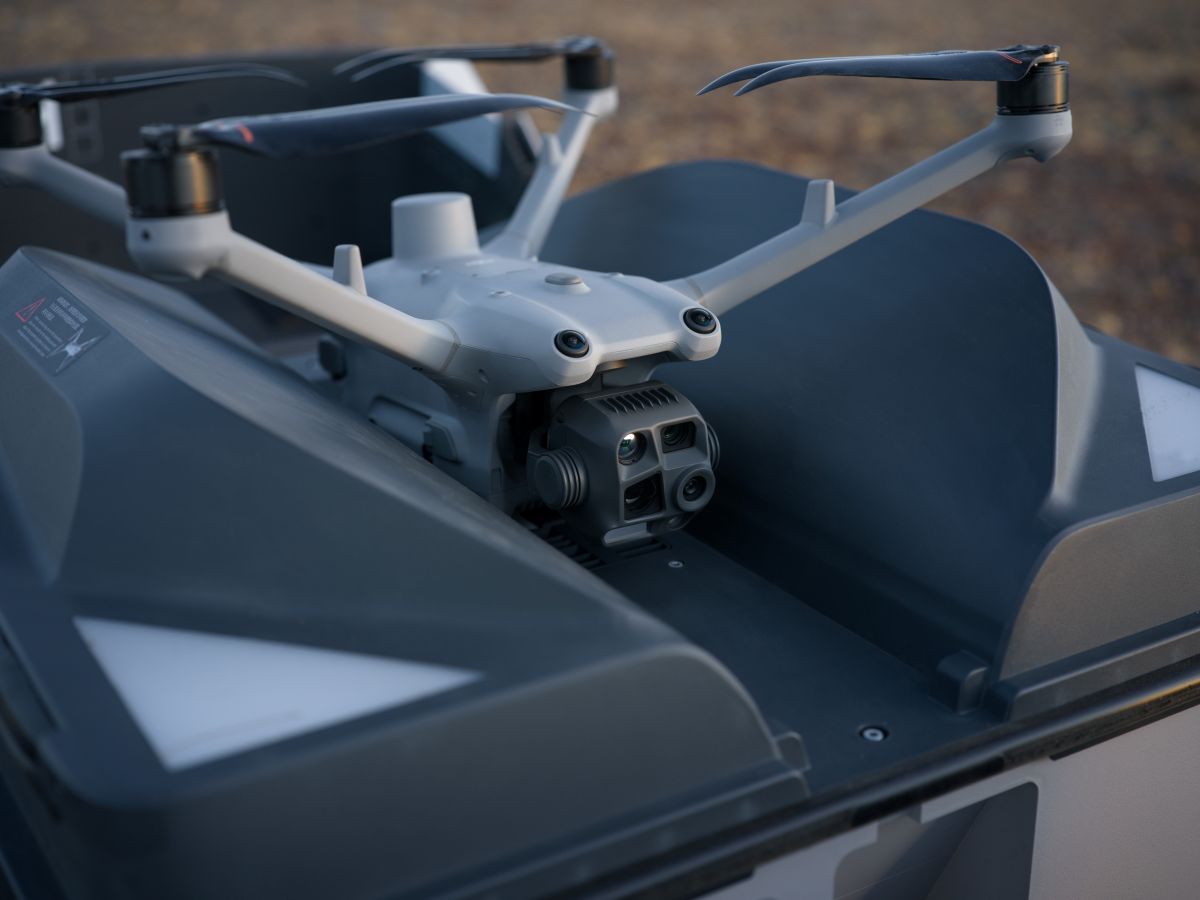
The mining industry may be thousands of feet below ground, but right now, it’s having a sky-high moment. DJI Enterprise has released a new white paper designed to help mining companies take a major leap forward: transitioning from manual drone flights to a fully automated BVLOS (Beyond Visual Line Of Sight) drone program powered by the DJI Dock.
If you’re in mining operations, planning, geospatial analysis, or safety management, this is one guide you’ll want to download. The report — “Implementing an Automated Mining Workflow using DJI Dock” — lays out a practical, field-tested roadmap for making automated drone workflows the new normal across pits, plants, and critical infrastructure.
And considering mining generated more than $3 trillion in global revenue in 2023, the timing couldn’t be better. Automation is no longer an experiment; it’s becoming the industry standard for efficiency, safety, and sustainability.
The white paper starts with the heart of the system: DJI Dock paired with FlightHub 2. For anyone who has had to drive out to a pit edge for a simple inspection, the pitch is compelling: automate everything.
DJI breaks down how operations can remotely plan missions, schedule flights, launch drones on-demand, and even automate data processing. Want automated volumetric measurements of ore stockpiles? The guide explains how to use FlightHub 2 to push imagery into existing photogrammetry workflows with zero human intervention.
It also tackles one of mining’s biggest hurdles: regulation. The report walks readers through licensing and approvals required for scaling BVLOS operations, including RePL, BVLOS permissions, SORA risk assessments, ROC certification, airspace considerations, HMI design, and even emergency-response planning.
One major highlight: DJI shares concrete performance data from real mining workflows.
- Post-blast photogrammetry survey time: reduced from 1.2 hours to just 30 minutes
- Monthly automated flights from a single DJI Dock: 150–200 missions
- Automated ground control marking: up to 94% time savings
This is time saved from travel, staffing, repeated flight planning, and redundant data processing, all of which translates directly to operational value. The paper also highlights emerging possibilities like trigger-based IFTTT inspections that automatically capture data whenever changes or anomalies appear.
Mining is one of the world’s most hazardous industries. DJI’s guide emphasizes how automated workflows enable teams to monitor assets and complete inspections remotely — far from blast zones, pit walls, voids, and hazardous pipelines. More frequent surveys mean better data, smarter restarts, improved compliance, and safer operations.
Two Australian mine sites, including Rio Tinto’s Gudai-Darri iron ore mine, demonstrate how the DJI Dock performed in extreme heat, dust, and cyclone-prone conditions. The Paddington Operations case shows the power of AI-driven modeling for blast analysis, ore grading, and processing efficiency.
If your operation wants to move faster, safer, and with better data, this is the blueprint to start with. Download here.
More: DJI will end support for these drones, payloads next month


FTC: We use income earning auto affiliate links. More.





Comments