
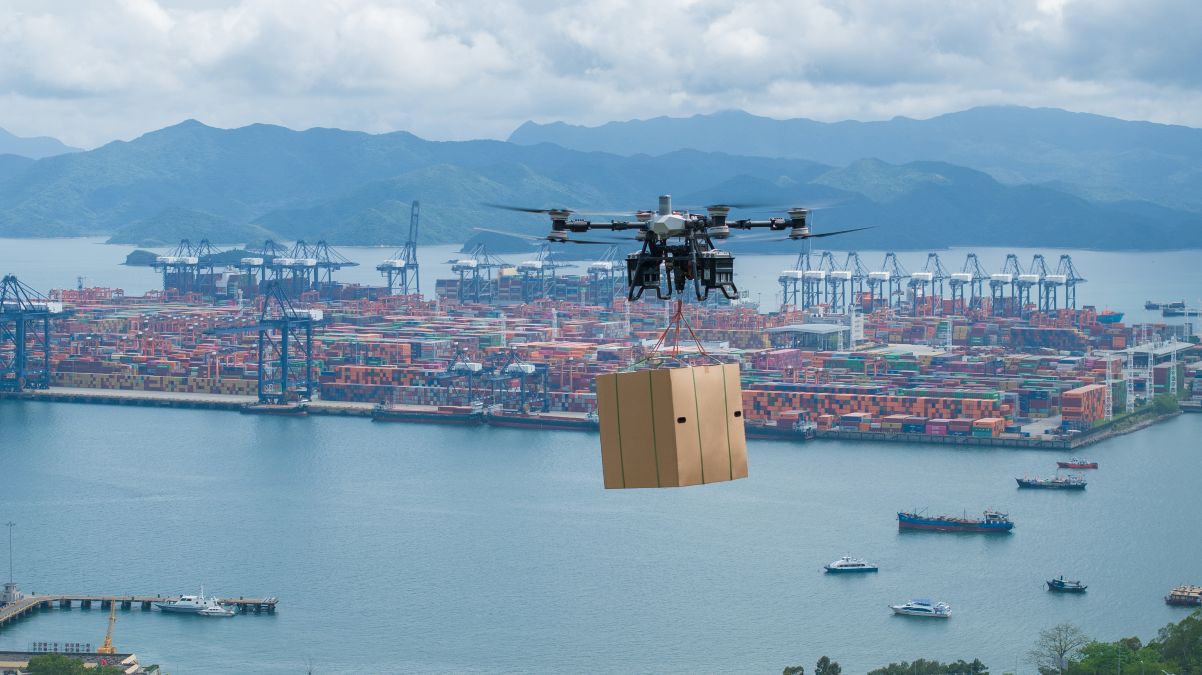
DJI is closing out the year with another heavy-lift announcement, quite literally. Months after debuting it in China earlier this summer, the company has officially launched its most powerful delivery drone, the DJI FlyCart 100 (FC100), for the global market.
While the US availability of DJI’s new drone remains uncertain, much like the company’s recent civilian drone releases, the global announcement shows the tech giant isn’t slowing down its ambitions in logistics, emergency response, and uncrewed transport.
A delivery drone built for the world’s toughest jobs
The FlyCart 100 arrives as the successor to the industry-defining FlyCart 30, the drone that literally proved itself on Mount Everest by hauling air tanks and helping researchers and sherpas reduce risk in extreme altitudes. The FC100 takes that concept and pushes it into an entirely new tier.
“With the next-generation DJI FC100, we built a drone that can deliver more – in payload capacity, endurance, and safety – and support more applications across more industries,” says Hao Jin, head of DJI Delivery Sales. Jin emphasizes that DJI’s delivery solutions are no longer niche tools but increasingly essential assets in construction, flood response, remote logistics, and long-range transport.
The headline improvement is obvious: payload capacity. While the previous FlyCart 30 topped out at 30 kg, the FC100 can now carry:
- Up to 65 kg for 12 km with the dual-battery configuration
- Up to 80 kg for 6 km in the emergency single-battery mode
- A maximum takeoff weight of 149.9 kg
That’s more than double the payload of its predecessor, and enough to push the aircraft into a category of its own. The bump comes from an optimized wing design, massive 62-inch carbon fiber propellers, and new high-torque motors arranged in the same coaxial four-axis, eight-blade setup as the earlier model, but clearly supercharged.
DJI says the FC100 is designed to “operate in the most challenging environments,” which includes mountain climbs, river crossings, and coastal transport — essentially the terrain where trucks, bikes, and even boats struggle, and where helicopters are too expensive or unavailable.
New: As DJI Neo 2 sneaks into US, Neo drone price crashes to $159
Ultra-fast charging and a new flagship winch
When it comes to delivery fleets, battery downtime can be a dealbreaker. The FC100 tackles this with a newly enhanced Energy System that supports ultra-fast charging via the C12000 charger or D14000iE generator.
The dual-battery hot-swap design means operators can keep the drone moving without scheduling breaks around charging cycles. Meanwhile, DJI’s Battery Incubator pre-heats the massive 41Ah batteries to maintain peak performance in cold climates — a subtle reminder of just how extreme the FC100’s intended use cases are.
DJI says the batteries are compatible with a variety of indoor and outdoor charging solutions, giving teams flexibility across field bases, disaster zones, or construction sites.
Another new addition is the upgraded Flagship Winch System, which now includes an electric hook for more efficient loading and unloading. The winch comes with a 30-meter cable and supports both automatic and manual release options.
Perhaps more important is the retracting speed: 1.2 m/s, even with heavy payloads. That might sound like a small detail, but in real-world deliveries — think emergency medical support, construction materials drops, or delivering supplies in flood zones — speed and control matter as much as lift capacity.
Safety first: LiDAR, radar, penta-vision, and even a parachute
The FC100 demonstrates DJI’s continued shift toward enterprise-grade redundancy and safety systems. The onboard Intelligent Safety System includes:
- High-precision LiDAR for terrain mapping
- Millimeter-wave radar for 360-degree detection
- A penta-vision camera array for environmental awareness
- An integrated parachute that slows descent to 6 m/s in emergencies
Add an IP55 rating, operational temperatures from –20°C to 40°C, flight altitudes up to 6,000 meters, and wind resistance up to 12 m/s, and you’re looking at a drone that’s built less like a gadget and more like industrial machinery.
With the hardware beefed up, DJI is also rolling out software to match. The DJI Delivery app gives pilots a streamlined interface to monitor aircraft status, view cargo details, and operate using new tools like A-B Route Mode and AR Display. This isn’t just a remote controller companion; it’s part of DJI’s bigger attempt to build a full-stack delivery ecosystem.
Complementing that is DJI DeliveryHub, a cloud-connected platform for fleet managers. It supports route planning, team management, real-time operational insights, and data analytics. And for organizations with custom needs, the FC100 supports PSDK and high-power third-party payloads, giving developers room to innovate.
With its combination of lift capacity, durability, safety redundancy, and software integration, the FlyCart 100 is primed for actual scaled deployments. And while DJI’s future in the US remains uncertain, the FC100’s global rollout signals that the company isn’t waiting for regulators or competitors; it’s building the infrastructure for a world where drones are not an experiment, but a daily part of supply chains.
More: Home backup for $399? DJI’s wild holiday power station discounts


FTC: We use income earning auto affiliate links. More.




Comments