
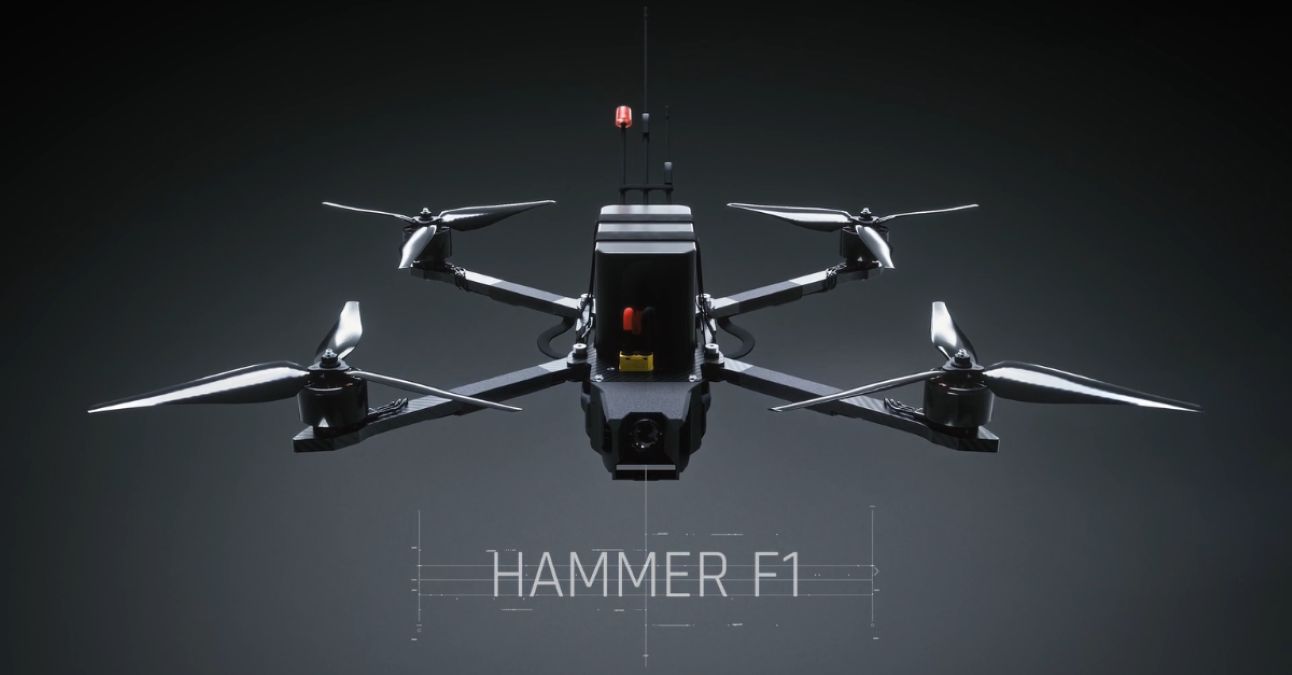
A new American-made drone built specifically for frontline troops is stepping into the spotlight, and it’s designed to do far more than simply scout the battlefield. Defense tech company Vector has unveiled the Hammer F1, a compact, foldable quadcopter built around the needs of US military operators.
The company says the drone was developed hand-in-hand with warfighters, aiming to give soldiers a fast, adaptable system capable of both reconnaissance and precision strike missions.
At just 10 inches in size when folded, the Hammer F1 is built for portability. Troops can carry the entire system in a single bag, allowing for quick deployment in fast-moving combat environments where speed and mobility can be the difference between success and failure.
But despite its small footprint, the drone packs some serious capability. Vector says the Hammer F1 can reach speeds of up to 97 mph and operate at ranges of up to 25 kilometers, allowing troops to scout or engage targets far beyond immediate visual range. The system also supports both day and nighttime operations, thanks to modular camera configurations that can be swapped depending on mission needs.
New: DJI Mini 4 Pro, Matrice pilots can now create 3D models faster
One key feature is its integration with the Android Tactical Assault Kit (ATAK), a widely used battlefield situational awareness platform that allows soldiers to share maps, intelligence, and drone feeds in real time across units. That integration could make the Hammer F1 a natural fit within existing US military command-and-control systems.
The drone is also designed with flexibility in mind. Its modular architecture allows operators to change payloads in the field as mission requirements evolve. The aircraft includes interchangeable sensor packages, a fiber-optic connector port, and a universal payload interface. A built-in Picatinny rail further allows integration of additional tools such as ISR sensors, electronic warfare components, or precision strike payloads.
That open-systems approach means units could quickly adapt the drone for different roles — from surveillance to electronic warfare — without needing entirely new platforms.
According to Vector CEO Andy Yakulis, that flexibility comes directly from operator feedback. “Warfighters didn’t just inform this system — they essentially built it with us,” Yakulis says. “As former operators ourselves, we understood exactly what they needed to win, and we engineered every inch of the Hammer F1 around those requirements.”
Vector also emphasizes that the Hammer F1 is fully compliant with US defense procurement rules, including the National Defense Authorization Act (NDAA), which restricts the use of certain foreign-made drone components in military systems. The company says the drone is manufactured using American supply chains and produced at its factory in Utah, positioning it as part of a broader push to expand domestic drone manufacturing for national security.
Cyber resilience was also a major focus during development. The system was designed to operate in contested electromagnetic environments, where adversaries may attempt to jam signals or interfere with drone operations.
Vector itself was founded by former Tier 1 special operations veterans and defense technology experts, a background that heavily influenced the Hammer F1’s design philosophy: build systems that match the realities of modern warfare rather than traditional procurement assumptions.
As conflicts increasingly highlight the importance of small, adaptable drones on the battlefield, systems like the Hammer F1 could become a growing part of the US military’s tactical toolkit. And if Vector delivers on its promise of scalable manufacturing, the company hopes its newest drone won’t just be experimental, but widely deployed.
More: Firefly drone nears commercial launch after key FAA approval


FTC: We use income earning auto affiliate links. More.




Comments