
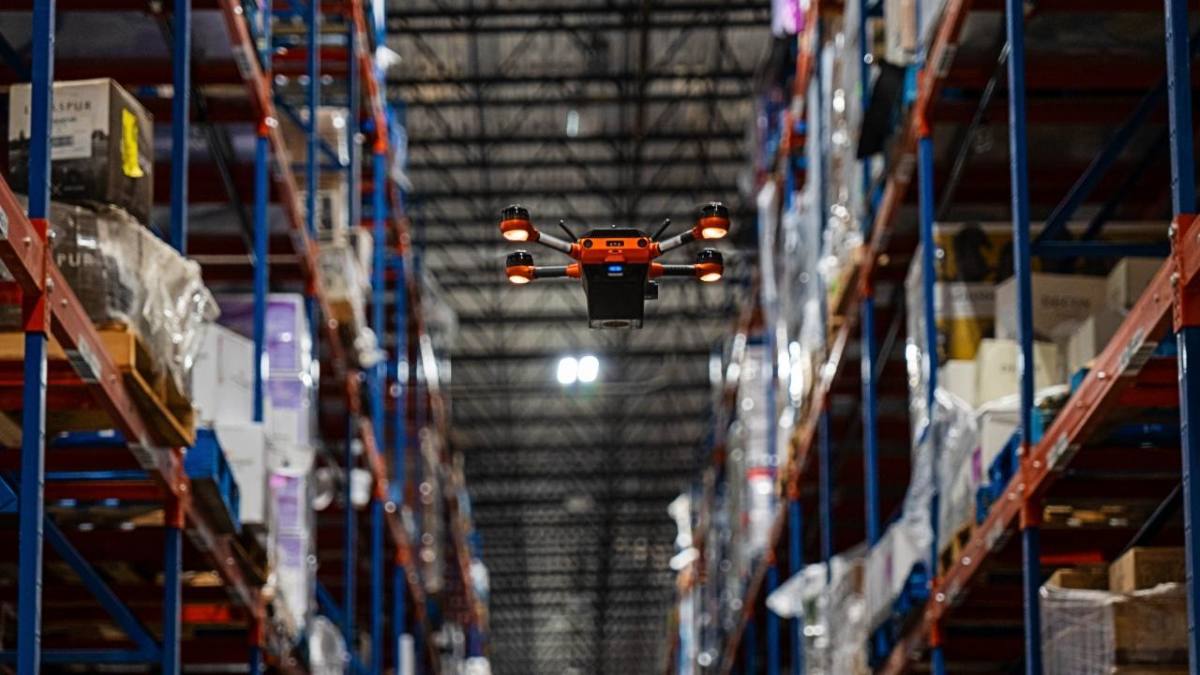
In a move that shows just how fast warehouse automation is evolving, Corvus Robotics has teamed up with Southern Glazer’s Wine & Spirits to scale autonomous inventory drones across one of the largest beverage distribution networks in the US.
Over the past 18 months, Southern Glazer’s has quietly deployed more than 40 Corvus One drones across nine distribution centers nationwide, and the results are starting to speak for themselves.
These aren’t your typical warehouse drones. The Corvus One system operates continuously inside active facilities, flying through aisles and scanning reserve storage locations without interrupting workers on the floor. That means no shutdowns, no manual counting slowdowns… just constant, real-time inventory validation happening in the background.
So far, the system has completed roughly 5,000 autonomous flights and flagged more than 35,000 verified inventory discrepancies. In a business where a single misplaced pallet can represent significant dollar value, that kind of visibility can make a big difference.
And it’s not just about catching errors; it’s about speed and efficiency. Southern Glazer’s says improved inventory accuracy has already led to a 100-basis-point increase in cases processed per hour. In plain terms, orders are getting fulfilled faster.
One of the biggest shifts has been how often inventory gets checked. Instead of relying on quarterly counts, facilities are now validating inventory every two weeks. That higher frequency helps teams catch and fix issues before they snowball into bigger problems like delayed shipments or out-of-stock items.
Labor is also being used more strategically. Each site is saving an estimated 60 to 70 hours per week that would otherwise be spent on manual cycle counting. Instead of walking aisles with scanners, employees can now focus on resolving confirmed issues using detailed data from the drones, including high-resolution images, barcode scans, and even historical video logs tied to specific pallet locations.
For a company operating at Southern Glazer’s scale — with distribution across 47 US markets and Canada — even small improvements can have ripple effects across the entire supply chain.
Company executives say the technology is helping shift teams from reactive problem-solving to a more proactive approach. Rather than discovering errors after they’ve already impacted orders, teams can now identify and fix discrepancies early.
Corvus Robotics CEO Jackie Wu believes this kind of deployment is setting a new standard for the industry. By integrating autonomous drones as core infrastructure, not just a pilot program, Southern Glazer’s is showing how large-scale distributors can modernize operations without slowing down day-to-day workflows.
The partnership also includes ongoing collaboration between facilities, with teams sharing best practices and refining how drones fit into daily operations. As more sites come online, both companies are working toward standardized deployment models and performance benchmarks.
For industries like food and beverage distribution — where high SKU counts and fast-moving inventory are the norm — this kind of always-on visibility could become less of a competitive edge and more of an expectation. And if early results are any indication, warehouse drones may soon be as essential as forklifts.
More: Bay Area next as Wing expands drone delivery network


FTC: We use income earning auto affiliate links. More.




Comments