
Kazakhstan, Central Asia’s largest economy, is building an entirely new smart city designed around drones and flying transportation systems from day one.
This week, California-based company A2Z Drone Delivery announced a partnership with Kazakhstan’s Alatau Advance Air Group as part of the country’s massive Alatau City project, a planned smart city that aims to integrate next-generation air mobility directly into daily life.
The partnership officially launched during the opening ceremony of the UAM Test Center Eurasia in Alatau, where companies demonstrated technologies that could eventually support everything from drone deliveries to emergency response operations and even passenger air taxis.
While drone demonstrations and futuristic transportation concepts have become increasingly common worldwide, Kazakhstan’s approach stands out because the country is attempting to design the infrastructure, regulations, and urban planning simultaneously, instead of retrofitting existing cities later. That’s a major difference.
Alatau City is still under development, but planners envision it as a fully integrated smart city where low-altitude aircraft are built into transportation systems from the start. The project includes plans for vertiports, autonomous drone operations, electric vertical takeoff and landing (eVTOL) aircraft, and digital infrastructure designed specifically for urban air mobility.
New: The US wants to move beyond DJI drones, but can it?
Kazakhstan has also already adopted experimental air regulations to support these technologies, signaling that the government is willing to move faster than many countries still debating how drones and autonomous aircraft should operate in urban areas.
According to project leaders, the goal is to spend the next two years developing infrastructure and testing systems ahead of a planned commercial launch in 2028.
The project is also notable for the international collaboration behind it. Companies and organizations from the United States, China, Italy, and South Korea are participating in various stages of development and testing. Organizers say the initiative has so far been funded entirely through private investment.
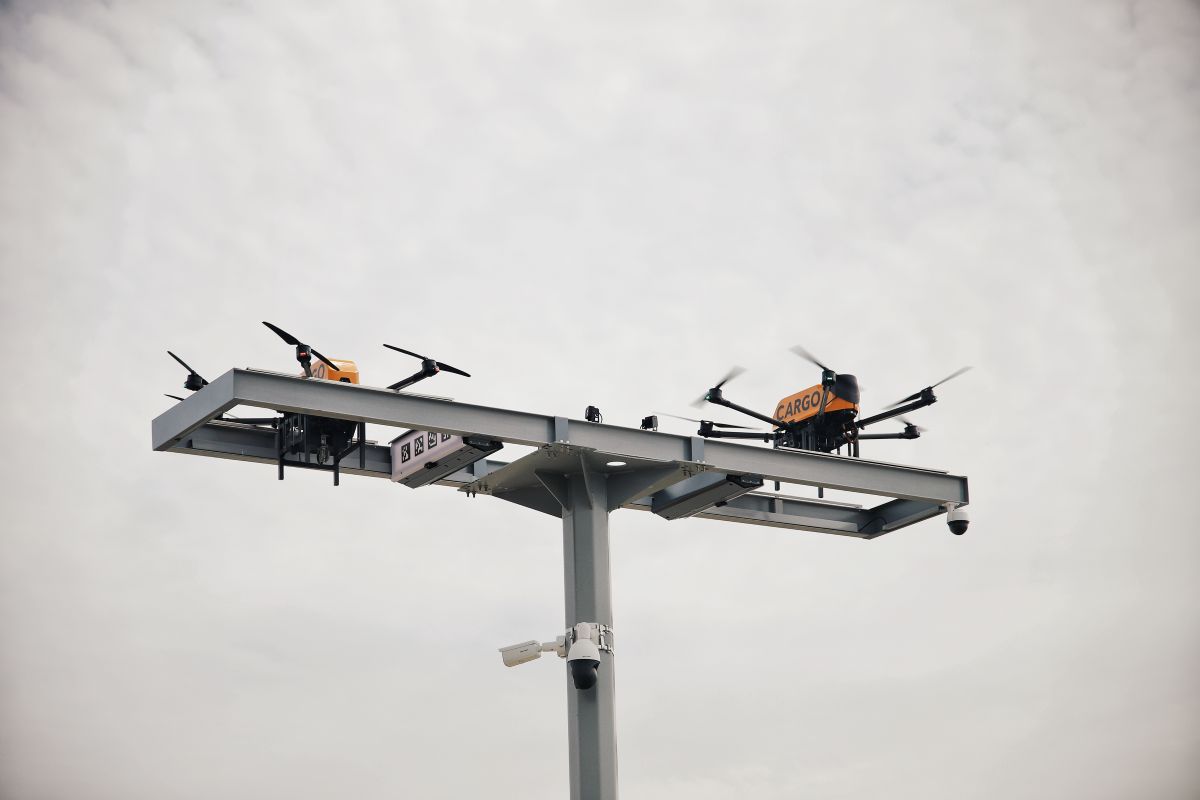
For A2Z Drone Delivery, the partnership gives the company an opportunity to test how large-scale drone logistics networks might function inside a purpose-built smart city. The company demonstrated its AirDock charging stations and Longtail commercial drones during the launch event.
But the bigger story may be what this says about Kazakhstan’s broader technology ambitions. Central Asia has not traditionally been viewed as a global hub for advanced aviation or smart-city development. However, projects like Alatau City suggest Kazakhstan wants to position itself as an early adopter of emerging transportation technologies while attracting international investment and expertise.
The country has already spent years investing in digital modernization initiatives, renewable energy projects, and infrastructure upgrades. Urban air mobility now appears to be another area where Kazakhstan sees an opportunity to leapfrog older systems instead of gradually upgrading traditional infrastructure.
Of course, turning futuristic concepts into reliable everyday transportation remains a major challenge globally. Questions around safety, regulation, public acceptance, and scalability continue to slow urban air mobility projects in many countries.
Still, Kazakhstan’s willingness to experiment with an entirely new aviation ecosystem, especially within a city being built from scratch, makes Alatau one of the more closely watched smart-city projects emerging outside the usual tech hubs in the US, Europe, and East Asia.
More: FlytBase and Yarra Drones prepare Australia for BVLOS era


FTC: We use income earning auto affiliate links. More.




Comments