
Every spring across Germany, an invisible race begins between wildlife rescuers and mowing machines. Young fawns often hide motionless in tall grass as farmers prepare to cut their fields. It’s a natural survival instinct that helps them avoid predators, but it also makes them nearly impossible to spot from the ground. For decades, rescuers relied on teams of volunteers walking shoulder-to-shoulder through meadows, searching for hidden animals before mowing began. Now, drones are dramatically changing that equation.
DJI has published a new video case study highlighting how Bavarian wildlife rescue organization Rehkitz-Rettung Mangfalltal is using the DJI Matrice 4T and Matrice 4TD thermal imaging drones to locate and rescue vulnerable fawns before they are harmed by agricultural equipment.
The results have been remarkable. According to the organization, annual rescues have increased from roughly 10 to 15 fawns per year to between 300 and 350 since drone technology became part of its operations.
“We can keep them in the air longer, cover more ground without intermediate landings, and survey fields faster and with even more precision thanks to RTK,” says Tim Rau, pilot and chairman of Rehkitz-Rettung Mangfalltal. “Also, AI features help pilots reliably spot fawns. On an operation day, that easily adds another 50% more area coverage compared to the previous generation of drone technology.”
RTK, or Real-Time Kinematic positioning, provides centimeter-level location accuracy, allowing rescue teams to pinpoint an animal’s exact location in a field.
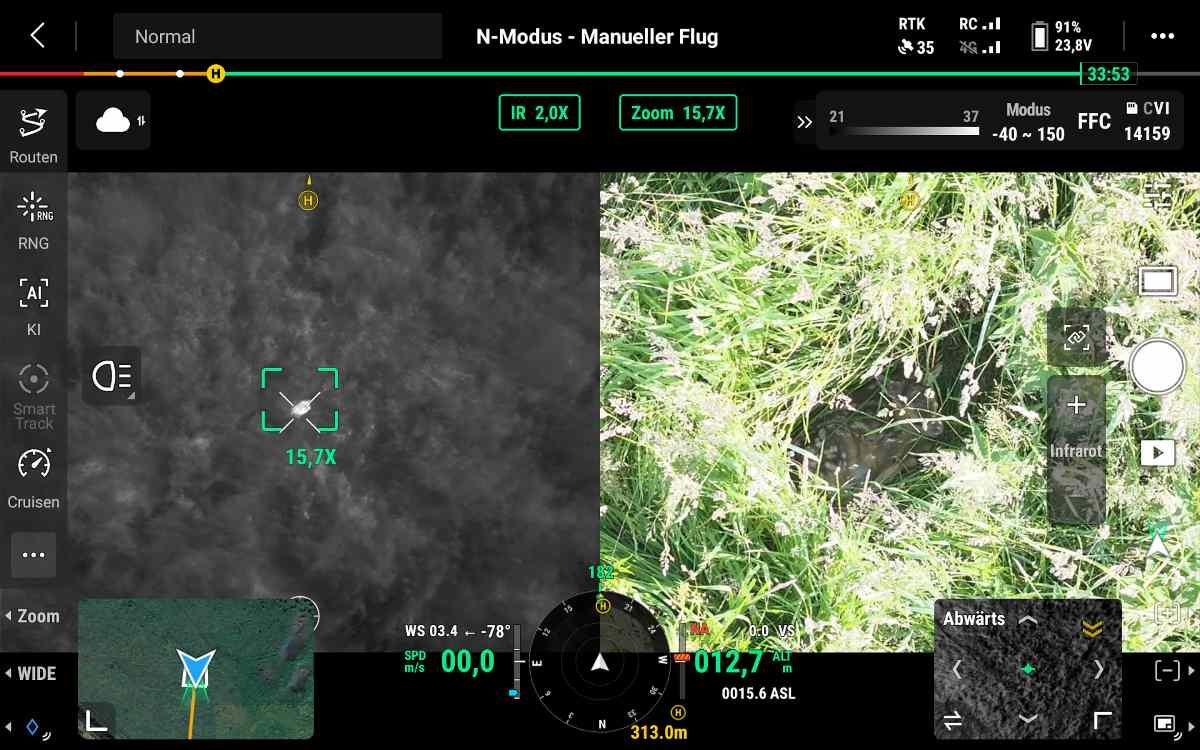
The case study offers a look at how the rescue process works in practice. Before mowing begins, operators fly the Matrice 4 series drones over meadows, either manually or through automated flight missions, typically at altitudes of 80 to 100 meters. Using the drones’ thermal cameras, pilots search for heat signatures hidden beneath dense vegetation.
Once a potential animal is detected, operators can switch to a split-screen view on the controller and use the drone’s zoom camera to visually confirm what they’re seeing. If the heat signature turns out to be a fawn, its location is marked and shared with ground teams, who can quickly move in and safely relocate the animal.
The Matrice 4TD adds another advantage with its weather-resistant design, allowing operations to continue in less-than-ideal conditions during the busy spring rescue season.
One of the more interesting aspects of the Matrice 4 platform is its support for customized smart detection. Organizations can develop and deploy their own recognition models, including algorithms specifically trained to identify fawns. Those custom models can work across both visual and thermal imagery, helping automate parts of the search process and reducing the chance of missing hidden animals.
The benefits extend beyond wildlife conservation. Farmers can begin mowing with greater confidence that fields have been cleared of hidden animals, reducing the risk of accidental fatalities and making operations more efficient.
While the case study focuses on one rescue organization in Bavaria, it highlights a growing trend across Europe: drones are increasingly becoming essential tools for conservation work. What once required large teams of volunteers combing fields on foot can now be accomplished faster, more accurately, and on a much larger scale. For wildlife rescuers, that means hundreds more animals getting a second chance each year. Check it out:
More: FCC says some Chinese drones are suddenly safe again


FTC: We use income earning auto affiliate links. More.





Comments