
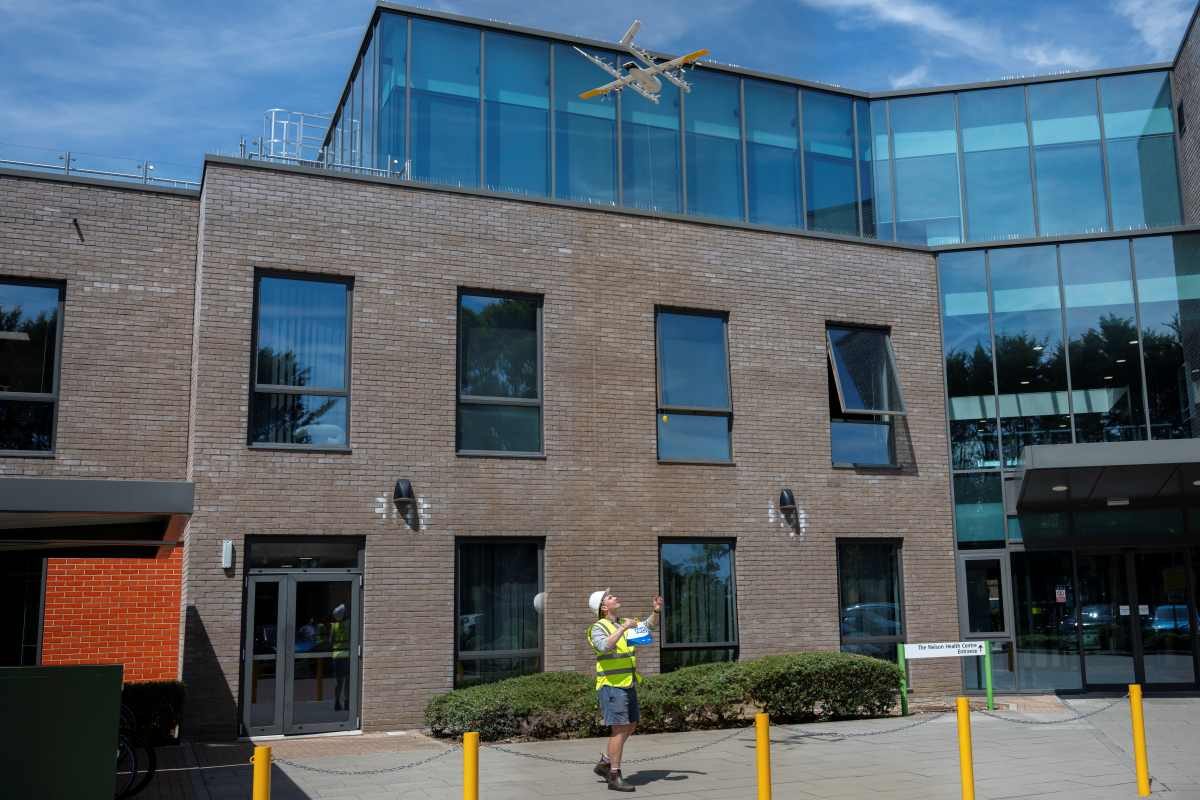
The UK’s National Health Service (NHS) is making drones a permanent part of its healthcare logistics after a successful pilot dramatically reduced delivery times for urgent medical samples. The expansion could ultimately benefit up to 1.8 million people across southwest London while helping the health system cut costs, reduce emissions, and speed up patient care.
Since February, drones have been flying blood and other diagnostic samples from Nelson Health Centre in Raynes Park to the South West London Pathology (SWLP) laboratory at St George’s Hospital in Tooting. The trip takes just over three minutes by air, compared to roughly 20 minutes by road.
The service is designed to keep urgent samples moving even when London’s roads are congested, an issue that becomes even more challenging during periods of extreme summer heat. Faster deliveries mean laboratories can begin testing sooner, allowing clinicians to make time-sensitive treatment decisions more quickly.
SWLP processes around 51 million diagnostic samples every year for NHS hospitals and family doctor (GP) practices serving approximately 1.8 million patients across southwest London. Following the pilot’s success, the organization plans to expand drone deliveries to additional hospitals, including St Helier, Croydon, and Kingston, while also connecting more primary care clinics.
According to SWLP, more than 2,000 patients have already benefited from the service, with deliveries running up to 85% faster than traditional ground couriers. The drones are also proving cost-effective, with some routes costing up to 23% less than urgent van or motorcycle deliveries. Officials expect those savings to grow as the network expands.
New: Archer unveils Halo autonomous VTOL built for long-range cargo missions
The environmental impact is another major advantage. Because the aircraft are fully electric, each delivery generates up to 98% less carbon dioxide than a delivery van, supporting the NHS’s efforts to reduce its overall carbon footprint.
The rollout also marks a first for the NHS. Nelson Health Centre, which serves about 27,000 patients, has become the first primary care facility in the health system to routinely send diagnostic samples by drone. Health officials say the project offers a blueprint for expanding healthcare services closer to patients while maintaining rapid access to centralized laboratory testing.
The network is operated by British healthcare logistics startup Apian, which was co-founded by NHS doctors, in partnership with Alphabet-owned drone company Wing. Apian says it has already completed thousands of sample deliveries across London, helping clinicians make faster decisions for emergency heart attack cases and pediatric patients requiring urgent diagnoses.
Wing, meanwhile, has completed more than one million commercial drone deliveries worldwide and continues expanding its retail operations in the US through partners including Walmart and DoorDash. But the company says healthcare remains one of the most impactful uses for its drone technology.
With more hospitals and clinics set to join the network, drone deliveries are quickly shifting from an experimental concept to an everyday tool for moving critical medical samples — helping the NHS deliver faster, greener, and more reliable patient care.
More: DJI just made European BVLOS drone approvals much easier


FTC: We use income earning auto affiliate links. More.




Comments