
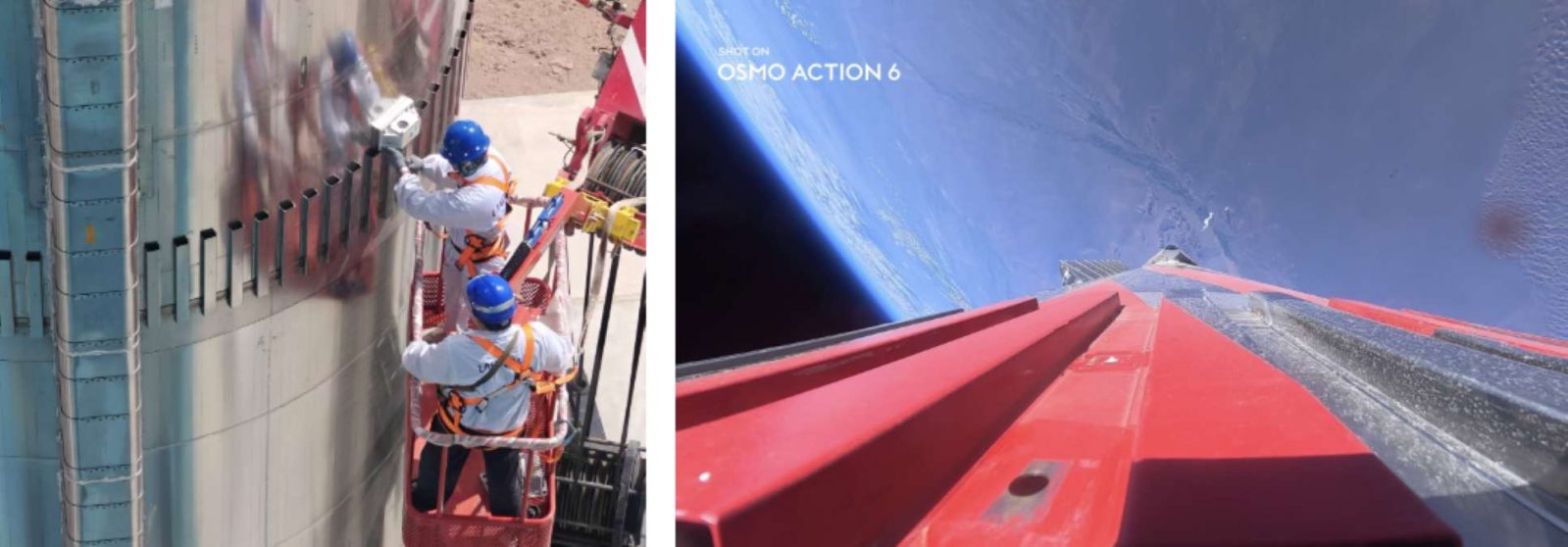
Most people buy an action camera to capture a ski trip, a mountain bike ride, or a family vacation. DJI just showed what happens when you strap one to a reusable orbital rocket instead.
The company says 12 unmodified DJI Osmo Action 6 cameras rode aboard LandSpace’s Zhuque-3 reusable rocket during China’s first successful land-based orbital booster recovery on August 19. And perhaps the most astonishing part isn’t simply that the cameras survived — it’s that one of them captured the entire mission in a single uninterrupted first-person video, from liftoff through spaceflight and all the way back to a pinpoint vertical landing.
If you’ve ever wondered what it would actually feel like to be bolted onto the side of a rocket, this is probably the closest you’ll get.
The continuous footage, released by DJI, begins on the launch pad before the engines roar to life. Seconds later, the camera is blasted skyward as the reusable booster climbs through thick clouds, punches into the upper atmosphere, performs its flight maneuvers, and eventually returns for a controlled landing. There are no cinematic cuts, no edited transitions, and no stitched clips; just one remarkably smooth perspective from start to finish.
For aerospace fans, it’s mesmerizing. For DJI, it’s also one of the strongest real-world demonstrations yet of what its latest action camera can withstand.
According to DJI, the Osmo Action 6 endured surface temperatures of roughly 400°C to 500°C during ascent and atmospheric reentry, while also surviving the intense vibration and high g-forces generated throughout launch and landing. Even more impressive is that these weren’t custom-built aerospace cameras. They were standard production Osmo Action 6 units mounted directly onto the rocket without special modifications.
That durability matters for more than bragging rights.
The footage gives LandSpace engineers a detailed first-person record of the booster’s journey, helping them study the rocket’s recovery sequence, inspect the first-stage body after flight, analyze attitude adjustments, and better understand how the vehicle behaved throughout the mission. Every frame becomes valuable engineering data.
New: DJI Mini 3 just got a massive $100 price cut
One particularly challenging moment came during the rocket’s trip through the atmosphere.
Like many spacecraft, Zhuque-3 entered a communications blackout zone where external signals were temporarily lost. Instead of relying on a live video feed, the Osmo Action 6 simply kept recording internally. Once the booster safely returned, all of the high-resolution footage came back with it intact, preserving every critical moment that couldn’t be transmitted in real time.
The quality of the video is equally surprising given what the camera experienced.
Rocket launches are violent. Extreme vibration, rapid acceleration, sudden attitude changes, and high-speed maneuvers would normally produce footage that’s almost impossible to watch. DJI says its latest stabilization algorithm continuously compensated for those forces, producing video that remains remarkably steady while still conveying the incredible power of launch.
You can clearly watch engine ignition, the changing orientation of the booster, grid-fin movements, atmospheric flight, and the final landing sequence without the footage dissolving into a blur of violent shaking.
Lighting was another major challenge.
The rocket traveled through dramatically different environments, from the brilliant sunlight of high altitude to lower-altitude backlighting, dust, and atmospheric haze during descent. DJI credits the camera’s 1/1.1-inch square image sensor, support for 4K video at up to 120fps, and 13.5 stops of dynamic range for preserving detail across those constantly changing conditions.
The result is footage that looks far more cinematic than you’d expect from a camera attached to the side of a rocket.
While the Action 6 understandably steals the spotlight, DJI’s broader imaging lineup also helped document the historic mission from nearly every possible angle. The company deployed its soon-to-be-launched Osmo 360 II for immersive panoramic views, while the DJI Mavic 4 Pro captured aerial perspectives around the launch site. The DJI Matrice 4TD provided thermal imagery, the DJI Avata 360 recorded aerial panoramic footage, and the Osmo Pocket 4P handled cinematic ground coverage.
Together, they created a complete visual record of one of China’s biggest private spaceflight milestones.
For everyday buyers, few people will ever ask an action camera to survive 500-degree heat or ride an orbital-class rocket. But that’s also what makes this demonstration so compelling.
When a consumer camera can withstand conditions that would destroy most electronics, and still return with crisp, stabilized 4K footage, it becomes much easier to imagine trusting it on a motorcycle ride, a scuba trip, a mountain climb, or simply recording your kids tearing through a weekend adventure.
Most action cameras promise durability. The Osmo Action 6 just proved it on a mission to space — and back.
More: Why modern DJI drones rely on LiDAR


FTC: We use income earning auto affiliate links. More.




Comments