
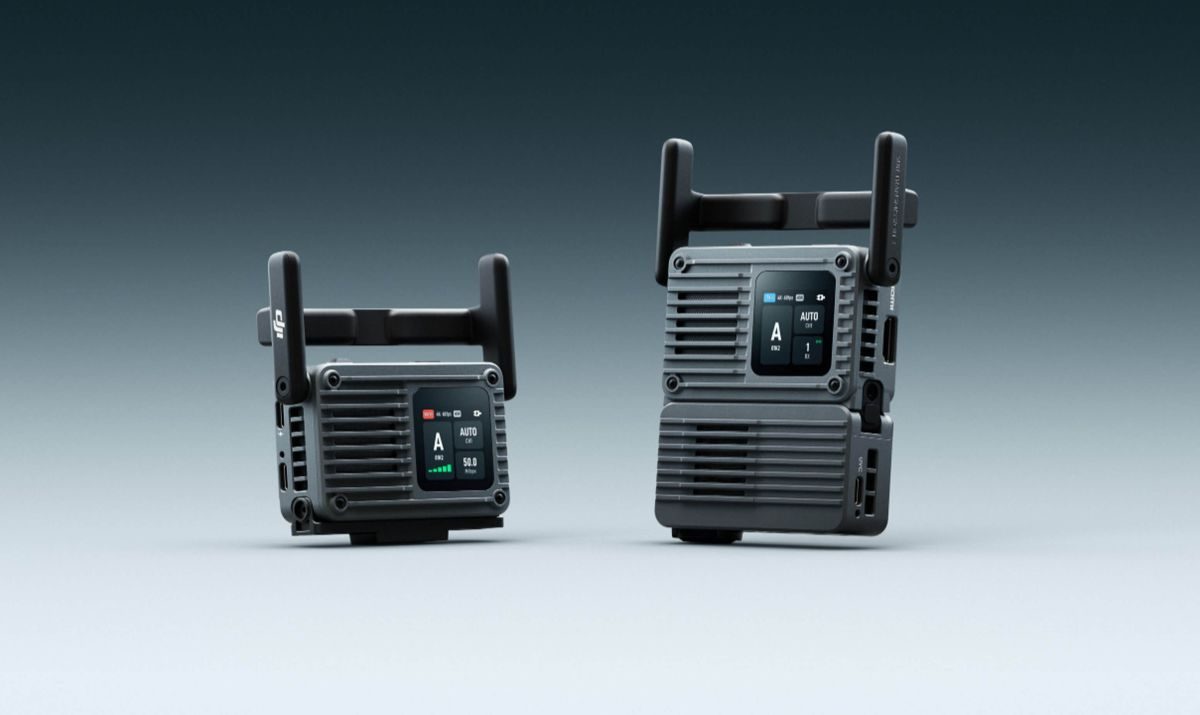
DJI is taking another swing at one of the less glamorous, and surprisingly frustrating, parts of professional filmmaking: getting a clean camera feed where it needs to go. The company has officially launched the DJI SDR Transmission 2, a new wireless video transmission system designed for professional productions where multiple cameras, monitors, and wireless devices are competing for space on the same set.
And DJI isn’t treating this as a minor refresh. The company says the new system brings a major upgrade to interference resistance, image quality, and transmission range, while making multi-camera setups considerably easier to manage.
At the heart of the SDR Transmission 2 is an upgraded software-defined radio (SDR) platform. It can transmit DCI 4K at 60fps with 10-bit HDR and H.265 at up to 50Mbps, while keeping latency as low as 35ms.
That combination is aimed squarely at situations where directors, cinematographers and camera crews can’t afford to rely on a heavily compressed or sluggish monitoring feed.
The transmission range reaches up to 4 kilometers, according to DJI, making the system suitable for everything from large outdoor productions and stadium shoots to car-to-car filming and FPV drone work.
One box that can do both jobs
One of the more practical changes is the hardware itself. Each SDR Transmission 2 unit can operate as either a transmitter or receiver. That means production teams don’t have to decide ahead of time exactly how many transmitters and receivers they’ll need.
The main unit weighs approximately 136 grams, which should make it relatively easy to mount on cameras and handheld gimbals without adding a huge amount of bulk.
An optional expansion board adds SDI, HDMI, and four USB-C ports, along with SDI metadata pass-through for compatible cinema cameras. There’s also an optional protective cage for more demanding outdoor setups, including vehicle-mounted cameras.
For crews already invested in DJI’s ecosystem, the system works with compatible Ronin gimbals, Ronin 2 and Master Wheels.
One camera feed, eight people watching
The SDR Transmission 2 is also designed to make multi-camera productions less of a cable-and-monitor juggling act.
A single transceiver operating as a transmitter can connect to as many as eight receivers, with each receiver supporting remote control. That means a director can monitor a shot while a camera operator or focus puller can also access the feed and make supported camera adjustments remotely.
For larger productions, DJI says as many as five transmitters and 40 receivers can operate simultaneously. That’s where the new frequency-management system becomes particularly important.
DJI’s Auto Channel 2.0 can recognize SDR Transmission 2 units and automatically allocate frequency bands. The system also provides frequency scans and channel-conflict diagnostics, allowing it to adapt to changing conditions rather than forcing crews to manually sort everything out.
In other words, the goal is to spend less time figuring out why a wireless feed is suddenly struggling and more time actually shooting.
Switching feeds without starting over
DJI has also focused on monitoring workflow. Instead of rebooting equipment, disconnecting and going through the pairing process whenever crews need to change camera feeds, users can switch between feeds directly on an RX transceiver or through the Ronin app.
The system can output video to professional displays through SDI, HDMI or DisplayPort, while USB-C allows phones and tablets to be used for mobile monitoring.
The Ronin app adds familiar professional tools such as LUTs, focus peaking, waveform and false color. Compatible cameras can also be controlled through the app, including adjustments to aperture, shutter speed, and ISO, as well as triggering recording.
Power options are similarly flexible. The units can run from standard NP-F batteries or USB-C PD power, and compatible DJI gimbals can supply power directly when the transmitter is mounted on them.
For professional crews, that’s ultimately what DJI appears to be chasing here: less friction between the camera and everyone who needs to see it.
With 4K/60 HDR, 50Mbps transmission, 35ms latency, 4km range, and substantially more automation for multi-camera environments, the SDR Transmission 2 is shaping up as a serious wireless monitoring option for productions where a reliable live feed isn’t optional.
More: FrameTap just got better, and DJI Pocket 4P owners will notice


FTC: We use income earning auto affiliate links. More.



Comments