
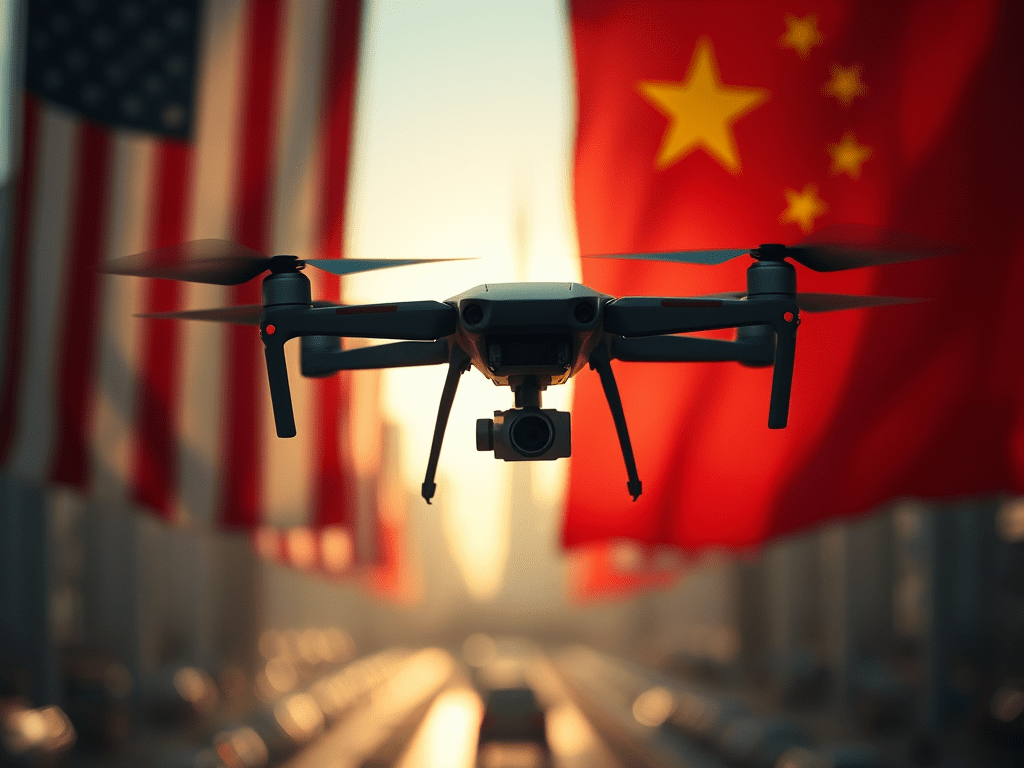
After a White House-led national security review flagged foreign-made drones as a risk, the Association for Uncrewed Vehicle Systems International (AUVSI) is backing the Federal Communications Commission’s move that blocks new foreign drones from entering the US market.
That determination — made by Executive Branch national security agencies under Section 1709 of the FY25 National Defense Authorization Act — directed the FCC to update its Covered List to include Chinese drone makers such as DJI and Autel Robotics. And in the eyes of AUVSI, which represents a broad swath of drone manufacturers, suppliers, public-safety users, and allied partners, this move is both a national-security imperative and an industrial reset.
“The FCC has built on the actions directed by Congress to protect US national security and encourage American Drone Dominance,” says Michael Robbins, AUVSI’s president and CEO.
According to AUVSI, multiple US intelligence and security agencies have already concluded that drones made in China pose risks that cannot be adequately mitigated.
But the FCC’s action doesn’t just stop at commercial-off-the-shelf DJI and Autel aircraft. Alongside the Covered List update, the agency has launched a broader review of foreign-manufactured drones and critical components — everything from communications systems and flight controllers to batteries and sensors.
For AUVSI, this wider lens is just as important as the headline-grabbing company names. “This combined action will truly unleash American Drone Dominance,” Robbins says, arguing that the US can’t secure its airspace without also securing the underlying supply chain.
At the same time, AUVSI is careful not to paint the decision as a blunt instrument. The organization supports strong, risk-informed controls but warns that overly broad restrictions could backfire, especially when it comes to allied nations.
Any limits on drones or components from friendly countries, AUVSI argues, must strike a balance between security and real-world operational needs. Robbins specifically points to the importance of a waiver system administered by the FCC and the Department of War — one that’s transparent, scalable, and tailored to genuine risk.
The concern isn’t hypothetical. Public safety agencies, commercial operators, and even military users rely on a global ecosystem of suppliers. Shutting down trusted allied inputs could slow innovation, disrupt missions, or unintentionally weaken domestic manufacturers rather than strengthening them.
Still, AUVSI’s broader message is clear: dependence on adversarial supply chains is no longer acceptable.
Robbins also points to recent history as a cautionary tale. During the COVID-19 pandemic, China restricted access to critical supplies when the US needed them most. More recently, Beijing limited exports of key semiconductor materials like gallium and germanium. In AUVSI’s view, drones — and the components that make them work — pose the same strategic risk if the US remains dependent on foreign sources.
Importantly for drone pilots and agencies watching nervously from the sidelines, AUVSI echoes a key reassurance from the FCC: nothing is being grounded.
The Covered List update applies only to new products entering the US market after December 22, 2025. Drones already in use can continue operating, and public-safety fleets aren’t being pulled offline. AUVSI describes the approach as a phased transition — one designed to keep critical missions running while giving US manufacturers time to scale up trusted alternatives.
Top comment by GreenCar
What have these American engineers been doing for the past 10 plus years? Obviously, they have had their heads up their backsides. Instead of competing for the market share, they allowed these foreign drone manufacturers be the only serious drone source. The US consumer now will have to suffer as they finally decide they want to destroy what they themselves created. Get ready to go back 10 years in technology while paying a US premium.
That distinction matters, especially as DJI has also now responded to the US government’s move, saying the decision won’t affect existing users and arguing that its products have passed years of security reviews. While AUVSI and DJI clearly see the issue from opposite sides, both acknowledge that today’s change is about the future market, not current operations.
Looking ahead, AUVSI says it will continue working with policymakers, regulators, public-safety agencies, and industry partners to manage that transition. The goal, Robbins says, isn’t disruption; it’s growth: stronger domestic innovation, resilient supply chains, high-quality jobs, and less long-term dependence on foreign adversaries.
In other words, the FCC’s move may close one chapter in the US drone market, but for AUVSI, it’s opening a much bigger one.
New: DJI Mic 3 fixes Mac transfer issues, gets first discount


FTC: We use income earning auto affiliate links. More.


Comments