
Commercial drone operations are getting more ambitious. Instead of short flights over empty fields, companies increasingly want drones that can deliver packages across cities, inspect infrastructure miles away, or help first responders without requiring a pilot to keep the aircraft in sight. That shift is exactly what A2Z Drone Delivery is targeting with its newest aircraft.
The California-based company has unveiled the Longtail Dual, an upgraded version of its commercial drone that swaps a single battery for a fully redundant dual-battery system. The goal isn’t simply to fly longer; it’s to make long-range beyond visual line of sight (BVLOS) missions safer while reducing the downtime that often slows commercial drone fleets.
For businesses hoping to scale drone operations, those two improvements could matter just as much as raw flight performance.
The headline feature is true battery redundancy. Unlike a conventional setup where a battery failure can immediately end a mission, the Longtail Dual is designed to remain fully controllable even if one battery stops functioning. That’s particularly important as regulators increasingly scrutinize flights over populated areas, critical infrastructure, and urban neighborhoods.
A2Z says the aircraft was designed to help operators navigate FAA Part 107 waiver requirements, commercial Part 135 certifications, and Europe’s Specific Operations Risk Assessment (SORA) framework — all key hurdles for companies looking to operate delivery drones at scale.
Aaron Zhang, CEO of A2Z Drone Delivery, says the company made only a small compromise in payload capacity to achieve the additional safety benefits.
According to Zhang, roughly 85% of drone delivery missions carry payloads weighing less than six pounds, meaning the Longtail Dual still covers the vast majority of real-world delivery use cases while staying below the common 55-pound commercial UAV weight limit.
The battery upgrade isn’t only about redundancy. Each battery continuously monitors its own health, tracking cell temperatures, charging cycles, degradation, and balancing individual cells to maximize reliability. The aircraft also retains onboard battery heating for cold-weather operations and automatically enters a low-power standby mode while waiting for its next assignment at one of A2Z’s docking stations.
Perhaps even more interesting is the charging system. The Longtail Dual integrates with the company’s AirDock autonomous docking stations, where batteries can recharge at roughly the same rate as flight time. In practical terms, a drone that flies for 30 minutes could be ready for another mission after approximately 30 minutes of charging, creating what A2Z calls a one-to-one flight-to-charge ratio.
New: Dronetag brings Remote ID intelligence to Airwise platform
For commercial operators running continuous inspection, delivery, or emergency-response missions, reducing time spent on the ground can have a significant impact on fleet productivity.
The rest of the aircraft also emphasizes redundancy. The hexacopter design can continue flying even if one motor fails. Dual cellular connections automatically switch between network providers to maintain video feeds and telemetry during long-distance flights. Operators can also equip the drone with an optional parachute to satisfy regulations in certain jurisdictions or add an ADS-B module for improved awareness of nearby aircraft.
The aircraft is rated IPX4, allowing operations in moderate rain, and includes high-visibility strobe lighting plus real-time monitoring of motor health to support predictive maintenance.
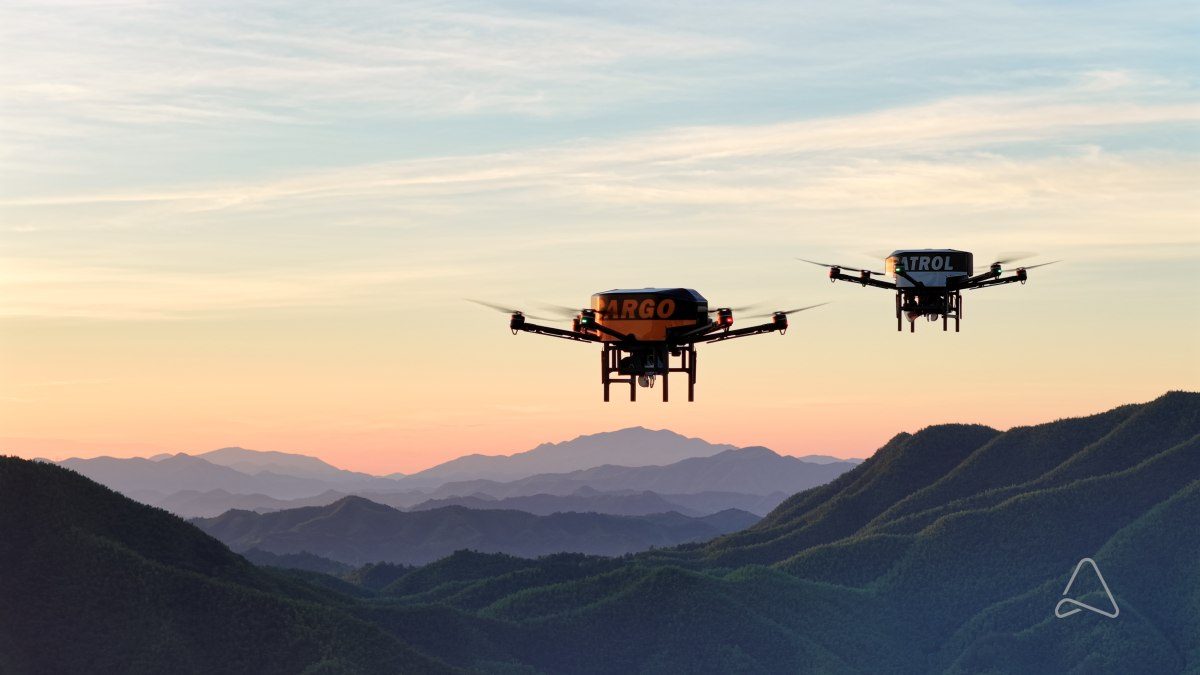
Rather than building separate drones for different industries, A2Z has also made the Longtail Dual modular. Customers focused on package delivery can choose the Longtail Dual Cargo configuration, which includes the company’s RDS2 drone winch capable of lowering packages from altitude instead of landing. That approach keeps spinning propellers safely away from people while allowing deliveries of retail goods, food, tools, or medical samples. A downward-facing LiDAR sensor helps automate precise package placement, while onboard FPV cameras provide operators with situational awareness throughout the delivery.
Organizations handling public safety or infrastructure work can instead opt for the Longtail Dual Patrol version. That model swaps the cargo setup for a quad-sensor camera featuring a 48MP zoom camera, wide-angle imaging, thermal vision, and a laser rangefinder. A powerful spotlight, onboard megaphone, and drone winch make it suitable for search-and-rescue operations, drone-as-first-responder (DFR) deployments, infrastructure inspections, and delivering emergency supplies to crews in the field.
The Longtail Dual is also part of a much larger ecosystem. A2Z’s AirDock stations allow drones to automatically land, recharge, pick up packages, and launch again without human intervention. Multiple docks can be linked together into regional networks, allowing aircraft to hop from station to station while operators oversee missions remotely through the company’s CloudOS fleet management platform.
As commercial drone regulations gradually evolve to support more routine BVLOS operations, companies are increasingly looking beyond individual aircraft and toward complete autonomous ecosystems. With the Longtail Dual, A2Z is betting that built-in redundancy, faster turnaround times, and dock-to-dock automation will become just as important as payload capacity in the next generation of commercial drone fleets.
More: DJI Matrice 400 finally gets its autonomous drone dock


FTC: We use income earning auto affiliate links. More.




Comments