
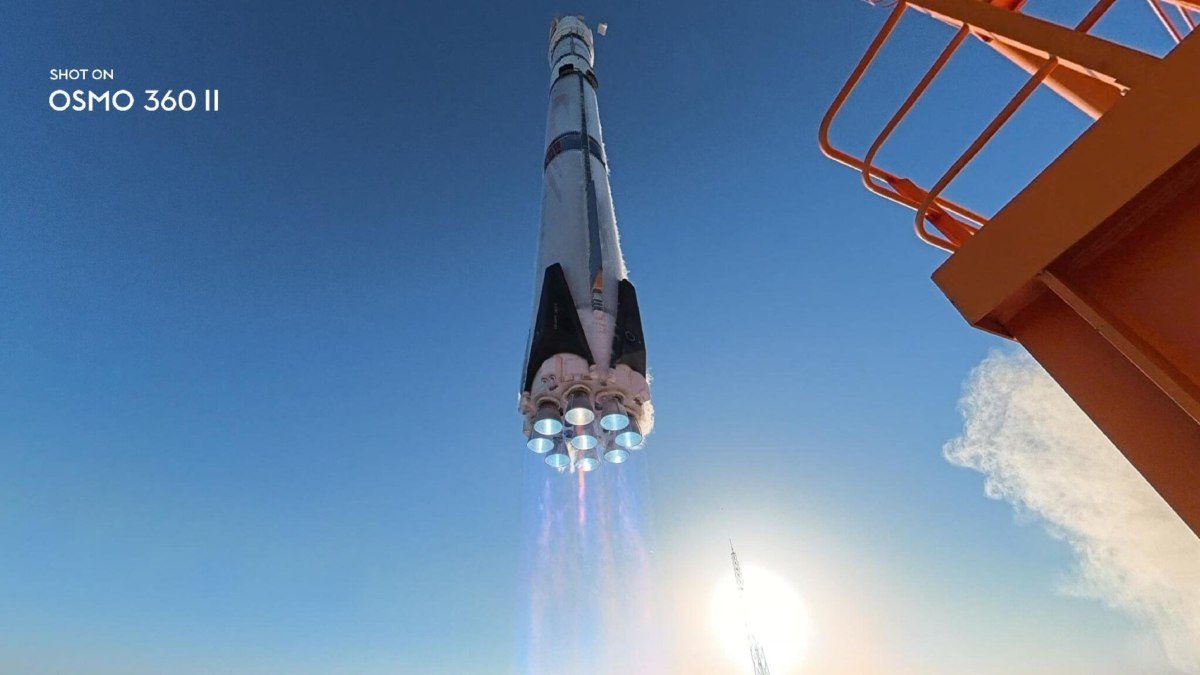
DJI used a historic reusable rocket mission to showcase not one, but two major camera milestones. While the upcoming Osmo 360 II quietly made its public debut by capturing immersive 8K/60fps panoramic footage of the launch site, the new Osmo Action 6 became the first unmodified consumer action camera to travel into space, survive temperatures approaching 500°C (932°F) during reentry, and return with first-person footage of the entire mission.
The feat took place during the successful launch and recovery of LandSpace’s reusable Zhuque-3 rocket, a milestone for the Chinese commercial aerospace company as it continues advancing reusable launch technology. Instead of relying solely on specialized aerospace cameras, the mission demonstrated how DJI’s growing ecosystem of imaging products — from drones and handheld cameras to thermal imagers and 360-degree cameras — can document complex operations from nearly every angle.
At the center of the mission were 12 Osmo Action 6 cameras, mounted directly onto the rocket’s first-stage booster without any hardware modifications. Positioned at key locations along the vehicle, the cameras recorded the journey from engine ignition and liftoff to the climb through the atmosphere, the booster’s return to Earth, and its eventual landing and recovery.
That makes the Action 6 the first consumer-grade action camera to capture an entire rocket launch-and-recovery mission from the rocket itself without requiring custom aerospace hardware.
Beyond producing dramatic footage, the recordings could prove valuable to engineers. Reusable rockets undergo extensive inspections after every flight, and onboard video offers another layer of data for evaluating how the booster performs during ascent, reentry, and landing. Detailed footage can help teams review recovery procedures, assess the condition of the first stage, and identify ways to improve future missions while reducing costs.
The mission also subjected the cameras to some of the harshest conditions imaginable. According to DJI, the rocket’s exterior reached temperatures between 400°C and 500°C during ascent and atmospheric reentry. At the same time, the booster experienced continuous high-frequency vibrations from its engines and aerodynamic forces.
The cameras also had to contend with the communications blackout that occurs during atmospheric reentry, when ionized plasma surrounding the vehicle temporarily interrupts external radio signals. Rather than streaming footage live, the Action 6 recorded everything internally, allowing all of the video to be recovered once the booster safely returned to Earth.
Keeping the footage usable presented another challenge.
Rocket launches generate violent vibrations and rapid attitude changes that would overwhelm most action cameras. DJI says the Action 6’s latest stabilization system minimized shake without excessive cropping, producing smoother footage while still preserving the rocket’s movement. Its custom 1/1.1-inch square sensor, capable of recording 4K video at up to 120 frames per second with 13.5 stops of dynamic range, also helped capture detail across dramatically changing lighting conditions — from intense sunlight high above Earth to dust-filled scenes during landing.
The resulting videos include close-up views of engine ignition, grid-fin steering maneuvers during descent, and the booster’s final landing sequence.
While the rocket-mounted footage provides the mission’s most dramatic perspective, DJI’s broader camera lineup documented the launch from the ground and sky.
Most notably, the upcoming Osmo 360 II was used to record 8K/60fps panoramic footage around the launch site, marking the camera’s first public appearance ahead of its official unveiling.
Supporting the operation were the DJI Mavic 4 Pro, which captured aerial views of the launch complex, the DJI Matrice 4TD, which provided thermal imaging of the mission, and the Osmo Pocket 4P, which recorded cinematic behind-the-scenes footage on the ground.
Together, the combination of aerial drones, thermal cameras, handheld cameras, immersive 360-degree imaging, and rocket-mounted action cameras created a comprehensive filming network spanning from the launch pad to the edge of space.
More: Why modern DJI drones rely on LiDAR


FTC: We use income earning auto affiliate links. More.



Comments