

In a moment when the world’s biggest drone maker faces an uncertain future in America, one Texas border city is proving just how critical the technology has become. El Paso is using DJI’s drones not just to watch the skies, but to reshape how police, firefighters, and airport crews respond when seconds matter.
El Paso is no ordinary city. Stretching across nearly 40 miles of desert terrain and flanked by military airspace and an international border with Mexico’s Ciudad Juárez, the region presents a uniquely complex landscape for public safety. Responding to emergencies here requires coordination across police, fire, and even airport authorities — each facing different challenges, but often converging on the same incidents.
For years, traditional response models meant delays. Officers might spend 45 minutes or more gathering equipment, driving across town, and manually setting up a drone before any aerial insight could be gained. For a city that must often act fast — whether it’s responding to border incidents, downtown disturbances, or fires in remote desert stretches — that lag could be costly.
Six years ago, the El Paso Police Department (EPPD) launched its drone program with modest goals. But as benefits became obvious, the program expanded rapidly. Today, El Paso operates 22 DJI Dock stations positioned throughout the city.
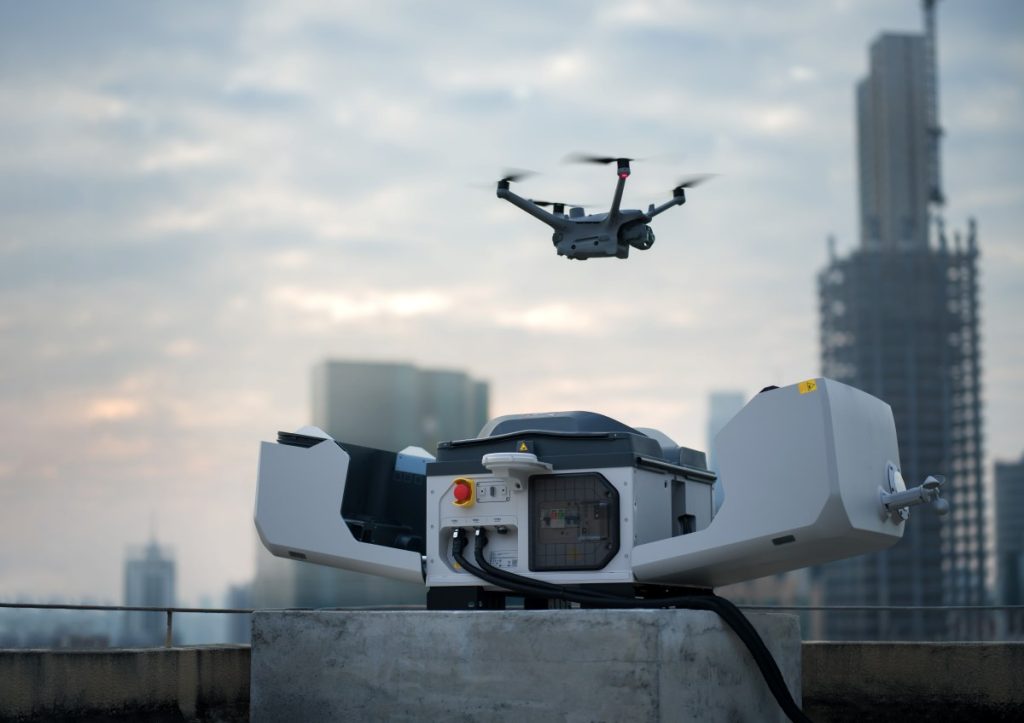
These docks house public safety drones that can be launched remotely at a moment’s notice, controlled from a laptop anywhere in the city. What once took nearly an hour now takes just minutes. A drone can be in the air, streaming live footage to officers en route, well before they arrive on scene.
That intelligence is game-changing. As Sgt. Balke of EPPD puts it: “A lot of bad things can happen in two minutes.” By letting drones handle noise complaints or house party calls, officers can be freed up and dispatched to higher-priority emergencies, arriving faster and with more clarity about what they’re walking into.
New: How to keep DJI Osmo 360 camera lenses scratch-free
However, operating a public safety drone program in a sensitive border zone brings its own challenges. Data security isn’t a nice-to-have; it’s mission-critical. That’s where DJI FlightHub 2 On-Premises comes in.
Built on AWS GovCloud and deployed with support from Technicalis, this platform lets El Paso run its drone operations entirely on secure private servers. Every image, coordinate, and log stays inside their network, meeting stringent security needs while giving agencies full control. The system also allows multiple operators to collaborate in real time — one piloting the drone, another focusing on camera operations and data capture.
What sets El Paso apart is not just the technology, but how it’s used. Instead of building siloed programs, the city’s police, fire, and airport teams chose to collaborate. They share infrastructure, training, and mission data, creating a citywide drone-as-first-responder (DFR) ecosystem.
This cross-agency approach streamlines operations and saves costs while improving outcomes. In one striking example, when a downtown mission required an electronic observer, a colleague stationed in Atlanta was able to step in remotely, allowing the mission to proceed safely without delay.
And the collaboration is only growing. Plans are underway to extend drone access to more city departments, including Parks and Recreation, Economic Development, and Streets and Maintenance — turning drones into a tool for the entire community, not just first responders.
But El Paso’s success story comes with a twist: it hinges on a company whose future in the US is far from guaranteed.
Under the 2025 National Defense Authorization Act (NDAA), federal agencies must conduct a formal security review of Chinese-made drone manufacturers, including DJI, by December 2025. If no review is completed, DJI could be automatically blacklisted on the FCC’s Covered List. That would severely restrict its ability to sell or operate in the US, leaving local governments like El Paso in limbo.
So far, no agency has taken up the review, and DJI has warned that the clock is ticking. For cities already relying on the technology, the uncertainty raises big questions: what happens if the tools they depend on are suddenly unavailable?
Nonetheless, El Paso shows what’s possible when a city embraces drones not as gadgets, but as part of a broader strategy for public safety. From cutting response times to strengthening security and uniting departments, the city is demonstrating how drone technology can evolve from pilot projects into core infrastructure. Watch here:
More: Canadian tourist admits to drone spying at US base, gets deported


FTC: We use income earning auto affiliate links. More.




Comments