
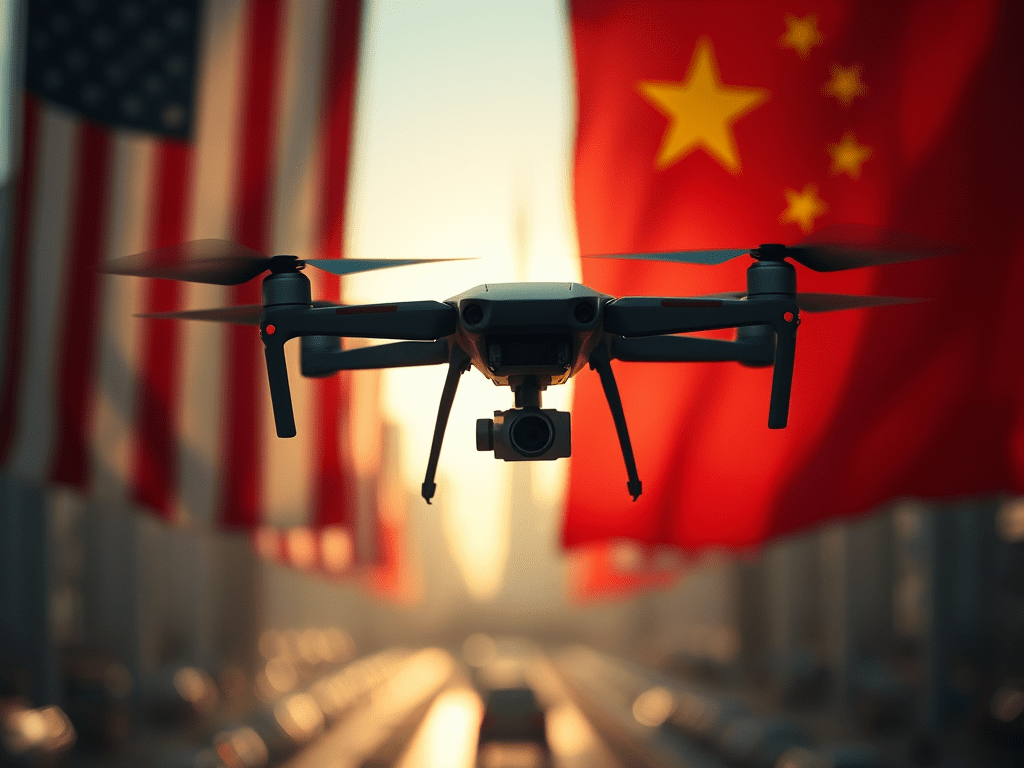
If you’re a US drone pilot trying to figure out whether DJI drones are banned, unbanned, half-banned, or just politically inconvenient, you’re not alone. In the latest twist, the US Department of Commerce has quietly withdrawn its proposed rules to restrict Chinese-made drones, even as the Federal Communications Commission (FCC) continues enforcing a sweeping ban on new foreign-made drone models, including those from DJI.
On the surface, that sounds like good news. In reality, it mostly confirms what many in the industry suspected all along: US drone policy right now is less about urgent national security threats and more about leverage, timing, and geopolitics. Let’s break down what actually changed, what didn’t, and why DJI and American drone operators are still caught in the middle.
US Commerce Deptartment backs off, FCC stays firm
Late last week, the US Commerce Department withdrew a proposal that would have restricted — or potentially barred — Chinese-made drones under its Information and Communications Technology and Services (ICTS) authority, according to Reuters.
That proposal had been in motion for months. The Commerce Department sent it to the White House for review on October 8 and continued internal discussions through December 19 before pulling it entirely. This is the same legal authority the department used to effectively block Chinese passenger vehicles and commercial trucks from the US market over data and national security concerns. Applied to drones, it would have gone far beyond what pilots are dealing with today.
Meanwhile, the FCC has already acted. On December 22, 2025, the FCC added foreign-manufactured drones and critical components to its Covered List, preventing them from receiving the equipment authorizations required for new models to be sold in the US. That move directly impacts DJI, Autel Robotics, and HoverAir, among others.
New: Yes, your DJI drone can still get firmware updates — FCC confirms
Why this matters: Commerce Dept.’s plan was the nuclear option
At first glance, the Commerce Department’s withdrawal of its proposal might look symbolic. It isn’t.
The plan was widely seen as the worst-case scenario for drone operators. The department had been exploring restrictions on core systems inside drones — onboard computers, communications links, flight control systems, software, ground stations, and data storage.
Had those rules gone into effect, they could have made existing DJI drones illegal to operate, not just future ones impossible to import. That’s a very different outcome from the FCC’s approach, which grandfathered in previously approved equipment.
The department itself acknowledged in early 2025 that it was examining whether foreign-made drones could allow adversaries to remotely access or manipulate devices and sensitive data. Some analysts warned at the time that targeting key systems would amount to a de facto operational ban.
That’s why this withdrawal matters. The US government effectively chose the less disruptive path.
During a December 11 meeting with US officials, DJI warned that blanket restrictions on drones manufactured in China would be “unnecessary, conceptually flawed, and would be extremely harmful to US stakeholders,” according to online records later retrieved by both Reuters and the South China Morning Post.
That argument wasn’t theoretical.
Public feedback during Commerce’s consultation period showed overwhelming concern from drone pilots, public safety agencies, and small businesses. Surveys conducted around the same time suggested that a large share of professional operators would face business-ending consequences if access to DJI hardware were cut off entirely.
The Commerce Department didn’t say DJI convinced it on the merits. But the outcome speaks volumes: instead of stacking another layer of restrictions on top of the FCC ban, the department walked away.
Related: DJI responds to US drone blacklist decision
The timing here isn’t accidental.
Both Reuters and SCMP report that the decision to withdraw Commerce’s proposal is tied to Washington freezing certain actions against China ahead of a planned April meeting between President Donald Trump and Chinese President Xi Jinping.
A government official told Reuters the move appeared linked to that effort. SCMP framed it as part of a broader attempt to avoid inflaming tensions before the summit, which follows previous trade discussions late last year.
That context is important — because it undercuts the idea that Chinese drones represent an immediate, non-negotiable national security emergency. If they did, enforcement wouldn’t pause for diplomatic convenience.
Instead, drones appear to be one lever among many in a much larger US-China negotiation.
What the FCC drone ban actually does (and doesn’t)
Despite all the noise, the FCC’s rules are very specific, and very limited. What is blocked:
- New foreign-made drone models cannot receive FCC equipment authorization
- New critical components from foreign manufacturers cannot be certified
- Future DJI drones without prior approval are effectively shut out
What is not blocked:
- Existing DJI drones remain legal to use
- Previously authorized DJI models can still be sold
- No current fleet is being grounded
On January 7, 2026, the FCC further updated its Covered List, exempting certain drones until January 1, 2027. Those exemptions include drones on the Department of Defense’s Blue UAS Cleared List, drones meeting a 65% domestic content standard, and individual products that receive conditional approvals.
For DJI users, that update didn’t change much, but it revealed flexibility in how the ban is being implemented.
So are DJI drones ‘banned’ in the US?
For most pilots, the honest answer is: not yet, but eventually… unless something changes.
If you already own DJI drones such as the Mini 3 (20% off) or Avata 2 (15% off), you can keep flying them. If you rely on models that were approved before December 22, you can still buy and sell them.
But the pipeline matters.
As fleets age over the next 12 to 24 months, operators who rely heavily on DJI hardware will face harder decisions. Repairability, replacement cycles, and access to newer sensors and safety features all become issues when future models are blocked.
The Commerce Department stepping away doesn’t fix that. It just means the government chose not to make things worse — for now.
Related: DJI drone scrutiny in the US just took a new turn
Zoom out, and the last few weeks tell us a lot about how US drone policy is actually being made:
- Multiple agencies were moving independently. The Commerce Department and the FCC pursued overlapping restrictions using different legal tools, apparently without full coordination.
- The rules are negotiable. The Commerce Department pulled its proposal entirely, suggesting these measures are policy instruments, not emergency actions.
- The mechanism matters more than the rhetoric. Unlike the Commerce Department, the FCC’s approach preserves existing operations.
- Trade politics shape enforcement. Drone policy is clearly entangled with broader US-China negotiations.
None of that screams “imminent catastrophic threat.” But with the Commerce Department stepping aside, everything now hinges on the FCC, and on geopolitics. Key questions remain unresolved:
- Will conditional approvals become more common or remain rare?
- Will the the 65% domestic content rule survive past January 1, 2027?
- Will the Trump–Xi meeting produce concessions that affect drones?
- Will legal challenges or quiet negotiations change enforcement?
For now, DJI drones aren’t disappearing from US skies. But uncertainty alone can reshape markets, and that may be exactly what this policy moment is designed to do.
More: End of an era: DJI dropping support for Mavic Mini drone, Osmo Pocket


FTC: We use income earning auto affiliate links. More.

Comments