
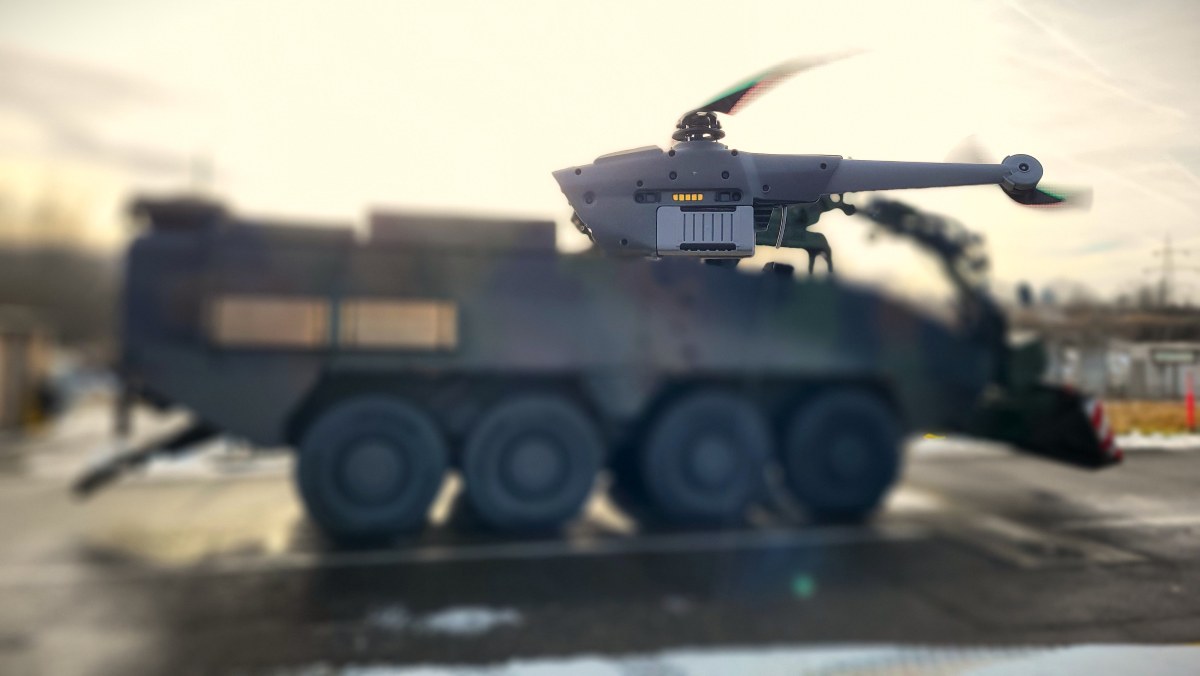
Switzerland is giving its armored vehicles something new: eyes that can fly.
In a move that hints at where modern military reconnaissance is headed, Teledyne FLIR Defense has secured a $17.5 million contract from armasuisse to deliver Black Hornet 4 nano-drones to the Swiss Armed Forces. These drones won’t just be carried by soldiers on foot — they’re being digitally wired into Switzerland’s Piranha 8×8 armored engineering vehicles, turning each vehicle into a mobile drone launch and intelligence hub.
The Black Hornet 4 is about as far from a traditional military drone as you can get. Weighing just 70 grams, it fits in the palm of a hand and looks more like a futuristic toy than a battlefield sensor. But that tiny form factor is exactly the point. Once launched by hand from a vehicle or by a dismounted soldier, the drone can quietly scout ahead, peek around buildings, and send back live video without drawing much attention.
What makes this deal different — and more interesting — is how deeply the drone is integrated into the vehicle itself. Teledyne FLIR Defense modified the Black Hornet’s software so it plugs directly into the Piranha’s digital infrastructure. Live video from the drone appears instantly on vehicle displays, while coordinates and target data are shared across onboard systems. Everyone inside the vehicle sees the same picture, at the same time.
That shared view matters in fast-moving situations. Instead of a single operator interpreting drone footage and relaying information verbally, the entire crew gets real-time situational awareness. The integration runs through the vehicle’s Integrated Combat Solution, provided by Kongsberg Defence & Aerospace, using harmonized military standards designed for modern networked warfare.
The setup is also surprisingly flexible. Operators can connect the Black Hornet’s control tablet to the vehicle system for mobile missions, launch the drone by hand, and fly reconnaissance while the crew monitors the feed. If soldiers need to dismount, the drone system detaches and keeps flying — then reconnects once the operator is back inside. The drone can even receive waypoint instructions from the vehicle or generate target points that feed directly into a remote weapon station.
This kind of tight coupling between vehicles and small drones is becoming a clear trend. Instead of relying solely on large UAVs or external support, armored units are getting their own organic aerial scouts. According to Teledyne FLIR Defense, the Swiss program highlights the growing global market for vehicle-integrated UAS and “drone-in-a-box” concepts designed specifically for armored platforms.
Despite its size, the Black Hornet 4 is built for serious conditions. It carries a 12-megapixel daylight camera and a high-resolution thermal imager, works in GPS-denied and contested environments, and can fly for more than 30 minutes at ranges exceeding three kilometers. It’s rated to operate in rain and winds up to 25 knots, with obstacle avoidance helping it survive cluttered urban and battlefield environments.
Switzerland has already received the first batch of vehicle-integrated Black Hornet 4 systems in 2025, with additional deliveries planned through 2026. Globally, more than 35,000 Black Hornet drones have been delivered to military and security forces in over 45 countries.
The takeaway is simple: armored vehicles are no longer just steel boxes with wheels. They’re becoming connected sensor platforms — and sometimes, the most valuable sensor weighs less than a chocolate bar.
More: HoverAir X1 Pro, Pro Max drones get smarter winter tracking


FTC: We use income earning auto affiliate links. More.




Comments