
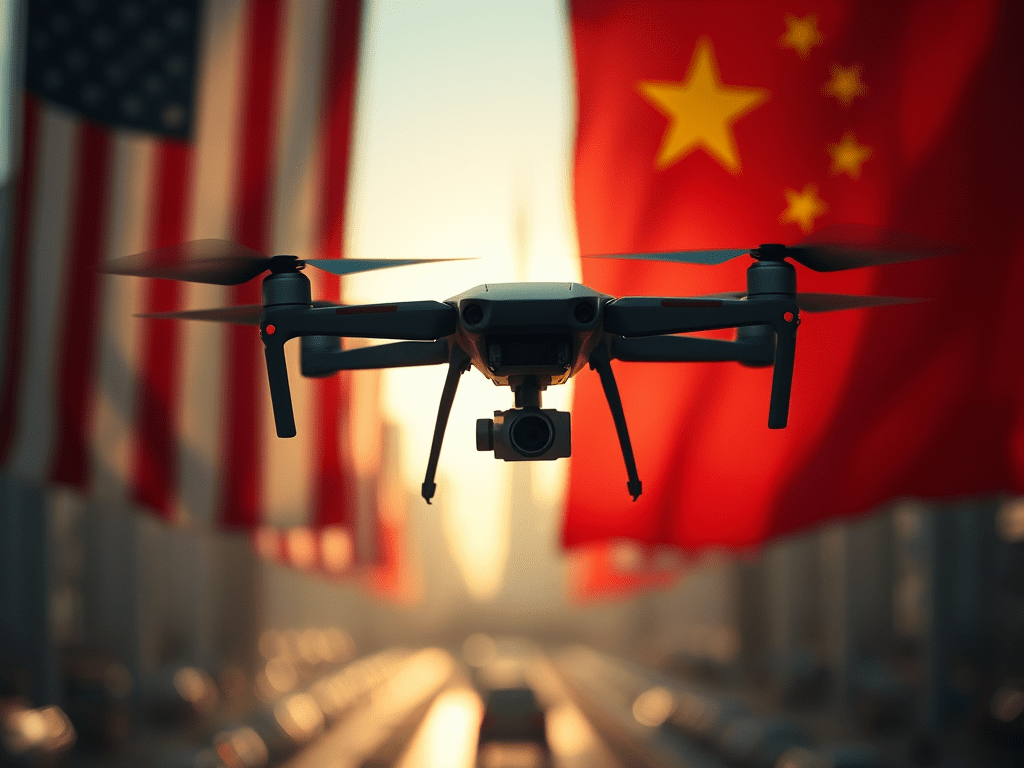
The United States has exempted four foreign-made drones from its sweeping import ban. See the latest additions to a list that’s quietly getting longer…
While most new foreign drones remain blocked under strict national security rules, US regulators are steadily carving out exceptions for systems that pass increasingly specific checks. What began earlier this year as limited carveouts tied to government-approved programs is now evolving into something more revealing: a growing, case-by-case whitelist of drones still allowed into the country. And with each new approval, the message is becoming clearer: Not all foreign drones are being treated the same.
A ban designed to filter, not freeze
The shift traces back to December, when the Federal Communications Commission (FCC) effectively halted approvals for new foreign-made drones and critical components. Without FCC authorization, companies cannot legally import or sell new models in the US.
The move followed a national security review that flagged risks tied to supply chains, data access, and potential vulnerabilities — concerns that have increasingly centered on Chinese drone makers dominating the global market. But even at the time, regulators signaled the policy wouldn’t be absolute.
By January, the FCC had already introduced its first round of exemptions, allowing certain drones and components to continue entering the country through the end of 2026. Those early carveouts were tied to systems vetted under government-backed programs like Blue sUAS or those meeting “Buy American” standards.
In other words, if a drone was already trusted — or built within a trusted supply chain — it could still pass.
Now, the framework is evolving again.
The latest update marks a notable shift: instead of relying only on broad categories, regulators are now approving individual drone models after detailed national security reviews. That change is subtle but significant.
It suggests the US is moving toward a more granular system… one where access to the market depends not just on where a drone comes from, but on how it’s built, sourced, and vetted. And it opens the door, however narrowly, for additional foreign-made drones to qualify in the future.
More: Rogue drone pilots face new FAA tracking system
The four drones that made the cut
So which drones just cleared that bar? According to the FCC, four systems, along with their critical components, have now been formally exempted after a Pentagon-led review determined they do not pose unacceptable national security risks. They are:
- SiFly Aviation Q12
- Mobilicom SkyHopper series
- ScoutDI Scout 137
- Verge Aero X1
None of these comes from Chinese manufacturers. And that’s a detail that aligns closely with Washington’s broader push to reduce reliance on Chinese drone technology.
At least one of the companies, California-based SiFly Aviation, actively petitioned for approval. The company argued that its Q12 drone posed no security risk and highlighted plans to shift key components toward domestic sourcing. That combination of security assurances plus an onshoring roadmap appears to be emerging as a blueprint for others hoping to follow.
That said, it’s important to note that the conditional approval for these four ends is valid only until December 31, 2026.
What it means for DJI and the broader market
While a small number of drones are now being cleared, major players like DJI and Autel Robotics remain effectively shut out from launching new models in the US. Under current rules, their latest drones cannot receive FCC authorization, even as existing products remain legal to use and sell.
DJI has already pushed back, filing a legal challenge that argues the restrictions unfairly limit competition and deny US customers access to its newest technology. But for now, the direction of policy is clear. This isn’t just about blocking certain companies; it’s about reshaping the supply chain behind the entire drone ecosystem.
Taken together, the FCC’s actions reveal a strategy that’s still unfolding. The US isn’t enforcing a blanket ban. Instead, it’s building a controlled entry system — one that favors trusted supply chains, closer alignment with domestic manufacturing, and the ability to pass rigorous security reviews.
And importantly, that system is expanding. The four newly approved drones don’t stand alone. They join a broader pool of systems and components already cleared earlier this year under Blue UAS and domestic sourcing pathways. With each update, the list grows… slowly, selectively, and under tight scrutiny.
New: DJI Avata 2 prices crash ahead of new 8K FPV drone


FTC: We use income earning auto affiliate links. More.

Comments