
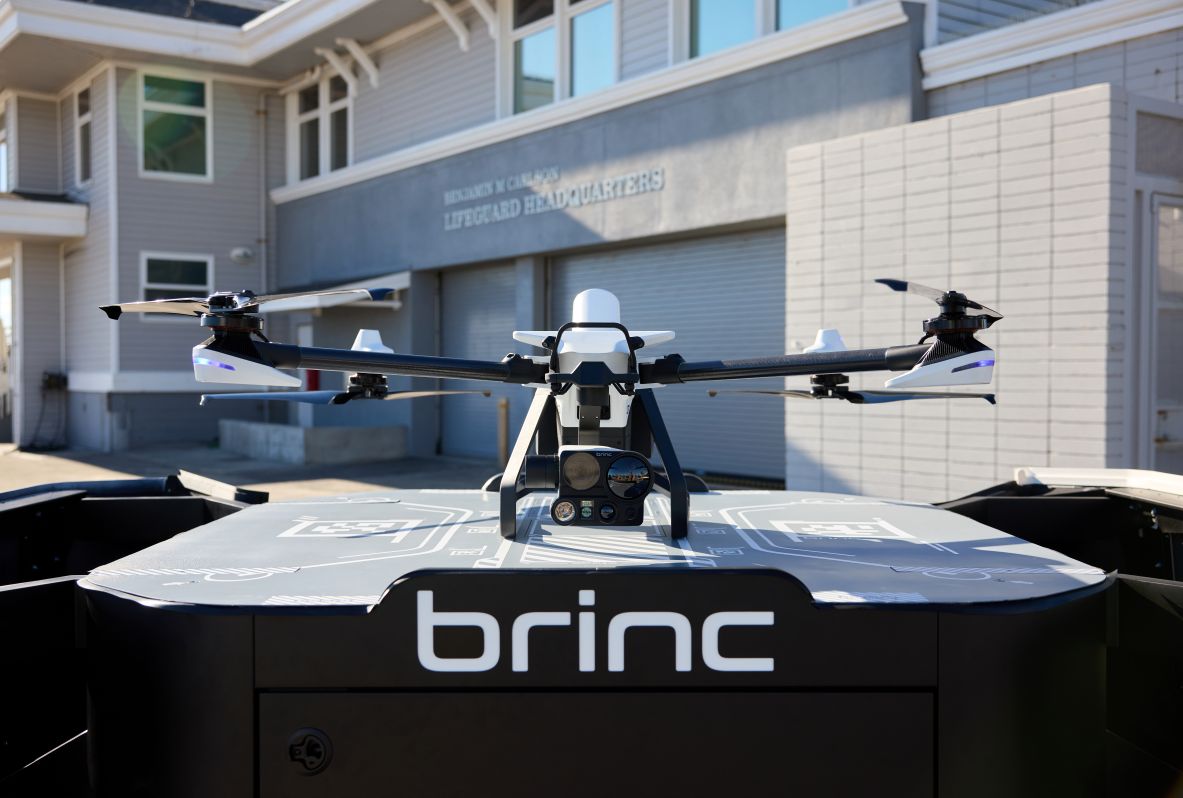
Drones responding to 911 calls are no longer experimental. Across the US, police departments are already using Drone as First Responder (DFR) programs to get eyes on emergencies faster than patrol units. In many cities, drones arrive in under two minutes, well before officers. But even with that progress, the tech still has friction. Drones need to stop and recharge. Coverage areas are limited. Connectivity can fail in the worst moments. Now, BRINC says its new Guardian drone is built to fix those exact problems.
A drone that never really goes ‘offline’
Here’s the part most people don’t see. After responding to a call, many DFR drones have to sit idle for 20 to 25 minutes just to recharge. That delay adds up, especially during busy shifts.
Guardian approaches this differently. Instead of waiting, it lands at its docking station, swaps batteries automatically, reloads what it needs, and goes right back into the air. No human involved.
BRINC says this enables up to 95% operational uptime. For comparison, many current systems operate at less than half of that. That alone could change how often drones are actually available when emergencies happen.
Built for real emergencies, not just surveillance
Also, most DFR drones today are used for visibility. They stream live video so dispatchers and officers can assess situations before arriving.
Guardian goes a step further. It can carry and deliver life-saving equipment, like defibrillators (AEDs), Narcan for overdoses, or flotation devices during water rescues. Even more interesting: it can automatically choose what to carry based on the nature of the 911 call.
That turns the drone into something more than a camera. It becomes part of the response.
Starlink connectivity changes everything
One of the biggest constraints in today’s DFR systems is connectivity. Most rely on cellular networks. And when those networks are weak or down, the drone’s usefulness drops fast.
Guardian integrates a built-in Starlink satellite connection. That means it can maintain a data link almost anywhere, including rural areas or disaster zones where traditional infrastructure isn’t reliable. For many agencies, especially outside major cities, this could remove a major barrier to adoption.
Range has also been a limiting factor for DFR programs. Many systems operate within about a three-mile radius. Guardian pushes that to roughly eight miles. It also flies at speeds up to 60 mph and can stay in the air for more than an hour. Put together, that means:
- Covering significantly more ground
- Staying on scene longer
- Reaching emergencies faster
For departments, that could mean fewer launch sites and lower costs to scale operations citywide.
So, could this drone replace police helicopters?
This is where things get interesting. Guardian is designed to track moving suspects, including vehicles. Instead of engaging in high-speed chases, officers could rely on a drone to follow from above, reducing risks on the ground. DFR programs already do this in limited ways today. But with longer flight time, higher speeds, and better connectivity, Guardian could expand that capability significantly. It’s not a full helicopter replacement, but it may start to overlap with some of those roles.
Guardian also pushes imaging further than most drones in its class. It combines:
- 4K video
- Up to 640x zoom
- Dual HD thermal cameras
That means responders can identify details from over 1,000 feet away, and still see clearly in complete darkness. On top of that, it includes a powerful spotlight, a laser rangefinder, and a speaker system louder than a police siren. All of it is designed to improve coordination and decision-making on the ground.
Built directly into 911 systems
Another key shift is how the drone fits into existing workflows. Through a partnership with Motorola Solutions, Guardian integrates into dispatch platforms. AI can scan incoming 911 calls for keywords like “heart attack” or “allergic reaction,” helping operators quickly decide whether to deploy a drone and what it should carry.
Officers can even trigger a drone launch themselves if they’re in distress. That kind of integration makes the drone feel less like a separate tool and more like part of the system itself.
Guardian also represents a scaling moment for BRINC as a company. The drone will be manufactured in a new Seattle facility that more than doubles its production capacity, with a vertically integrated supply chain based in the United States. That’s significant at a time when the US is pushing to strengthen domestic drone manufacturing.
DFR programs are already expanding across the country. But the conversation is changing. It’s no longer just about getting a drone to the scene first. It’s about what that drone can actually do once it gets there. BRINC’s Guardian is built around that idea. Always ready. Always connected. And increasingly capable of taking action, not just observing it.
If that vision plays out in real-world deployments, the role of drones in emergency response could look very different, very soon.
More: US Army orders 2,500 Skydio drones in record deal


FTC: We use income earning auto affiliate links. More.



Comments