
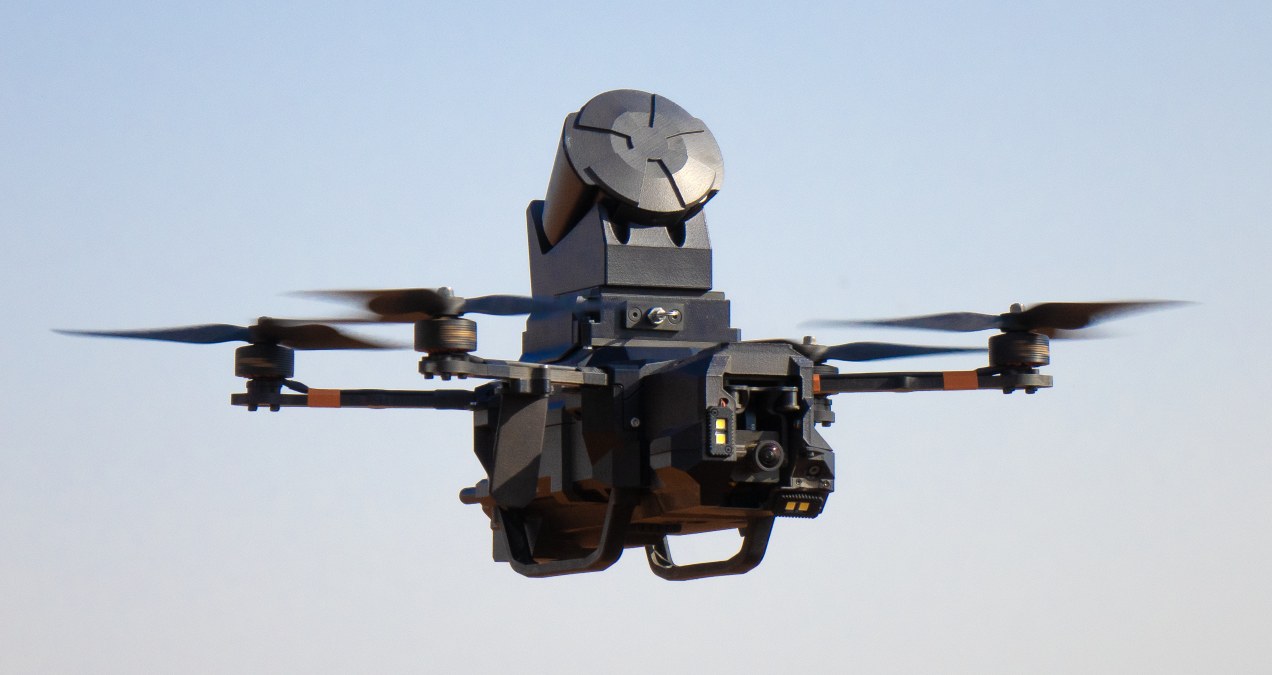
XTEND is doubling down on one of the biggest challenges in modern warfare: how to stop hostile drones, without making things worse in the process. The AI-driven robotics company, backed by Eric Trump, has announced a new partnership with ParaZero Technologies as part of its broader $1.5 billion public-market merger. Together, the companies are rolling out a fully autonomous drone interception system that can detect, chase, and capture enemy drones mid-air using a physical net. Yes, a net.
Instead of blowing targets out of the sky or jamming signals, the system focuses on physically catching drones, making it far safer for use in crowded urban environments or sensitive military zones.
The new capability combines XTEND’s Scorpio 1000 drone platform with ParaZero’s DefendAir net-launching system. Powered by XTEND’s XOS operating system, the platform can autonomously detect threats, track them in real time, pursue them at speed, and deploy a net to capture them with minimal collateral damage.
If this sounds familiar, that’s because the concept of “drones catching drones” has been gaining traction for some time now. Companies like Fortem Technologies have already operationalized similar ideas with systems like the DroneHunter, which uses radar-guided autonomous drones to fire nets and safely bring down rogue UAVs. These systems can even tow captured drones away or deploy parachute-like nets to ensure controlled landings.
The key advantage? No explosions, no falling debris, and in some cases, the ability to recover the captured drone intact for analysis or reuse.
XTEND is now entering this space with ParaZero’s help, but with its own twist. The system leans heavily on AI-driven autonomy and multi-domain operations, meaning it’s designed to function seamlessly across air, ground, and maritime environments. That flexibility could be critical as drone threats evolve beyond isolated incidents into coordinated, multi-domain attacks.
Watch the Scorpio 1000 in action here:
ParaZero CEO Ariel Alon says the partnership is about delivering an integrated, autonomous defense solution that works just as effectively in cities as it does on the battlefield. XTEND CEO Aviv Shapira, meanwhile, points to a future where human-machine teaming and AI-powered systems define how threats are detected and neutralized in real time.
With more than 10,000 XTEND systems already deployed across 30+ countries, this new interception capability could scale quickly. And as drone threats continue to grow worldwide, one thing is becoming clear: the future of air defense might not be louder, it might just be smarter.
More: DroneShield opens Amsterdam HQ as counter-drone demand grows


FTC: We use income earning auto affiliate links. More.

Comments