
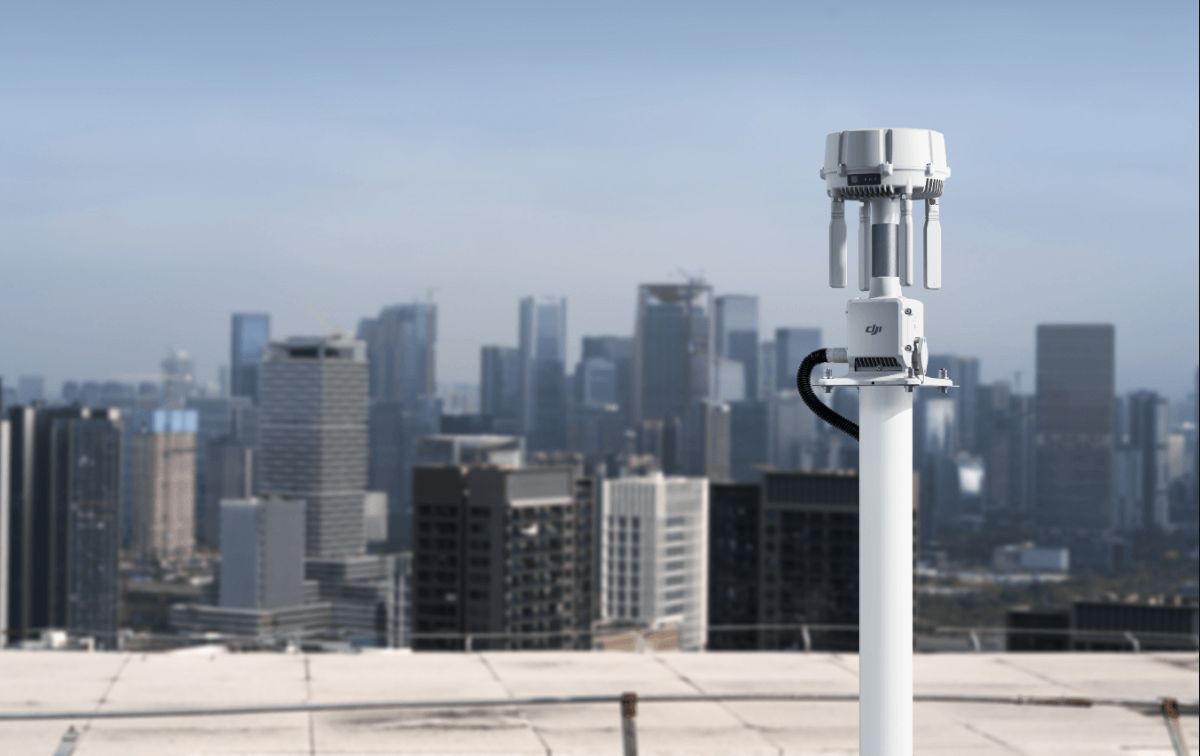
DJI is taking aim at one of the biggest challenges drone pilots face: maintaining a strong, reliable connection when flying in difficult environments. The company has unveiled the DJI O4 Ground Station, a new transmission system designed to dramatically extend drone communications while improving reliability in areas where signal interference, obstacles, or distance can disrupt operations.
While most recreational pilots won’t need infrastructure on this scale, DJI says the O4 Ground Station is designed for organizations conducting demanding drone missions. The system is aimed at public safety teams carrying out search-and-rescue operations, as well as inspection, surveying, and monitoring crews that require reliable connectivity in remote or challenging environments.
The new platform is designed to overcome many of the limitations that traditionally affect long-range drone operations. At the heart of the system is an advanced hardware architecture featuring a 12-antenna array that combines both internal and external antennas. With support for both horizontal and vertical polarization, the setup delivers omnidirectional, high-gain coverage designed to maintain a stable connection regardless of the drone’s position in the sky.
DJI says the O4 Ground Station‘s high-output RF unit significantly boosts signal penetration and coverage, helping maintain reliable communications even when operating in dense urban environments filled with buildings and other obstacles. The company has also optimized the system’s signal-to-noise ratio, improving receiver sensitivity so that weak signals can still be recovered in areas with heavy electromagnetic interference.
One of the standout capabilities is automatic frequency management. Rather than relying on a single transmission band, the O4 Ground Station can automatically switch between sub-2 GHz, 2.4 GHz, 5.2 GHz, 5.8 GHz, and other available frequencies when interference is detected. The goal is to maintain a smooth, uninterrupted video feed even in congested RF environments where wireless signals compete for bandwidth.
Accurate positioning is equally important during long-range operations, and DJI has equipped the ground station with advanced RTK capabilities. The integrated high-gain RTK module can track 19 frequencies across five global satellite systems, allowing it to rapidly acquire positioning data even in difficult environments such as dense urban corridors or heavily forested areas. DJI says the system continuously provides centimeter-level positioning information to support safer flight operations.
The O4 Ground Station offers two primary operating modes: Gateway Mode and Relay Mode.
Gateway Mode is designed to provide broad coverage through a direct connection to DJI FlightHub 2. According to DJI, when paired with DJI Dock 3, the system can extend operational coverage up to 30 kilometers. The mode supports low-latency, high-bandwidth video transmission, enabling operators to monitor flights remotely while maintaining responsive control.
Related: DJI unlocks longer-range Dock 3 drone missions with new update
Another benefit of Gateway Mode is compatibility with FlightHub 2’s Virtual Cockpit feature. This allows operators to remotely control aircraft and even override pre-programmed flight routes when necessary. For teams managing multiple assets or responding to changing conditions in the field, the ability to quickly adjust flight plans can provide valuable operational flexibility.
DJI has also introduced a Signal Map feature that uses flight data to visualize areas with weak coverage. By identifying communication blind spots, operators can position ground stations more effectively and improve overall transmission reliability. The company believes this capability can enhance flight safety while helping users maximize the performance of their infrastructure.
Power efficiency is another area where DJI has focused attention. When operating in Gateway Mode, the O4 Ground Station automatically enters a low-power hibernation state when no drone is connected. During standby, power consumption drops to just 7 watts, helping reduce operating costs during extended deployments.
For locations without reliable internet connectivity, DJI offers Relay Mode. This configuration allows the ground station to be placed at an elevated location, such as a hilltop or rooftop, where it can act as a communication relay. By extending video transmission range and supporting connections to multiple remote controllers and DJI docks, Relay Mode helps maintain connectivity in valleys, dense urban environments, and other areas where signal obstruction is a challenge.
The company has also designed the O4 Ground Station for continuous outdoor operation. The unit carries an IP67 rating for dust and water resistance and is capable of operating in temperatures ranging from -40°C to 55°C. These specifications make it suitable for year-round deployment in a wide variety of climates.
To improve reliability, DJI has incorporated lightning protection measures through a proprietary grounding design that meets EN/IEC 61643-21 Category C standards. The system also features fanless passive cooling and an automatic self-recovery mechanism that can resume operations following power outages or software anomalies, reducing the need for on-site maintenance and troubleshooting.
For off-grid installations, the O4 Ground Station can be connected to DJI Power solar solutions or third-party photovoltaic systems. It also supports MQTT connectivity, enabling integration with third-party Remote ID and ADS-B receivers. This allows operators to monitor nearby manned and unmanned aircraft in real time, providing greater situational awareness around flight operations.
As drone operations continue expanding into more complex environments and longer-range missions, reliable communications remain one of the industry’s most important requirements. With its combination of advanced signal management, long-range transmission capabilities, rugged construction, and support for remote deployments, DJI’s O4 Ground Station is designed to help operators stay connected when it matters most.
More: DJI vs Insta360: The creator-tech cold war is officially over


FTC: We use income earning auto affiliate links. More.




Comments