

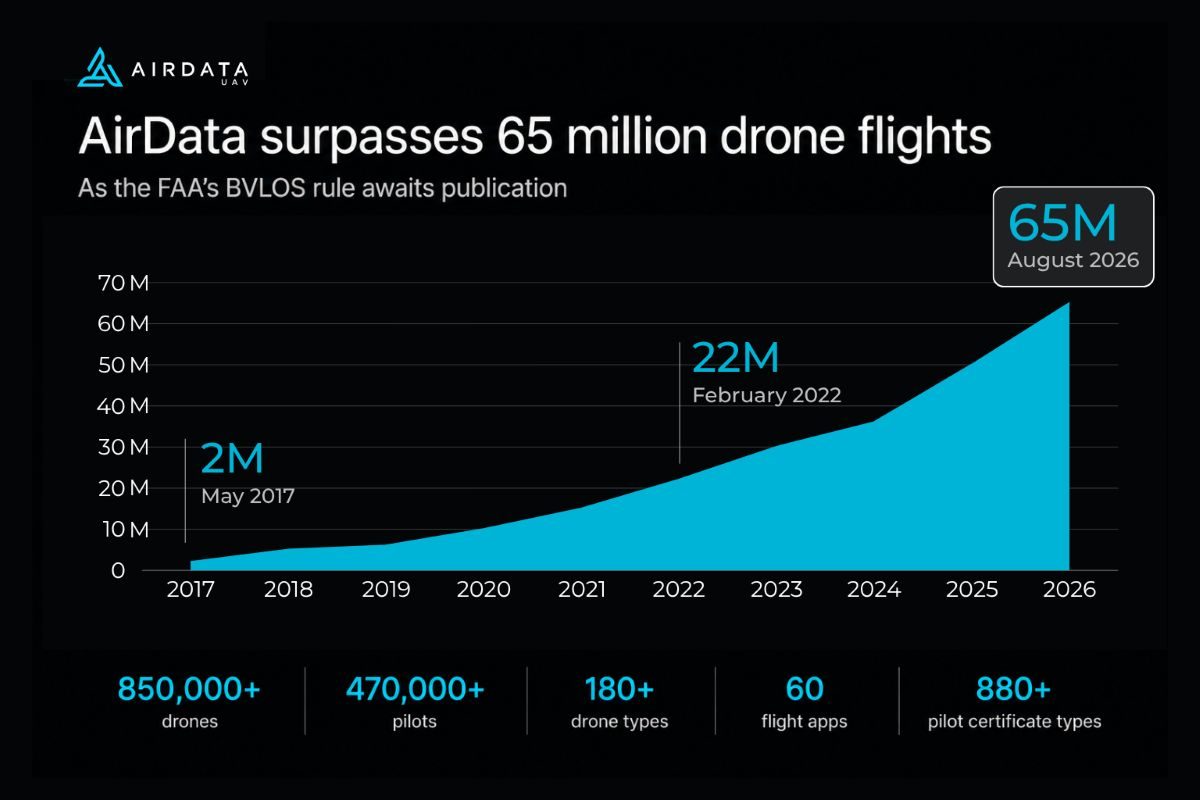
Drone fleet management platform AirData has crossed a major milestone that offers a glimpse into just how quickly commercial drone operations are maturing. The California-based company says it has now tracked more than 65 million drone flights worldwide, covering over 850,000 drones and 470,000 pilots. And the timing couldn’t be more significant.
The announcement comes as the Federal Aviation Administration’s long-awaited Part 108 rule, which would allow routine beyond visual line of sight (BVLOS) drone operations, is in its final stage of federal review before publication. If finalized, the regulation is expected to reshape how commercial drone programs operate across the United States.
The numbers themselves tell an interesting story. AirData reached 50 million flights in May 2025, meaning it has added another 15 million flights in just 15 months — that’s roughly one million flights every month! This rapid growth suggests commercial drone use is moving well beyond trial programs, with more companies integrating drones into everyday operations.
New: Flying Lion offers on-demand remote pilots for public safety drones
That’s exactly the kind of shift the upcoming Part 108 rule is designed to support. Rather than placing responsibility primarily on an individual remote pilot, Part 108 would make the operating organization accountable for ensuring aircraft are airworthy, personnel are properly trained, and flights follow approved procedures. Companies would also need to maintain detailed records covering flight operations, maintenance, pilot qualifications, and incident reporting.
Those requirements line up closely with what AirData has been collecting for years. Its platform already tracks flight logs, maintenance records, pilot certifications, battery health, and compliance information across mixed drone fleets.
According to AirData founder and CEO Eran Steiner, the company’s massive flight database isn’t just a bragging point; it enables insights that individual operators simply couldn’t generate on their own. With millions of flights available for comparison, AirData can detect subtle issues, such as a single battery aging differently from dozens of identical batteries operating under similar conditions, potentially helping operators spot maintenance problems before they become costly.
The scale of the dataset is also notable because it isn’t limited to one manufacturer’s ecosystem. AirData supports more than 180 drone models and 60 flight applications, giving enterprise customers a centralized platform even if they operate mixed fleets. The company also says it analyzes every battery cell after each flight and recognizes more than 880 pilot certificate types worldwide for certification tracking.
One real-world example comes from Pacific Gas and Electric (PG&E), which conducts BVLOS inspections across its sprawling 70,000-square-mile California service area under an FAA waiver. The utility uses AirData to automate documentation for flights, maintenance, and personnel — exactly the type of operational recordkeeping that could become standard if Part 108 is officially adopted.
With the FAA’s BVLOS framework now closer than ever to becoming reality, AirData’s latest milestone underscores how rapidly the commercial drone industry has grown, and how companies are already preparing for a future where large-scale drone operations become part of everyday business.
More: GoPro MAX2 camera unlocks pro video tools in free update


FTC: We use income earning auto affiliate links. More.





Comments