
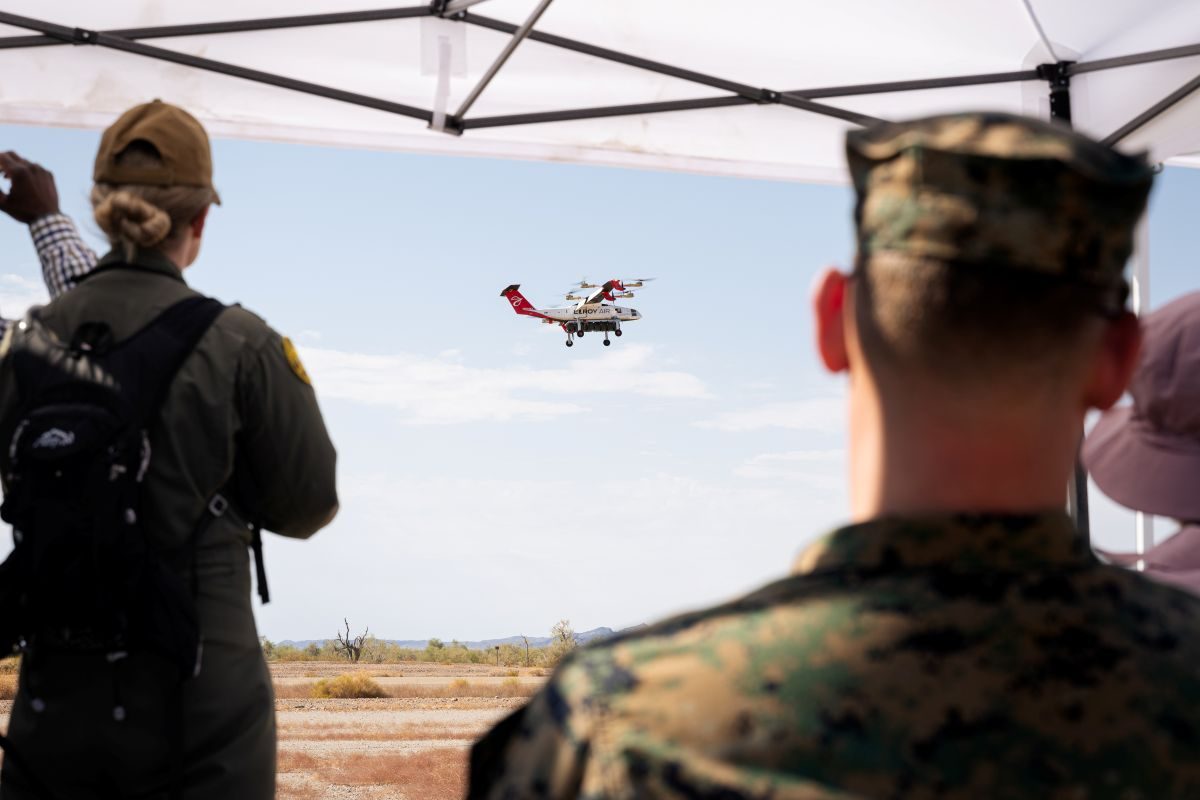
Elroy Air is getting a much bigger financial runway as it prepares to turn its autonomous cargo drone into a production aircraft. The California-based company has expanded its previously announced private investment in public equity (PIPE) commitments to $175 million, with existing backers including Lockheed Martin Ventures and Inflection Point participating. So far, $75 million of that funding has been provided ahead of Elroy Air’s planned business combination with Inflection Point Acquisition Corp. VII.
For Elroy Air, the timing is significant. The company is trying to move its Chaparral autonomous cargo aircraft from testing and demonstrations toward large-scale production for both military and commercial customers.
At its core, Chaparral is designed to do something relatively simple: carry heavy loads without needing a runway, airstrip, or traditional cargo aircraft infrastructure. The autonomous vertical-takeoff-and-landing drone is designed to carry more than 500 pounds of cargo and travel up to 450 miles using a hybrid-electric powertrain.
That makes it potentially useful for situations where getting a truck, helicopter, or conventional aircraft into an area is difficult or risky.
Elroy Air says the new funding will help accelerate production and get Chaparral aircraft into the hands of its commercial and defense partners at scale.
More: Insta360 cameras can now turn your travel videos into explorable 3D worlds
Lockheed Martin Ventures, the investment arm of Lockheed Martin, is also deepening its relationship with Elroy Air. The two companies plan to work together on advanced autonomous systems and business development across defense and commercial markets.
The investment comes after several important developments for Elroy Air. Earlier this year, the company announced a multi-year US Army contract worth up to $46 million. The work is focused on improving Chaparral’s ability to operate alongside troops in difficult environments, including by expanding its modular payload options and improving how it delivers cargo.
The company has also reached an important milestone on the commercial side. Elroy Air recently completed what it described as the first autonomous, uncrewed flights authorized under the US Department of Transportation and Federal Aviation Administration’s eVTOL Integration Pilot Program. The flights were conducted with LIFTOFF Louisiana and longtime partner Bristow Group.
Bristow has since expanded its reservations for early Chaparral deliveries. It now has 15 early delivery positions, up from five, while also maintaining a separate agreement to potentially purchase as many as 100 Chaparral aircraft.
Meanwhile, manufacturing is moving closer to reality. Kratos Defense & Security Solutions is the exclusive US manufacturer of Chaparral and plans to build the aircraft at its expanding facility in Sacramento, California. Elroy Air expects the first production aircraft to be built in late 2026.
The company is pursuing commercial logistics, rapid-response missions and defense applications, giving Chaparral a wide range of potential uses. But the next challenge is turning successful demonstrations and customer commitments into aircraft produced at meaningful scale.
With $175 million now committed through the expanded PIPE financing, Elroy Air has added considerably more financial firepower for that next phase.
More: Matternet unveils new M3 drone with 11-pound payload and 10-mile range


FTC: We use income earning auto affiliate links. More.




Comments