
Drone delivery has spent years trying to answer a deceptively simple question: What happens when you want to move from a handful of pilot programs to thousands of deliveries every day? Matternet thinks the answer starts with taking people out of the loop.
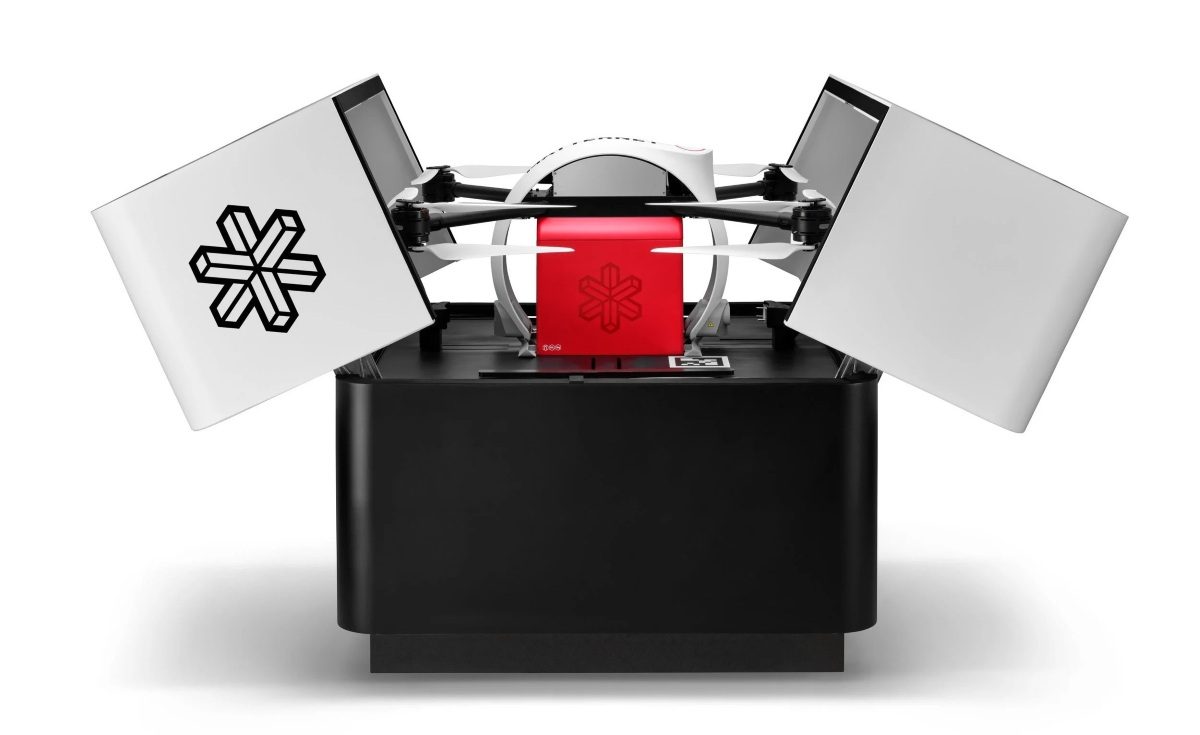
The company has unveiled M3, its next-generation autonomous drone delivery platform, designed to let restaurants, retailers, and hospitals send packages from dedicated micro-hubs without an operator standing by or anyone manually handling the aircraft.
The idea is straightforward. A restaurant or hospital gets a small delivery hub, potentially on its roof. An employee puts a package into Matternet’s M3 Portal, walks away, and lets the system handle the rest. The drone takes off, makes the delivery and returns to the hub without requiring someone on-site to interact with the aircraft.
Matternet is targeting commercial service for the second half of 2027. And one of its first US customers will be Dave’s Hot Chicken.
“We started Matternet to build a new layer of transportation above our cities,” founder and CEO Andreas Raptopoulos says. “M3 is how we scale drone delivery into an infrastructure layer that anyone can access, and everyone can depend on.”
New: DoorDash goes all-in on its own drone delivery ecosystem
That infrastructure consists of three pieces. The first is the M3 aircraft, which can carry packages weighing up to 11 pounds and is designed for a service radius of up to 10 miles. Unlike systems that require specially designed payload containers, Matternet says its cargo bay can accommodate ordinary merchant packaging, including food bags and retail boxes. Healthcare and industrial payload configurations will also be available.
Then there’s the M3 Dock, which stores and charges the aircraft between flights. It can be installed either on a rooftop or at ground level. Finally, the M3 Portal is essentially the handoff point. It’s a low-cost, off-grid drop box where multiple packages can be deposited for pickup. That means employees don’t necessarily have to wait around for a drone to arrive before handing over a delivery.
That seemingly mundane detail could be important. Drone delivery networks have to solve more than just getting an aircraft from Point A to Point B. Operators also need convenient places to launch and recover drones, ways to charge them, manageable noise levels, suitable payload capacity, and infrastructure that doesn’t require every customer location to become a miniature airport.
Matternet is pitching M3 as an answer to those problems in one package. “Drone delivery should be a utility: largely invisible, dependable and low-cost,” Raptopoulos says.
The company already has some serious operational experience behind that pitch. Matternet’s M2 became the first drone delivery system to receive standard Type Certification and Production Certification from the FAA, and the company has spent more than a decade operating delivery networks in the US and Europe. Its history includes healthcare deliveries, residential operations in Silicon Valley, and work with logistics partners including UPS.
M3 will now get its first real-world deployments through two launch partners. Dave’s Hot Chicken will be an initial US partner, while UK-based Apian will use the platform as part of its healthcare delivery work. Apian already operates a Matternet-powered drone network for the National Health Service in Central London.
Matternet says it plans to announce additional M3 partnerships in the coming months, particularly around high-volume, instant delivery. In the meantime, Matternet plans to establish US manufacturing capacity for the M3 aircraft and is looking to its strategic partnership with SoftBank Robotics America, announced earlier this year, to help accelerate deployments.
More: Drone pilots can now analyze crashes and count crowds with SkyeBrowse app


FTC: We use income earning auto affiliate links. More.




Comments