
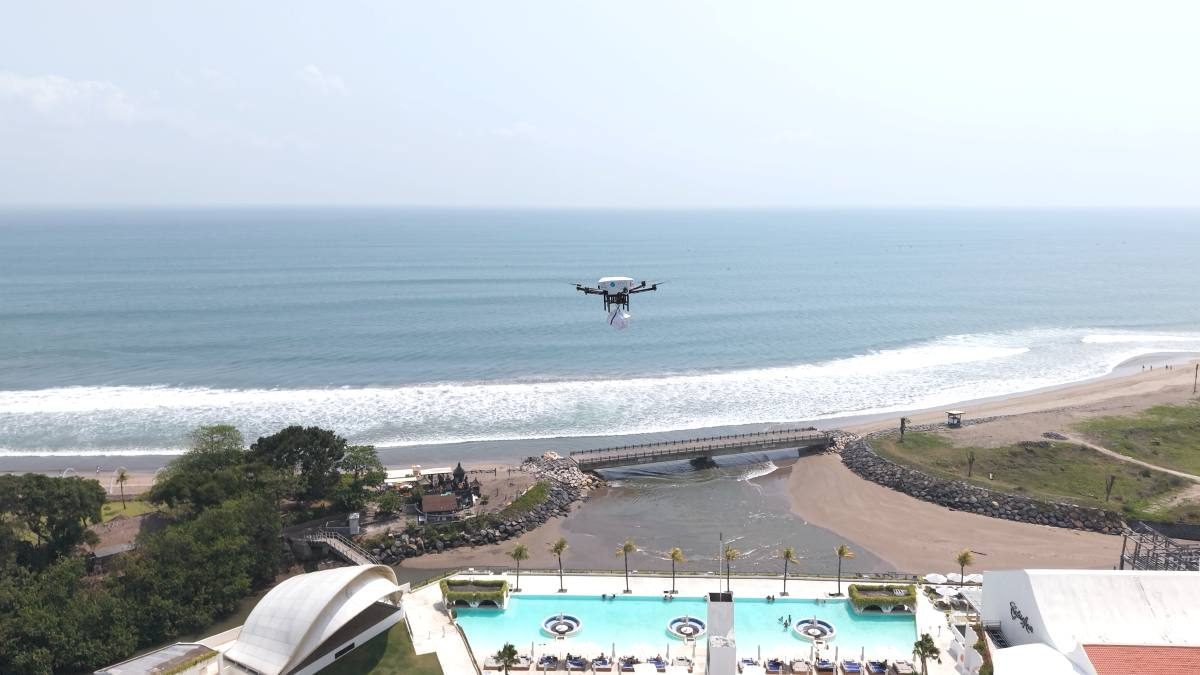
Bali is taking a small but notable step toward drone-powered delivery, with a new pilot project testing whether food orders can be transported by autonomous aircraft between two locations on the popular Indonesian island.
The trial connects Café del Mar Bali with Nuanu Creative City, a 44-hectare development focused on culture, wellness, innovation and community. Customers can place food orders through Grab, Southeast Asia’s major ride-hailing and delivery platform, while drone services provider SKYY Network operates the flights.
The project is particularly interesting because it is not simply a demonstration flight. The partners are testing what it would take to integrate drone delivery into an existing logistics network, including airspace management, infrastructure, customer experience, and regulatory requirements.
It is also reportedly the first beyond-visual-line-of-sight (BVLOS) food delivery operation in Indonesia. The flights are being conducted under a certificate issued by Indonesia’s Directorate General of Civil Aviation (DGCA), following a Specific Operations Risk Assessment (SORA) process.
California-based A2Z Drone Delivery is supplying the aircraft and automated docking infrastructure for the project. Its Longtail Dual delivery drone is being used for the flights, while its AirDocks handle automated landing, recovery, and charging between missions.
That combination could be important if Bali’s experiment eventually moves beyond a single delivery route. Unlike conventional drone demonstrations, where someone may need to manually prepare and relaunch the aircraft after every flight, automated docking stations are designed to reduce the amount of human intervention required. The goal is to make repeated drone missions more practical and eventually allow operators to manage larger autonomous fleets.
The Longtail Dual is also designed with BVLOS operations in mind. It uses two batteries, allowing the aircraft to maintain flight control if one power source fails. The company says the drone has a one-to-one flight-time-to-charge-time ratio when used with its AirDock system, helping reduce the downtime between missions.
Bali is an interesting place to test that concept. The island combines dense population centers, tourist destinations, varied terrain, changing weather, and challenging connectivity conditions. The pilot route also operates in controlled airspace associated with Bali’s Ngurah Rai International Airport, adding another layer of complexity to the operation.
And then there are the winds. Strong and unpredictable winds can be a significant challenge for delivery drones, particularly when flights take place over populated areas. Successfully operating under those conditions could provide useful data for future drone services elsewhere in Indonesia.
For Grab, however, the experiment isn’t about replacing its human delivery network. The company says the drones are intended to complement its driver-partners rather than take over their jobs. That points toward a hybrid delivery model in which drones handle certain routes or portions of a journey while people continue handling deliveries where they make more sense.
Food delivery is essentially the test case. If the infrastructure proves reliable, the same network could eventually support other types of drone operations. A2Z says the AirDock system could provide a foundation for services including emergency response, inspections, offshore logistics and ship-to-shore deliveries. That could make Bali’s experiment more significant than a handful of meals flying between two tourist destinations.
The broader question is whether drones can become a dependable piece of everyday infrastructure rather than an occasional novelty. A network of automated docks could allow operators to position aircraft around a region, launch them when needed, and keep them available with relatively little on-site support.
For now, though, Bali is starting with something much simpler: getting food from one place to another. If the flights can demonstrate that drone deliveries can operate safely, consistently, and within Indonesia’s regulatory framework, the island could provide an early look at what a larger autonomous delivery network might eventually look like.
More: Airwise and LiveU want to fix fragmented public safety drone workflows


FTC: We use income earning auto affiliate links. More.




Comments