
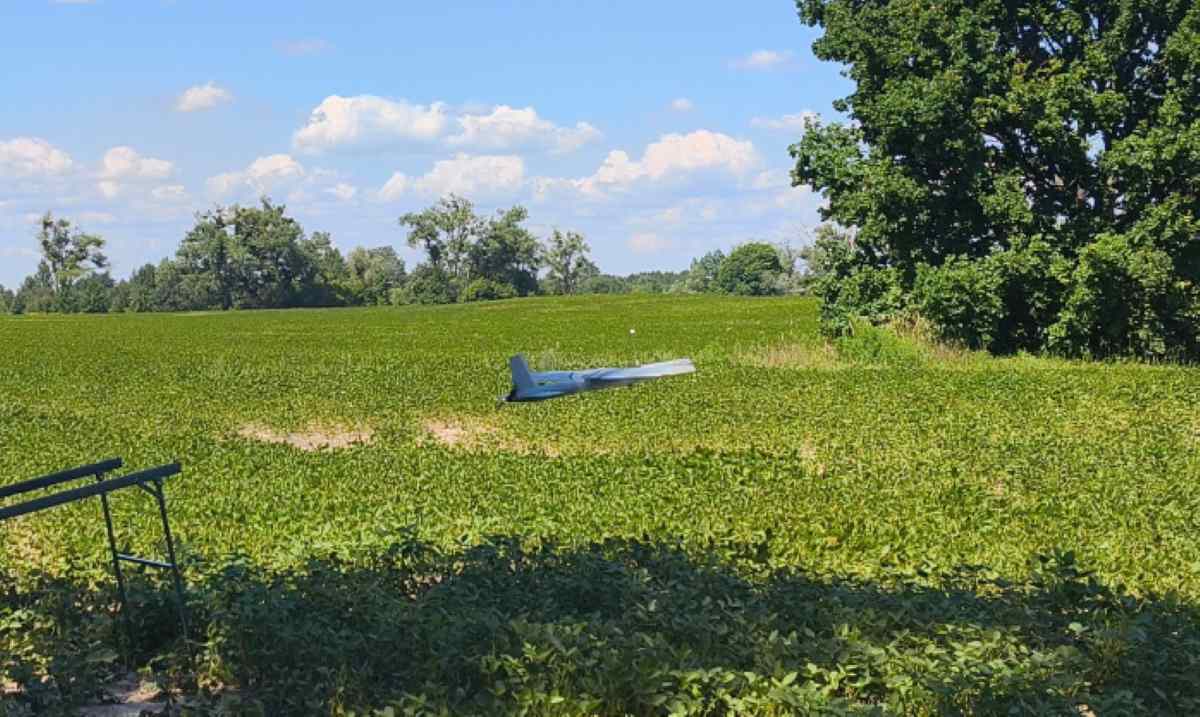
As low-cost attack drones continue reshaping modern warfare, Japanese drone company Terra Drone is now taking a major step deeper into the defense sector. The company has announced the operational deployment of its new fixed-wing interceptor drone, called Terra A2, in Ukraine — one of the world’s most intense real-world testing grounds for anti-drone technologies.
The deployment is happening in partnership with Ukrainian defense tech company WinnyLab, which helped co-develop the aircraft. According to Terra Drone, the goal isn’t simply to test another military drone. Instead, the company says it wants to prove that low-cost interceptor drones can become a sustainable alternative to expensive missile-based air defense systems increasingly strained by waves of cheap unmanned aerial attacks.
That’s especially relevant in Ukraine, where long-range one-way attack drones, including Iranian-designed Shahed-style UAVs used by Russia, have forced defenders to rethink how air defense works economically.
Why interceptor drones matter now
Traditional air defense systems were built for aircraft, helicopters, and high-value missiles. But modern conflicts are increasingly dominated by inexpensive drones that can overwhelm defenses through sheer numbers.
The problem is cost imbalance. In many cases, militaries are firing interceptors worth hundreds of thousands — or even millions — of dollars at drones costing a tiny fraction of that amount. Defense experts worldwide have increasingly warned that this model simply isn’t sustainable during prolonged conflicts.
That’s where interceptor drones like Terra A2 come in. Instead of relying entirely on conventional missiles, companies are now developing reusable or lower-cost drone interceptors capable of detecting, chasing, and neutralizing aerial threats. The market for these systems has exploded over the past two years, but Terra Drone says very few companies have actually managed sustained deployment in live combat environments.
And that distinction matters. In Ukraine, drone systems are often evaluated directly on the battlefield before larger procurement decisions are made. Companies must prove their drones can survive GPS jamming, electronic warfare attacks, disrupted communications, and rapidly changing frontline conditions — challenges that are difficult to fully recreate during controlled testing.
What Terra A2 brings to the battlefield
Unlike quadcopters or rocket-style interceptors focused on short-range engagements, Terra A2 is designed for wider-area aerial defense. The fixed-wing drone reportedly reaches speeds up to 312 km/h (around 194 mph), covers operational ranges of 75 km, and can stay airborne for more than 40 minutes. Terra Drone says the aircraft is also designed to integrate with radar systems for coordinated surveillance, tracking, and interception missions.
In practical terms, that means Terra A2 is intended to identify and engage threats before they get close to cities or critical infrastructure. The company describes the system as part of a future “layered defense” concept. Terra A2 would operate alongside Terra A1, the company’s previously deployed rocket-type interceptor drone that has already demonstrated successful interceptions in Ukraine.
The idea mirrors how traditional air defense networks operate with multiple layers — long-range systems for early interception and shorter-range systems for threats that break through.
Ukraine becomes the proving ground
For drone companies entering the defense market, Ukraine has effectively become the ultimate credibility test.
A drone can look impressive in promotional videos or controlled demonstrations, but surviving actual battlefield conditions is another story entirely. Systems that work well in ideal conditions may fail once electronic warfare systems start interfering with navigation, communications, and targeting. That’s why “combat-proven” status has become such an important label in the defense world.
Terra Drone openly acknowledges that one of the biggest benefits of deployment in Ukraine is the operational data it can gather. The company says frontline feedback will help refine the drone’s performance and improve future versions faster than traditional testing cycles allow.
And the company clearly has bigger ambitions beyond Ukraine. Terra Drone says the experience and operational insights gained from combat deployments could strengthen future discussions with defense authorities in Europe, the Middle East, Japan, and the broader Asia-Pacific region.
One of the more interesting parts of Terra Drone’s announcement came from a Ukrainian commander operating anti-air interceptor drones in the Kharkiv region. According to the commander, the unit evaluated multiple systems before choosing Terra A2. He said the drone stood out because it was relatively simple and intuitive to operate — an important factor in wartime conditions where rapid training and operational readiness matter enormously.
The commander also claimed the drone exceeded its published specifications during actual missions and described it as highly reliable in real operational environments. That kind of operator feedback can become extremely valuable for companies competing in the rapidly growing counter-UAS market, where reliability under battlefield pressure matters far more than polished marketing materials.
As defense-related drone development attracts increasing scrutiny worldwide, Terra Drone also used the announcement to emphasize its ethical and compliance policies. The company said its technologies are intended strictly for defensive purposes aimed at protecting civilian lives and critical infrastructure from unmanned aerial threats. It also stated that it does not develop weapons prohibited under international treaties and complies with Japanese laws and international regulatory frameworks.
That messaging reflects a broader balancing act now facing many drone companies globally. Firms that originally focused on industrial inspections, mapping, infrastructure, and commercial drone operations are increasingly finding themselves pulled into defense markets as governments race to counter emerging drone threats.
And with low-cost aerial warfare reshaping conflicts from Ukraine to the Middle East, interceptor drones like Terra A2 could soon become a far more common part of national defense strategies worldwide.
More: Autel fights FCC drone ban, denies China data access claims


FTC: We use income earning auto affiliate links. More.




Comments