
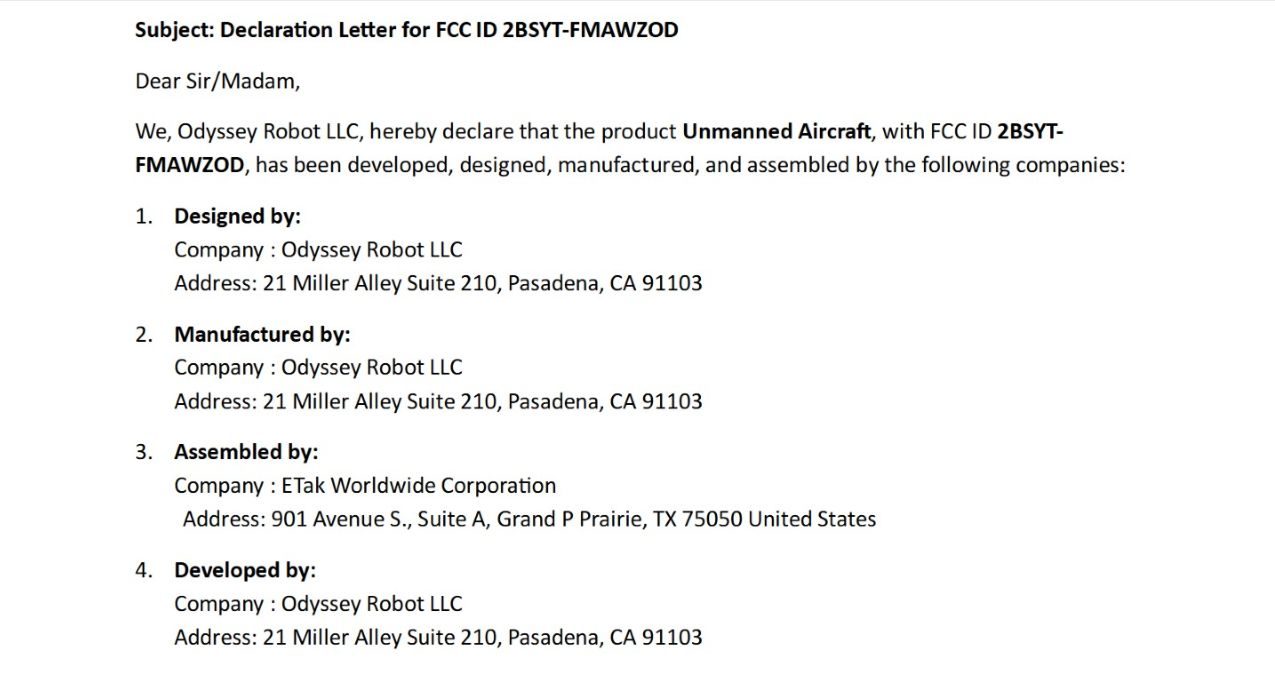
The Federal Communications Commission (FCC) has launched its first-ever effort to revoke a drone company’s equipment approvals after accusing it of falsely claiming its products were made in the United States to sidestep national security restrictions.
The company at the center of the case is Odyssey Robot, which independent security researcher Konrad Iturbe has alleged is a DJI-linked front company created to bypass the FCC’s ban on new authorizations for certain foreign-made drones. While the FCC does not identify Odyssey as a DJI front company in its order, it says Iturbe’s research prompted a formal investigation that uncovered evidence the company may have made false statements during the equipment authorization process.
If the allegations are upheld, the case would mark the FCC’s first revocation of drone equipment authorizations under its expanded national security rules.
The FCC says its Enforcement Bureau opened an investigation in June after reviewing research published by Iturbe on June 5. His investigation questioned Odyssey’s claims that it was an American drone manufacturer and suggested the company was attempting to circumvent restrictions placed on foreign-made drones.
According to the FCC, investigators subsequently requested documents from Odyssey, including records about its ownership, manufacturing, and supply chain. They also asked for vouchers to purchase the company’s products for examination.
The agency says Odyssey never responded to either its initial Letter of Inquiry or a follow-up deficiency notice.
False manufacturing claims?
At the heart of the FCC’s case are claims Odyssey made while applying for approval of a drone and its remote controller earlier this year.
As part of the certification process, Odyssey declared that its products were not “covered” equipment under the FCC’s national security rules. The company also stated that the drone was designed, developed, and manufactured by Odyssey in California and assembled by eTak Worldwide Corporation in Texas.
But when FCC investigators contacted eTak directly, the company painted a very different picture.
According to the FCC’s Order to Show Cause, eTak said it had no business relationship, contractual relationship, ownership connection, or affiliation with Odyssey. It also said it had never assembled products for the company and had no records showing Odyssey had ever been a customer.
The FCC also noted that eTak is an electronics recycling company and not a drone manufacturer, raising additional questions about Odyssey’s earlier certification.
Investigators further observed that the compliance testing submitted with Odyssey’s applications had been performed by TÜV Rheinland (Shenzhen) in China. While overseas testing alone does not prove where a product was manufactured, the FCC says it became another factor supporting its investigation into Odyssey’s claims.
Taken together, the agency says the evidence provides reason to believe Odyssey’s certifications may have contained false statements.
Why the case matters and what’s next
The action comes just months after the FCC expanded its Covered List to include drones and drone components produced in foreign countries identified by the Executive Branch as posing unacceptable national security risks.
Because equipment on the Covered List cannot receive new FCC authorizations, manufacturers cannot legally market or sell newly introduced covered products in the United States. According to the FCC, the move has coincided with more than $4 billion in investment in US drone manufacturing, tens of billions of dollars in capital raised by domestic drone companies, and thousands of new manufacturing jobs.
FCC Chairman Brendan Carr said the Odyssey case “sends a message that the FCC will not allow companies that produce abroad to evade the FCC’s prohibition.”
Now, the FCC has given Odyssey 10 calendar days to explain why its equipment authorizations should not be revoked. If the company cannot demonstrate that its certifications were accurate, or fails to respond, the agency says it may revoke the approvals for both the drone and its remote controller.
While the FCC’s order stops short of concluding that Odyssey is a DJI front company, its decision to cite Iturbe’s investigation as the catalyst for the case underscores the growing role independent researchers are playing in uncovering potential attempts to circumvent US drone regulations.
Should the FCC ultimately revoke Odyssey’s approvals, the decision would establish a significant enforcement precedent, signaling that the agency is willing not only to block future applications but also to revisit approvals it believes were obtained through false or misleading certifications.
More: This DJI Mini 5 Pro drone deal saves up to $110 today


FTC: We use income earning auto affiliate links. More.


Comments