
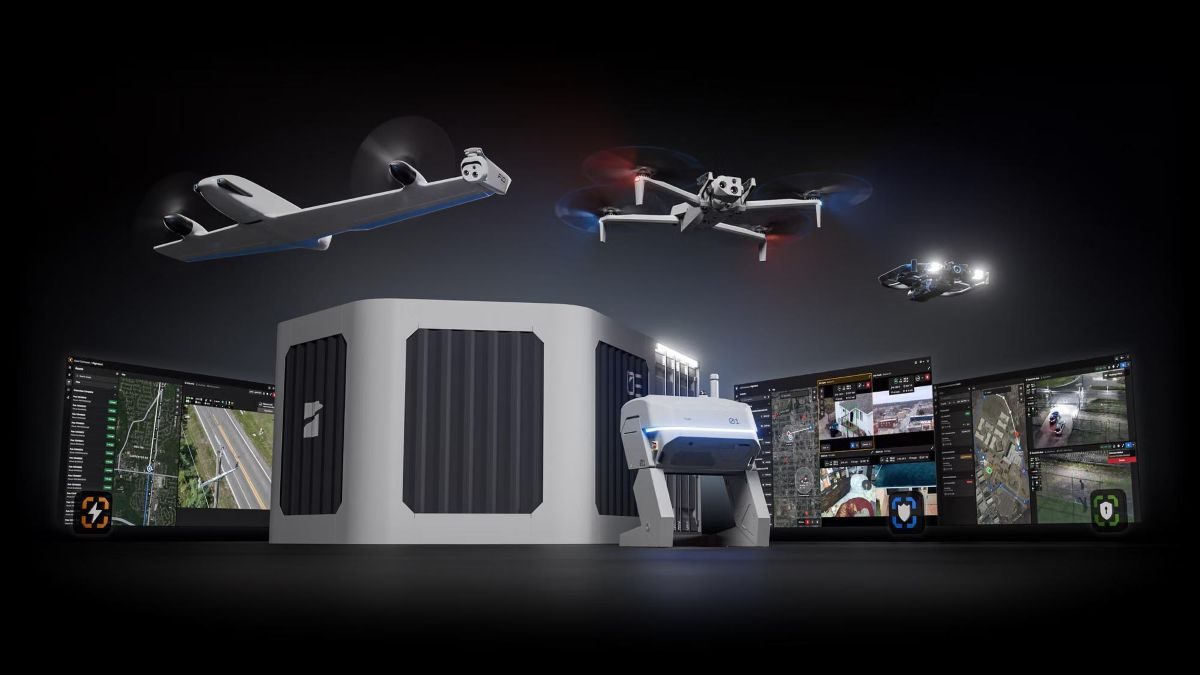
Skydio is making a pretty dramatic statement about where it thinks the drone industry is headed: not toward another pocket-sized camera drone, but toward fleets of autonomous flying machines that can respond to emergencies, inspect infrastructure, and patrol large properties with very little human intervention.
At its annual Ascend conference in Nevada, the US drone maker unveiled its first fixed-wing aircraft, the F10 Lightrunner, along with the MegaDock, two new software platforms called Asset Command and Security Command, and a collection of hardware and software upgrades for its existing fleet.
And while there are plenty of new products here, the bigger story is the direction Skydio is taking: it is increasingly treating the drone itself as just one piece of a much larger autonomous system.
F10 Lightrunner: Skydio’s first fixed-wing drone
The most eye-catching announcement is undoubtedly the F10 Lightrunner. Unlike Skydio’s familiar X10 quadcopter or its indoor R10, the F10 is a fixed-wing aircraft designed to cover much larger distances at much higher speeds. Skydio says it can reach 100 mph, operate out to a 30-mile radius, and remain on a mission for up to two hours, including its charging cycle.
That changes the kinds of jobs a docked drone could realistically handle.
A quadcopter is excellent when you need to hover over a scene, maneuver around a building, or inspect something up close. But send that same aircraft dozens of miles down a rural road or along a long transmission corridor, and endurance quickly becomes the limiting factor. That’s the gap Skydio is trying to fill.
Imagine a sheriff’s department in a rural county receiving a report of a vehicle pursuit. Instead of waiting for a patrol car to drive across the county, an F10 sitting in a dock could launch, cover the distance at high speed, and provide an aerial view while officers are still responding.
Or consider a utility company trying to inspect dozens of miles of transmission infrastructure after a storm. Rather than sending a crew from pole to pole hoping to find the problem, a long-range autonomous aircraft could potentially fly the corridor and send back live imagery.
Skydio has been making this argument essentially for months. The company says fixed-wing aircraft make sense when DFR — Drone as First Responder — missions require speed, endurance, and geographic reach rather than the close-in maneuverability of a quadcopter.
The numbers are significant. Skydio says the F10’s 30-mile radius puts about 2,800 square miles within reach of one launch location. That’s less “drone replacing a patrol car” and more “drone becoming part of the infrastructure of an entire community.”
And there’s no runway
Here’s where things get particularly interesting. Fixed-wing drones traditionally come with an annoying logistical problem: they need somewhere to launch and land.
Skydio’s answer is MegaDock.
The company has designed a robotic takeoff and landing system that uses a suction-based robotic gripper to grab the F10 and launch or catch it automatically. There is no runway and, importantly, no person standing next to the aircraft waiting to catch it.
MegaDock can house up to five F10 aircraft, allowing multiple missions to be handled from the same location. That is an important distinction because Skydio isn’t really selling the F10 as a traditional aircraft that happens to be autonomous. The company is pitching the whole package — aircraft, dock, connectivity, autonomy and software — as a single robotic system.
The F10’s camera setup is also unusual. Its SideEye design places the camera outside the rotor plane, keeping the wing from obstructing the view. The idea is simple: if you’re following a vehicle or watching an incident, the thing you’re looking at shouldn’t periodically disappear behind your own aircraft.
Skydio’s autonomy software handles much of the rest. Pathfinder plans the route, taking things such as terrain, structures, geofences, and airspace restrictions into account. Foresight then adjusts the aircraft’s flight path while it’s airborne. Skydio’s Airspace Assurance System is intended to combine airspace information, organizational rules, and onboard perception to keep missions compliant and avoid nearby crewed aircraft.
The company says the F10 isn’t based on an entirely new autonomy architecture. Instead, it is extending the same core autonomy technology already used across its existing flying robots. That matters because Skydio is trying to build something closer to an autonomous fleet ecosystem than a collection of unrelated drones.
The software may be just as important as the aircraft
This is arguably the other big story from Ascend. Skydio is introducing Asset Command and Security Command, and both are designed around a fairly straightforward idea: organizations shouldn’t have to completely reorganize their operations around drones.
Asset Command is aimed at utilities and other organizations responsible for huge numbers of physical assets. Instead of telling an operator, “Here’s a drone, go inspect that power line,” the system is designed to start with the organization’s existing asset database. Skydio says Asset Command can import information from GIS, CMMS, and other systems and use that information to plan inspections around individual assets.
That could be a major shift for utilities. A drone inspection becomes less of a standalone drone mission and more of an ordinary maintenance workflow; just one that happens to involve an autonomous aircraft.
Skydio says companies including AEP, Chevron, Dominion Energy and Southern Company have been early partners in developing the platform.
Then there’s Security Command. This one is aimed at turning docked drones into an always-available layer of physical security. Instead of security personnel physically responding every time an alarm goes off, Security Command can dispatch a drone to the location and provide live aerial video. A human can then see what’s actually happening before sending people into potentially dangerous situations.
It can also support scheduled patrols, including overnight operations or times when a facility is short-staffed. And, importantly, the software is designed to allow one operator to oversee multiple drones and sites.
That’s the recurring theme across Skydio’s announcements: fewer pilots, more aircraft, and more automation.
Skydio is building a very different company from the one consumers knew
For anyone who remembers Skydio from its consumer days, this transformation is pretty remarkable. Skydio originally became known for drones such as the Skydio 2, which were aimed at consumers who wanted autonomous “follow me” video without having to manually pilot a drone.
But in August 2023, Skydio officially sunset its consumer drone business. It stopped selling the Skydio 2+ Starter, Sports, Cinema and Pro kits and shifted its focus entirely toward enterprise and public-sector customers. Existing consumer owners continued to receive software support, repairs, and other assistance.
CEO Adam Bry said at the time that the company’s enterprise and public-sector business had become compelling enough to require its full attention. That pivot has defined pretty much everything Skydio has done since.
The company launched the X10 for public safety, infrastructure and defense, developed dock-based Drone as First Responder systems and expanded into indoor autonomous flight with the R10. Skydio now says its customer fleet performs around 2 million missions per year, more than half from docks, while its Pathfinder autonomous flight capability has logged more than 600,000 miles.
The F10 is essentially the next logical step: take that autonomous system and give it wings.
There’s also a little unavoidable industry politics surrounding Skydio. The company has become one of the most prominent American voices arguing for tighter restrictions on Chinese-made drones, particularly DJI. Skydio has spent heavily on federal lobbying over the past several years, with lobbying records showing activity around transportation, aerospace, defense, and homeland-security issues.
Regardless of how one interprets Skydio’s role in getting DJI drones off US shelves, the competitive landscape has changed substantially. In December 2025, the Federal Communications Commission added restrictions affecting new foreign-made drones and components, with DJI among the companies affected, although existing DJI products remained available — for now. DJI has challenged the restrictions in court.
So Skydio’s decision to abandon the consumer market is particularly interesting in retrospect. It no longer needs to fight DJI on the shelf for the person looking for a $1,000 camera drone. Instead, it is competing in a market where American manufacturing, autonomy, cybersecurity, government procurement, and regulatory compliance can be just as important as image quality. And F10 is very much designed for that market.
Related: Skydio’s $3.5 billion US drone expansion begins
There’s more hardware coming, too
The F10 may be getting most of the attention, but Skydio also announced Controller 2, with a 7-inch sunlight-readable display, a claimed 5.5-hour battery life, and IP55 protection. Augmented-reality street overlays are also planned.
The company is also redesigning its Cockpit interface for remote and multi-drone operations.
Then there are upgrades for existing X10 fleets. A new VT300-Z Rev 2 telephoto camera is already shipping with new X10 and X10D units, while ThermalBoost and Low-Light Enhance are coming as software features. ThermalBoost is designed to combine thermal and color imagery for better visibility in difficult lighting, while Low-Light Enhance uses multiple frames to improve dark, noisy video.
Skydio is also launching a new mobile app for more secure live-video sharing and rebuilding its Transparency Dashboard, which lets public-safety agencies publish information about their drone programs and flights.
That last piece is worth watching as DFR programs expand. The more drones are being used to respond to 911 calls, patrol communities and gather evidence, the more important questions about transparency and public access become. Skydio says its redesigned dashboard will give agencies more control over which flight information, policies, and operational details they publish.
Put all of this together, and the F10 starts to make more sense. Skydio isn’t simply adding a fixed-wing drone to its product catalog. It is building a hierarchy of autonomous aircraft for different jobs.
The X10 handles close-in outdoor work. The R10 takes autonomy indoors. The F10 is intended for long-distance, high-speed missions. MegaDock keeps them ready to deploy, while Command software increasingly determines what each aircraft should actually do. That is a much more ambitious proposition than selling someone a drone and a controller.
The real pitch is that eventually, an organization could tell its drone system what needs to happen, rather than telling a pilot how to fly the drone. For a consumer who simply wants to capture a mountain-bike ride, that’s probably not particularly relevant. But for a sheriff’s department trying to get eyes on a rural emergency, a utility inspecting hundreds of miles of infrastructure, or a large facility trying to automate security patrols, that’s a very different proposition.
Skydio says F10 will begin deploying to customers in 2027.
More: Lowe’s is now delivering tools by drone in as little as 20 minutes


FTC: We use income earning auto affiliate links. More.


Comments