
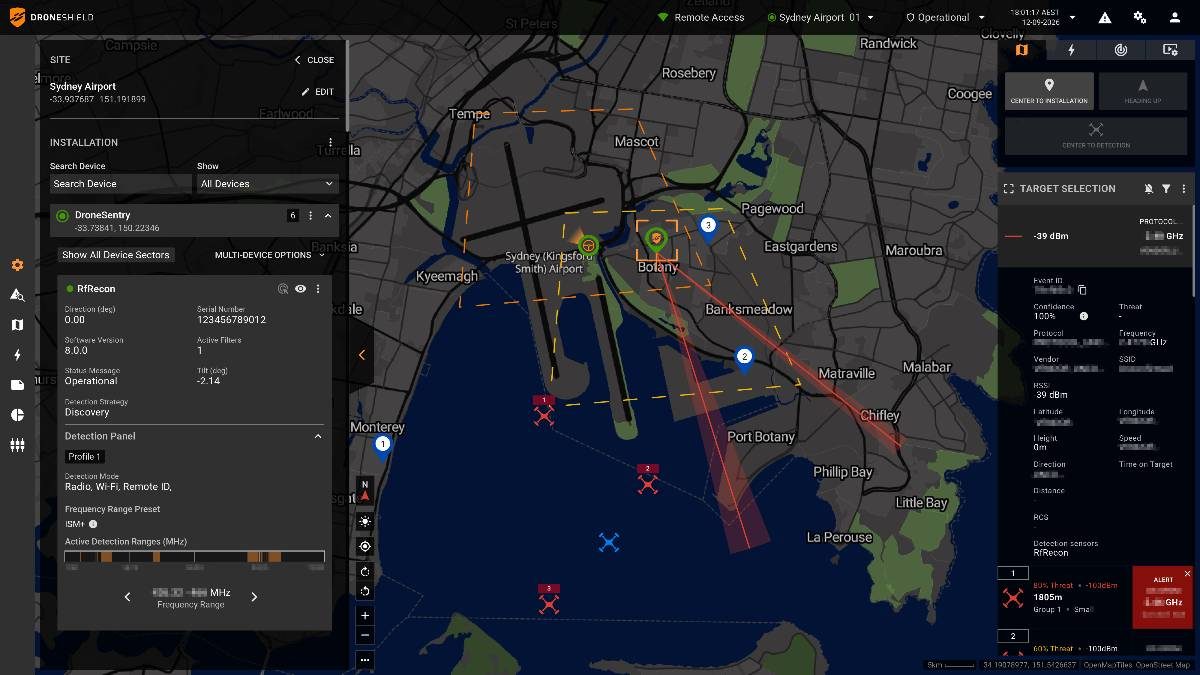
DroneShield has released a new software update designed to help counter-drone operators identify emerging threats earlier, reduce false alarms, and coordinate responses more precisely, without replacing equipment already in the field.
The Australian counter-drone technology company has announced its Q4 2026 software release, introducing enhancements across detection, identification, tracking, and drone defeat. The update is available through its Mission Ready Services subscription, which provides ongoing software improvements to more than 4,200 software-enabled devices deployed in the field.
One of the key changes helps operators spot unfamiliar drone signals before they appear in DroneShield’s existing threat library. Its RfRecon system can now forward signals that resemble drone activity directly to the DroneSentry-C2 dashboard, allowing teams to investigate potential new threats sooner and filter records by frequency range.
The update also improves camera-based detection and classification. DroneShield reports a 44% improvement in thermal camera classification accuracy, along with an 18% increase in precision and an 8% improvement in recall when identifying fixed-wing drones. Target detection in standard video has also been improved.
Another enhancement connects radio frequency (RF) sensing with optical cameras for passive drone detection and tracking. Operators can visually verify detected targets without using radar or transmitting emissions that could reveal their position. With compatible Bosch Starlight cameras, teams can direct cameras toward the source of an RF detection before locking onto and tracking the drone.
The software also introduces coordinated response capabilities across connected DroneSentry-X Mk2 systems. When one unit detects a threat, it can share that detection with other connected units, enabling them to coordinate disruption efforts. The system focuses jamming on frequencies the targeted drone can use, aiming to reduce interference with nearby systems.
Additional changes simplify the user interface and connectivity configuration while adding compatibility with Sentrycs firmware 6.7.1 for layered counter-drone deployments.
“Drone threats change constantly, and counter-drone capability has to keep pace long after it is deployed,” says Angus Bean, DroneShield’s CEO.
The release also reinforces DroneSentry-C2’s role as the central platform connecting sensors, intelligence, and response systems. For operators, the update highlights an increasingly important aspect of counter-drone technology: improving deployed systems through software, rather than relying solely on new hardware purchases.
More: Raytheon wins $729 million to arm three countries against drones


FTC: We use income earning auto affiliate links. More.




Comments