
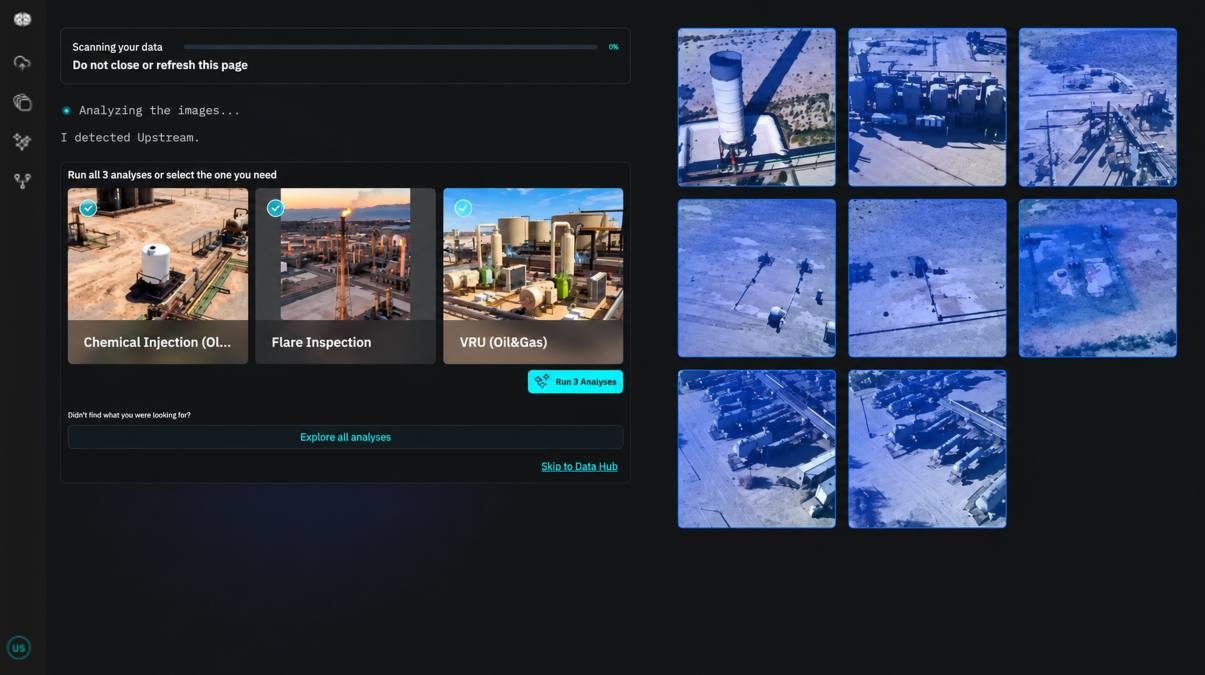
Industrial drone inspections have a data problem. Drones can capture detailed images of miles of power lines, sprawling oil and gas facilities, and hard-to-reach industrial equipment. But someone still has to sift through all that footage, identify potential problems, and decide which ones need attention first.
Percepto wants to change that equation with Axion, a new software platform that brings AI-powered inspection analysis to existing drone fleets, sensors, and inspection records. The big difference? Companies don’t have to buy Percepto hardware to use it.
That hardware-agnostic approach marks a significant shift for the Austin, Texas-based company, which has built its business around autonomous drone inspections and robotic systems. With Axion, Percepto is betting that the next big opportunity in industrial drone operations lies not just in collecting more data, but in making that data useful.
Turning drone footage into maintenance decisions
Axion is launching with more than 160 specialized AI models trained on over 100,000 hours of real-world autonomous inspection data collected across more than a decade. Rather than treating every image as an isolated observation, the platform analyzes findings alongside asset information, historical inspection records, and expected equipment behavior.
That context matters. A thermal anomaly, for instance, doesn’t automatically mean a piece of equipment is failing. Its significance depends on factors such as operating conditions, the surrounding environment, and how the asset has behaved previously. Similarly, identifying a downed wire is one thing; understanding its relationship to nearby infrastructure can help maintenance teams assess the situation more effectively.
Axion aims to connect those dots, surfacing issues that deserve attention instead of leaving inspection teams to manually review enormous volumes of imagery and sensor readings.
Operators can also ask questions about assets and inspection findings in plain language, using the platform’s AI capabilities to investigate potential problems and prioritize maintenance. Think of it as moving from a folder full of inspection reports to a system that helps explain what those reports mean and what deserves action first.
For utilities and industrial operators dealing with aging infrastructure, workforce shortages, and the cost of unexpected outages, that could be particularly valuable. The goal is to cover more assets while reducing the time employees spend reviewing data.
No need to replace your existing drone fleet
Perhaps Axion’s most consequential feature is its flexibility. The software can ingest inspection data from supported third-party drones, fixed and mobile sensors, and existing inspection archives. Companies can therefore begin with data they already have rather than overhaul their operations to accommodate a new hardware ecosystem.
That lowers a potentially significant barrier to adoption. Industrial operators may already have invested heavily in drones, sensors, and inspection programs, but those investments don’t always translate into a unified view of infrastructure health.
Percepto is positioning Axion as the intelligence layer that connects those existing systems. Customers can subsequently add the company’s Ranger drone portfolio, Harbor autonomous stations, and managed remote operations if they need more frequent or automated data collection.
In other words, buying more drones is an option, not a prerequisite.
A new chapter for Percepto
The launch also comes with a leadership expansion designed to support Percepto’s software-first strategy. CEO Julien Bellanger is joined by Chief Revenue Officer Kurt Nantkes and Chief Marketing Officer Amir Khoshniyati, bringing experience across robotics, sensors, IoT, Physical AI, and cybersecurity.
Percepto has also secured a new multi-year contract with a leading US energy company to support transmission-line inspections. The agreement covers aerial data collection and AI-powered analytics, helping the utility identify issues earlier and prioritize maintenance across its grid.
Meanwhile, the company is consolidating engineering, manufacturing, and assembly in the United States, alongside its existing US remote operations. Its operations are also backed by a nationwide FAA waiver for beyond visual line of sight (BVLOS) flights.
Axion is available now as a software-as-a-service offering.
The bigger question is whether platforms like this can make AI-assisted inspections a routine part of infrastructure management, rather than an expensive capability reserved for specialized drone programs. Percepto’s approach suggests that unlocking value from existing inspection data could be just as important as expanding autonomous flight operations.
For industrial operators, the promise isn’t simply more images or faster inspections. It’s finding the problems that matter before they turn into outages, costly repairs, or safety incidents.
More: Drone delivery noise is becoming a problem. Zipline has a new answer


FTC: We use income earning auto affiliate links. More.


Comments