
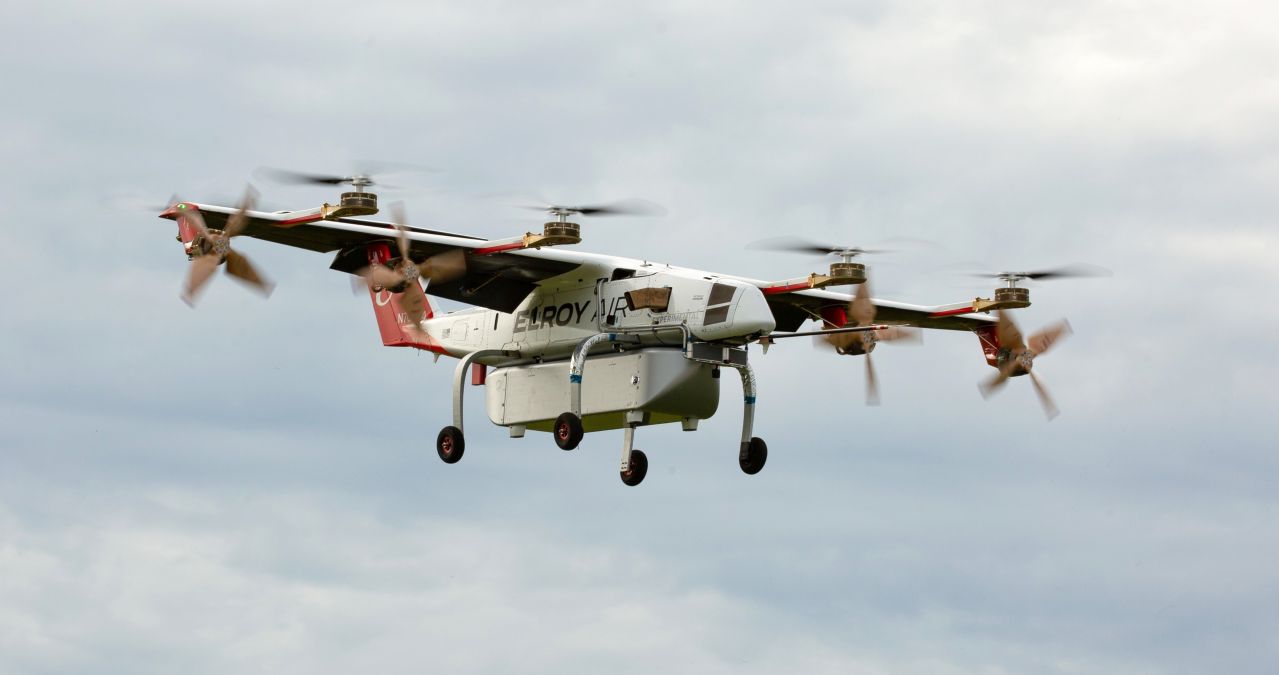
A California startup developing large autonomous cargo drones has landed a key role in a new federal program aimed at accelerating the integration of electric vertical takeoff and landing (eVTOL) aircraft in the United States.
Elroy Air has been selected for the US Department of Transportation’s eVTOL Integration Pilot Program (eIPP) — a government initiative designed to help regulators and industry partners test and scale next-generation aviation technologies. The program was launched under the Unleashing American Drone Dominance Executive Order, which calls for faster development and deployment of advanced air mobility systems across the country.
While most companies participating in the program are focused on air taxis or modified passenger aircraft, Elroy Air stands out for a different reason: its aircraft is built entirely for cargo.
The company’s Chaparral autonomous cargo VTOL drone is designed specifically for “middle-mile” logistics — the movement of goods between distribution hubs, ports, and remote facilities. That focus helped it become the only manufacturer in the program offering a purpose-built heavy-payload cargo drone rather than a passenger aircraft.
Instead of tackling the regulatory complexity of flying people, Elroy Air is betting that autonomous cargo flights will provide a faster path to scaling advanced air mobility.
New: This $209 DJI drone deal feels like a pricing mistake
The Chaparral aircraft is capable of carrying up to 300 pounds of cargo over distances of roughly 300 miles, thanks to a hybrid-electric propulsion system that allows long-range operations without relying on charging infrastructure. The aircraft uses detachable pods to load and unload cargo quickly, allowing ground crews to swap payloads while the aircraft continues flying missions.
That design could make it particularly useful for industries where speed and reliability are critical, such as offshore energy operations, disaster response, and industrial logistics.
Under the federal pilot program, the aircraft will be tested in real-world operations across the US Gulf Coast.
Elroy Air was selected as part of a proposal led by the state of Louisiana, alongside aviation services provider Bristow Group, a long-time partner and early customer of the startup. The companies plan to deploy the Chaparral for cargo deliveries to offshore and industrial locations across Louisiana, Texas, and Mississippi, regions where aviation already plays a critical role in supporting energy infrastructure.
According to the Department of Transportation’s announcement, operations are expected to begin in 2026, giving regulators and operators a chance to test how large autonomous cargo drones integrate into the national airspace.
For the aviation industry, that kind of real-world testing is crucial. Advanced air mobility concepts still face major regulatory and operational hurdles before they can scale nationwide. Programs like eIPP aim to bridge that gap by allowing companies to work closely with federal regulators.
Participation gives Elroy Air a direct collaboration channel with the Federal Aviation Administration as both sides explore how heavy-payload autonomous aircraft can safely operate in the National Airspace System. The company says the Chaparral platform has already generated strong demand, with a backlog exceeding 1,000 aircraft across commercial and defense customers.
To prepare for that demand, Elroy Air has been building out manufacturing partnerships both in the United States and internationally. In January, Elroy Air signed an agreement with Abu Dhabi-based Barq Group to form a joint venture that would invest $200 million in a manufacturing facility in Abu Dhabi. The plant is expected to produce Chaparral aircraft for commercial and humanitarian customers across the Middle East and North Africa.
More: This pocket device lets police identify drones in seconds


FTC: We use income earning auto affiliate links. More.




Comments