
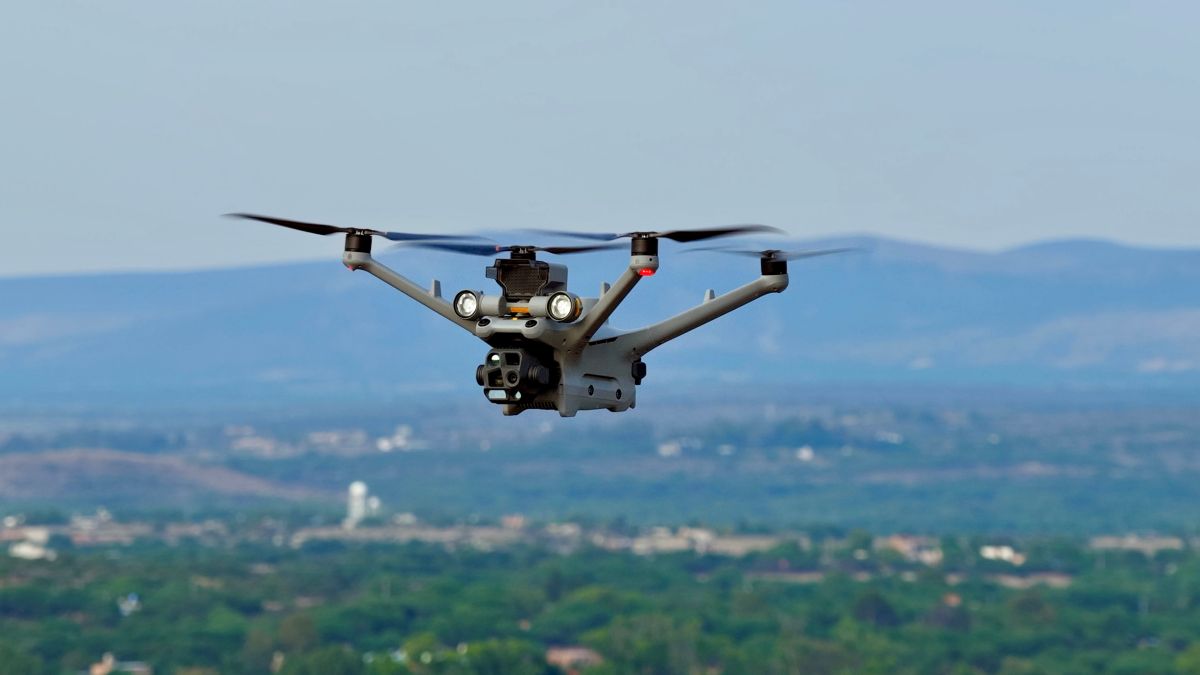
DJI has announced an important certification update for its Matrice 4D drone series in Europe. The company’s enterprise drones are now covered by C6 certification even when operated directly with the DJI RC Plus 2 Enterprise controller, rather than exclusively through the DJI Dock 3.
This development significantly increases flexibility for organizations that want to conduct advanced drone operations without investing in a permanent docking station.
When DJI first announced C6 certification for the Matrice 4D Series, the approval applied only when the aircraft was used alongside DJI Dock 3, the company’s automated drone-in-a-box system. That made perfect sense for organizations running automated inspections or remote monitoring missions, but many enterprise users still rely on manually deploying drones from vehicles or temporary worksites.
Now, DJI says the same C6 certification also applies when the Matrice 4D or thermal-equipped Matrice 4TD is flown using the DJI RC Plus 2 Enterprise controller, provided the aircraft is updated to firmware version 17.1.5 or later, and operators follow the required documentation. The aircraft itself hasn’t changed; only the certified operating configuration has expanded.
For many European operators, that’s a much bigger deal than it first appears. The Matrice 4D Series is designed for demanding professional work such as infrastructure inspections, emergency response, utility maintenance, mapping, and public safety. The standard Matrice 4D focuses on high-resolution visual inspections, while the Matrice 4TD adds a thermal camera for firefighting, search and rescue, security, and night operations. Both models also feature multiple cameras, AI-powered object detection, improved low-light performance, and obstacle sensing, making them suitable for complex industrial environments.
The key advantage comes from Europe’s C6 classification. Under EU drone regulations, C6 is one of the class markings defined by Delegated Regulation (EU) 2019/945. It allows compatible aircraft to be used under the Specific Category’s STS-02 standard scenario, provided operators also meet all operational and training requirements.
Unlike lower-risk operations, STS-02 permits certain Beyond Visual Line of Sight (BVLOS) flights using pre-programmed flight paths in sparsely populated areas. That’s particularly valuable for jobs where the drone needs to travel long distances.
Think about inspecting kilometers of power lines, pipelines, railways, or highways. Instead of repeatedly moving pilots along the route to maintain visual contact, operators can program the flight in advance and conduct compliant BVLOS missions within the STS-02 framework.
Search and rescue teams could also benefit when covering large forests, rural terrain, or other areas where maintaining a continuous visual line of sight would otherwise be difficult.
Of course, C6 compliance doesn’t automatically mean anyone can begin flying BVLOS tomorrow. The drone itself must satisfy a long list of technical requirements, including a maximum takeoff weight below 25 kilograms, geocaging capabilities, flight volume enforcement, command-and-control link monitoring, and an independent Flight Termination System that automatically activates if the aircraft leaves its approved operational area. These features are already built into the Matrice 4D series hardware.
What has changed is that regulators now recognize those capabilities, whether the drone launches from Dock 3 or directly from the RC Plus 2 Enterprise controller.
Operators, however, still need to do their part. To legally fly under STS-02, organizations must obtain the appropriate operational authorization or submit the required declaration through their national aviation authority, complete both theoretical and practical training, maintain operations and maintenance documentation, prepare emergency response procedures, and meet any observer requirements for longer-range missions. The aircraft meeting C6 standards satisfies only the hardware portion of the regulatory framework.
The distinction between STS-01 and STS-02 also helps explain why this update matters.
STS-01 generally covers Visual Line of Sight (VLOS) operations using C5-class drones in controlled ground environments. STS-02, meanwhile, is specifically designed for C6 aircraft and supports pre-planned BVLOS operations in sparsely populated locations. Pilots must still maintain visual line of sight during takeoff and landing, but the aircraft can continue beyond visual range during the mission as long as it follows its programmed route and all operational requirements are met.
For companies already considering the Matrice 4D platform, the latest change removes one of the biggest practical limitations. Instead of needing a fixed Dock 3 installation to take advantage of C6-certified operations, organizations can now deploy the same aircraft from virtually anywhere using a handheld controller, making it easier to conduct mobile inspections, emergency deployments, and temporary field operations while remaining within the applicable European regulatory framework.
For enterprise drone operators across Europe, that added flexibility could prove just as valuable as any new hardware feature.
More: DJI introduces next-generation Agras agricultural drones globally


FTC: We use income earning auto affiliate links. More.



Comments