
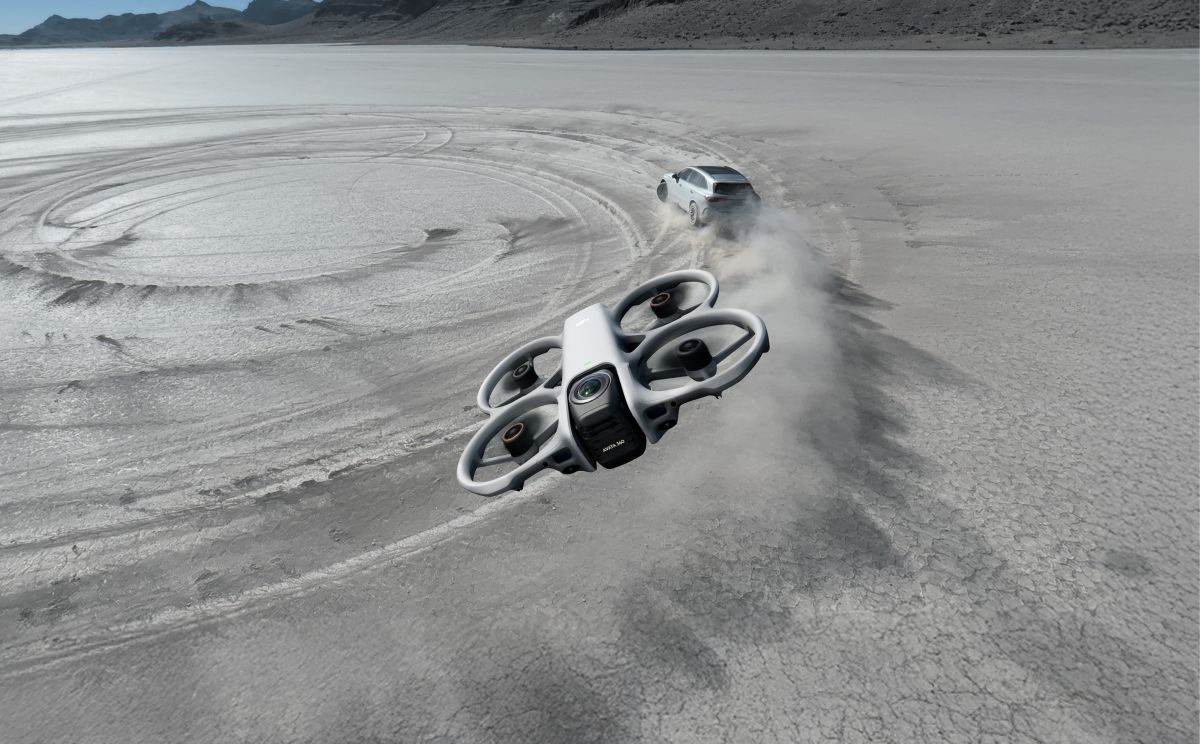
DJI has kicked off the global rollout of the Avata 360, positioning it as its most immersive consumer drone yet. In many parts of the world, that means orders are either already live or pre-sales have begun. In the US, though, things are playing out a little differently, again.
A recently updated banner on DJI’s official Amazon storefront points to March 30 at 8 a.m. ET as the actual go-live timing for American buyers. It’s a subtle shift, but one that reinforces a now-familiar pattern: global launch first, US availability later, and that too through third-party suppliers. But zoom out for a second, and the bigger story isn’t the delay — it’s what this drone actually represents.
Until very recently, the idea of a true 360-degree drone was more concept than category. That changed with the arrival of the Antigravity A1, the world’s first 8K 360 drone backed by Insta360. Now, with the Avata 360, DJI isn’t just entering that space; it’s accelerating it.
Related: DJI vs Insta360 drone patent war just got a lot more intense
What’s fascinating is how different the approaches feel. The A1 proved that you could put a 360-degree camera in the sky and capture everything around you. The Avata 360 takes that idea and layers on DJI’s strengths: flight control, imaging science, transmission tech, and software. The result is something that feels less like an experiment and more like a fully realized creative tool.
This isn’t just a drone, it’s a flying 360-degree camera
At the heart of the Avata 360 is a simple but powerful idea: you no longer have to worry about framing your shot while flying. The drone’s dual-lens system, backed by 1-inch-equivalent sensors, captures full 360-degree video in 8K at 60 frames per second, along with massive 120-megapixel stills. Thanks to large pixels and strong dynamic range, it’s not just about resolution—it’s about usable detail, whether you’re shooting into bright skies or darker environments.
But the real magic happens after you land. Instead of committing to a camera angle mid-flight, you can go back into the footage and “choose” your shot later. You can pan, tilt, rotate, or even flip perspectives entirely — pulling multiple usable clips from a single flight. A forward push becomes a cinematic reveal. A missed subject becomes a perfectly tracked shot. A simple orbit becomes something that looks like it required expert piloting.
It fundamentally changes how you think about capturing video. You’re no longer flying to get a shot; you’re flying to capture every possible shot.
Smart tracking, editing, and ‘virtual gimbal’ magic
Where DJI really pushes ahead is in how it refuses to treat this as just a floating camera. The Avata 360 still behaves like a proper FPV drone. You fly it with goggles and motion controllers for that immersive, almost VR-like experience, where every tilt of your head and movement of your hand translates into motion in the air. For newcomers, that alone can feel transformative — less like piloting a device and more like being inside it.
At the same time, experienced pilots aren’t boxed in. Traditional controllers are fully supported, and the drone can switch into a more classic single-lens shooting mode for standard 4K capture. That flexibility matters because it means the Avata 360 isn’t replacing your FPV workflow; it’s expanding it.
And importantly, DJI has worked to make that experience less intimidating. With omnidirectional obstacle sensing, including low-light capability, and built-in propeller guards, the drone is designed to reduce the fear factor that usually comes with FPV flying. It invites experimentation instead of punishing it.
DJI has also packed in a few practical upgrades:
- 42GB internal storage (no SD card needed for ~30 mins of 8K footage)
- Wi-Fi 6 transfers (1GB in ~10 seconds)
- Replaceable front lens, so you don’t need full repairs after damage
These are the kinds of features that make a big difference for everyday creators, especially those shooting frequently or on the go.
New: Watch this flying cop chase and capture rogue drones [Video]
But if the hardware is what gets people talking, the software is what might keep them hooked. Through DJI’s apps, the Avata 360 leans heavily into automation and intelligent editing. The drone can lock onto subjects and track them through complex environments, even when they move unpredictably. It can simulate cinematic camera moves that would normally require careful planning and multiple takes. And with features like GyroFrame and the so-called virtual gimbal, it allows you to reshape your footage in ways that simply weren’t possible before.
You can rotate horizons after the fact. You can create smooth, flowing camera motion from footage that was originally chaotic. You can even apply FPV-style motion effects in post, rather than risking them during flight. That combination — capture everything, then refine later — is what makes this drone feel less like a gadget and more like a creative platform.
For years, drones have been getting better in predictable ways: sharper cameras, longer flight times, smarter tracking. The Avata 360 doesn’t just improve those things; it changes the workflow. It takes the pressure off the moment of capture and shifts it into post-production, where creators have more control. It lowers the barrier for beginners while still giving professionals new tools to experiment with. And maybe most importantly, it suggests that 360 capture isn’t just a novelty, it’s a direction the industry might seriously move toward.
More: 2026 might be the most affordable year to buy a DJI drone


FTC: We use income earning auto affiliate links. More.

Comments