
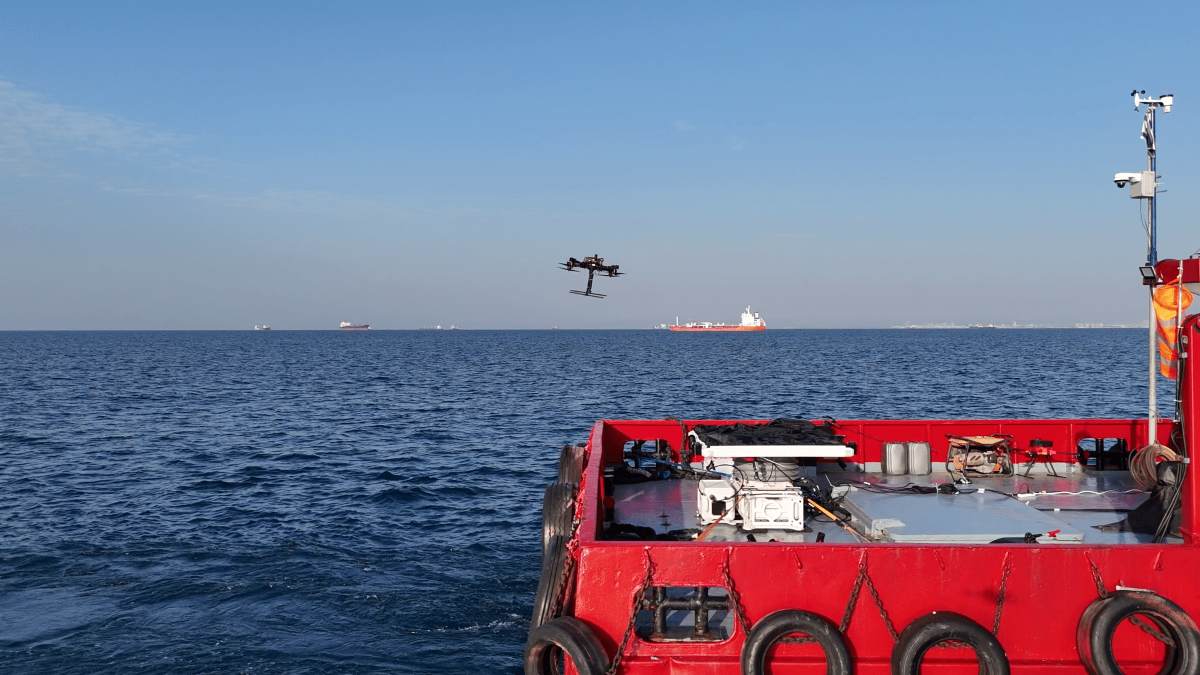
Drones have gotten incredibly good at flying, but out at sea, landing them is still a gamble. Constantly shifting decks, unpredictable waves, and slippery surfaces mean even experienced pilots can struggle, forcing most offshore operators to limit flights to calm conditions. Now, a young maritime tech company thinks it has finally cracked the code.
WaiV Robotics, a startup focused on autonomous maritime infrastructure, has unveiled a new system that allows drones to take off and land automatically on moving boats, even in rough sea conditions. And if it works as advertised, it could unlock a whole new chapter for drone operations far beyond land.
On land, drone landings are relatively predictable. Even in windy conditions, the ground doesn’t shift beneath you. At sea, that’s a completely different story. A vessel deck is constantly moving in multiple directions — pitching, rolling, and heaving with wave patterns that are anything but consistent. Add saltwater, slippery surfaces, and smaller vessels with limited deck space, and the challenge becomes exponentially harder.
Until now, most drone landing systems have only worked in calm waters or controlled environments. That’s left offshore industries, such as energy, shipping, and defense, hesitant to rely on drones for critical missions.
Instead of trying to make drones smarter, WaiV Robotics is flipping the script by building smarter infrastructure around them. At the heart of its system is a gyro-stabilized landing platform powered by AI-driven predictive algorithms. Rather than relying on a pilot to manually land the drone, the platform essentially “takes control,” guiding the aircraft safely onto a moving deck.
Here’s how it works in simple terms:
- The platform anticipates the vessel’s motion in real time
- It adjusts the drone’s approach using predictive algorithms
- Upon contact, the landing pad absorbs impact
- A catch-lock-release mechanism secures the drone instantly, preventing it from bouncing or sliding off
This approach removes the need for highly skilled pilots during recovery — one of the biggest bottlenecks in offshore drone use.
No drone modifications required
One of the more surprising aspects of WaiV’s system is its compatibility. The platform works with any VTOL (vertical take-off and landing) drone — including multicopters, fixed-wing VTOLs, and even helicopter-style UAVs — without requiring hardware or software changes.
That’s a big deal for operators who already have fleets in place.
The system can currently handle drones weighing up to 15 kg, with plans to expand support for smaller (around 3 kg) and much larger aircraft in the 100–300 kg range. It can also operate from vessels as small as 10 meters long, meaning even compact boats could become mobile drone hubs.
Offshore industries, from oil and gas in the Gulf of Mexico to maritime security and Coast Guard operations, have long eyed drones as a way to reduce costs and improve safety. But without a reliable way to launch and recover drones at sea, scaling those operations has remained out of reach.
WaiV Robotics’ system directly targets that gap. By turning vessels into autonomous drone launch-and-recovery stations, it could enable:
- Persistent offshore inspections
- Real-time surveillance and search-and-rescue support
- Faster delivery of equipment or medical supplies between ships
Most importantly, it does this without requiring entirely new drone fleets. And now, with $7.5 million in seed funding backing its development, WaiV is ensuring that drones will finally become a reliable tool at sea.
More: DJI agri drones boom globally, US farmers left behind


FTC: We use income earning auto affiliate links. More.




Comments