
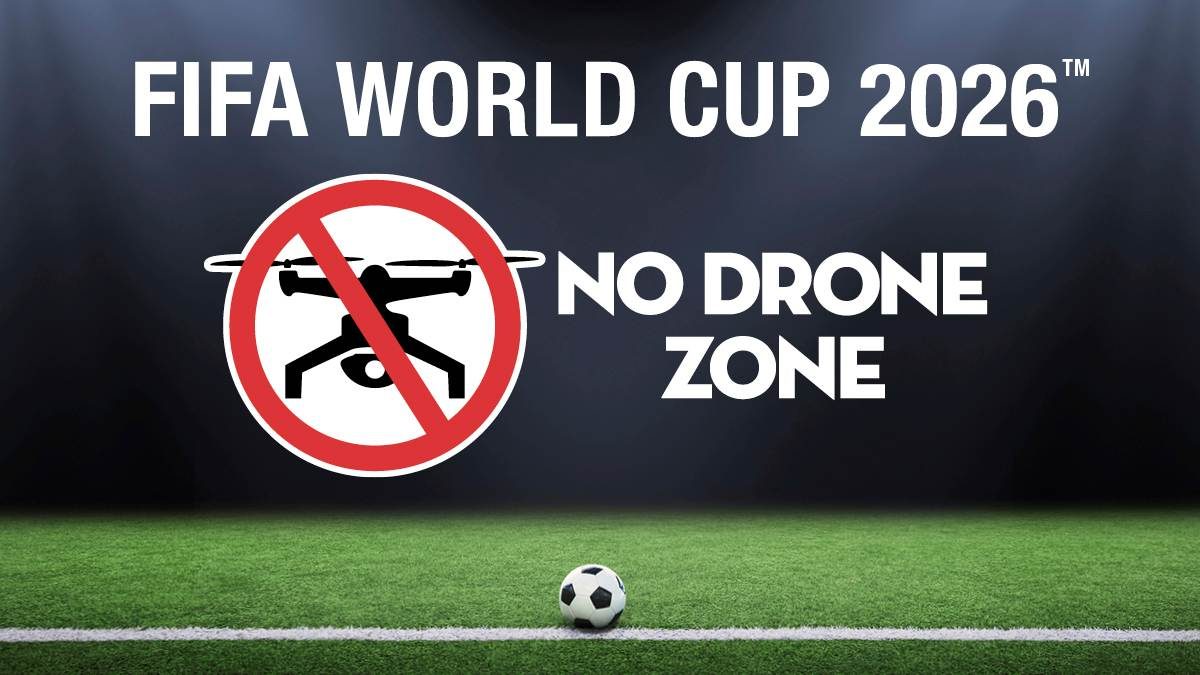
Authorities say they have detected 1,139 drones operating near World Cup stadiums and tournament-related sites across the United States, with more than 300 of those aircraft already mitigated without the use of force. Meanwhile, the FBI says it has seized more than 500 drones as part of ongoing investigations into unauthorized flights near tournament venues.
The figures, shared this week by White House World Cup task force coordinator Andrew Giuliani and FBI officials, offer the clearest look yet at the sheer scale of the airspace security operation surrounding the largest FIFA World Cup in history.
Speaking at the International Police Cooperation Center near Washington, DC, Giuliani said authorities have successfully responded to hundreds of drone incursions while keeping tournament operations running smoothly.
Officials have not disclosed exactly how those drones were neutralized, but Giuliani emphasized that more than 300 were dealt with without using force — a sign that electronic counter-drone technologies are playing a major role in protecting stadiums and fan events.
The FBI’s response has gone even further. According to Doug Olson, the FBI special agent overseeing World Cup coordination, investigators have seized more than 500 drones. Those aircraft are expected to be examined for evidence such as flight logs, ownership records, and other digital data that could help determine whether operators simply ignored the rules or intentionally violated restricted airspace.
Not every drone represents a malicious threat. In fact, officials suggest most incursions involve recreational pilots or commercial operators who either failed to check temporary flight restrictions or underestimated how aggressively those restrictions are being enforced.
That creates a unique challenge. Security teams must rapidly distinguish between harmless hobbyists and the rare operator who could pose a genuine danger. It’s a classic “needle in a haystack” problem, except the haystack now contains hundreds of drones.
That’s why authorities have repeatedly warned pilots to stay well away from World Cup venues.
Before the tournament began, the Federal Aviation Administration designated all US World Cup stadiums and related fan events as “No Drone Zones,” backed by temporary flight restrictions that prohibit unauthorized drone operations around stadiums on match days and around designated fan festivals. Officials warned that violators could face drone confiscation, criminal charges, fines of up to $100,000, and as much as one year in prison.
Those warnings haven’t stopped violations. In New York and New Jersey alone, the NYPD says officers have seized or mitigated 97 drones since June 13 after they entered restricted airspace over World Cup matches, fan zones, and public watch parties.
Police Commissioner Jessica Tisch said enforcement will continue through the busy July 4 holiday weekend, warning that any drone flown illegally into restricted airspace will be seized.
The department only recently received federal authority, technology, and training to electronically disable and safely remove drones from protected airspace. Officials have described the new capability as one of the biggest security upgrades the city has received in years.
Interestingly, nearly all of the drones confiscated so far have been ordinary hobbyist aircraft rather than sophisticated custom-built platforms. But officials stress that’s exactly the point.
Modern consumer drones are inexpensive, widely available, and capable enough that even an off-the-shelf aircraft could potentially be modified for more dangerous purposes. Security planners, therefore, can’t afford to dismiss any unauthorized flight until it’s been evaluated.
That concern has only grown after investigators recently disrupted an unrelated alleged plot involving drones capable of carrying explosives. Authorities have not linked that case to the World Cup, but it illustrates why every unauthorized drone attracts immediate attention.
The World Cup has also become a proving ground for America’s expanding counter-drone strategy. A new interim rule that took effect July 1 broadens the number of state, local, tribal, territorial, and corrections agencies that can assist federal authorities with counter-UAS operations under federally authorized programs. The change, enabled through the 2026 National Defense Authorization Act, effectively gives more trained personnel the legal authority to respond when unauthorized drones appear over protected events.
Technology alone, however, isn’t enough. Police officers from all 11 US host cities have undergone specialized counter-drone training covering drone identification, detection equipment, coordinated response procedures, and techniques for protecting spectators while minimizing disruptions.
The World Cup is also reinforcing a lesson that’s becoming increasingly clear across the drone industry: counter-drone operations are no longer reserved for military bases or airports. They’re quickly becoming standard planning for concerts, festivals, political events, and major sporting competitions.
France experienced a similar challenge during the 2024 Paris Olympics, where authorities reported hundreds of unauthorized drone sightings despite extensive security measures.
For legitimate drone pilots, the message remains straightforward. Whether flying recreationally or commercially, operators need to check FAA temporary flight restrictions before every flight — especially near stadiums, airports, or major public gatherings. As recent enforcement has shown, assuming the airspace is open can be an expensive mistake.
And judging by the more than 1,100 drone detections already recorded during the tournament, authorities aren’t taking any chances.
More: This DJI drone flies up to 93 minutes for under $300


FTC: We use income earning auto affiliate links. More.





Comments