
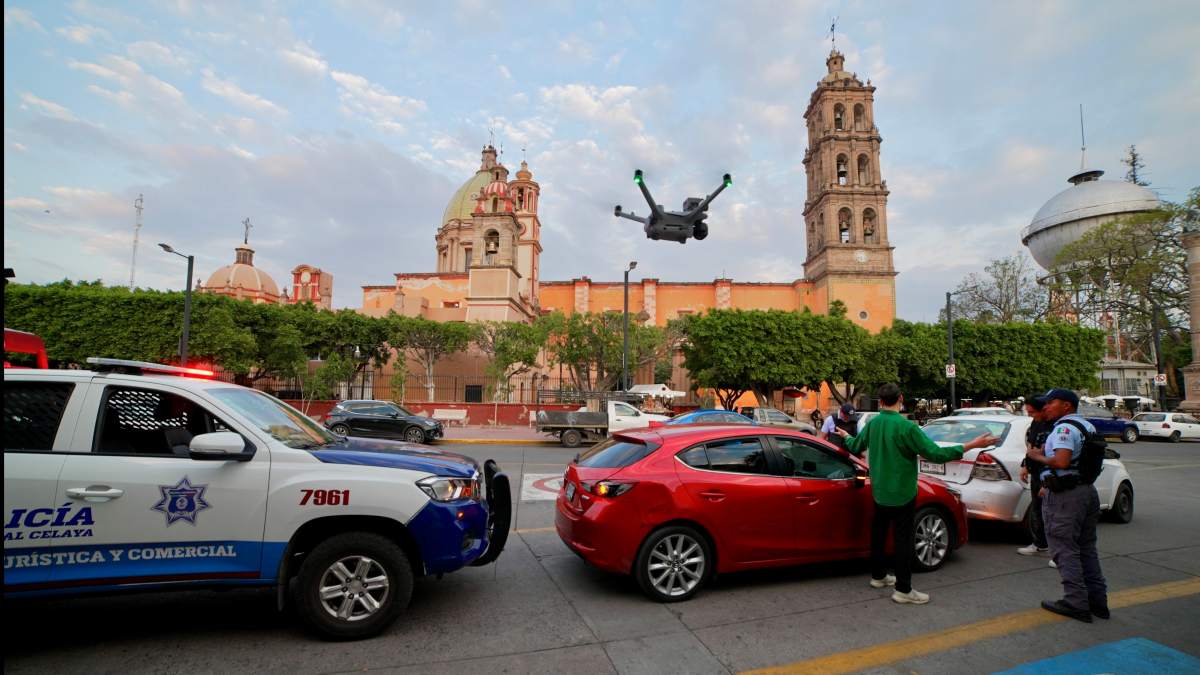
For years, the Mexican city of Celaya was known for all the wrong reasons. Once ranked among the country’s most dangerous cities, it struggled with violent crime and an emergency response system that often left police reacting instead of preventing incidents. Now, city officials say a combination of autonomous drone technology and integrated command-and-control systems is helping rewrite that story.
At the heart of the effort is DJI’s Dock 3, an automated drone-in-a-box system that can launch aircraft remotely within seconds of an emergency call. Instead of waiting for officers to reach a scene with limited information, the drone becomes the first responder — streaming live video back to operators and giving police a real-time view before they arrive.
“For many years, Celaya was a very dangerous city; we were the most dangerous city in Mexico,” Celaya Mayor Juan Miguel Ramírez Sánchez says. “That’s why we had to take measures.”
The deployment is part of a broader public safety initiative led by Mexican smart city and security technology company OKIP, which integrates DJI’s autonomous drone platform with the city’s emergency response infrastructure.
Moving beyond fixed cameras
Like many cities, Celaya previously relied on stationary surveillance cameras and police patrols. While those tools remain useful, they also have obvious limitations. Cameras can only monitor fixed locations, and officers responding to calls often have little information about what they’re walking into.
According to OKIP, that uncertainty created unnecessary risks for first responders.
“If officers arrived at an incident involving armed individuals or another high-risk situation, they often didn’t know what to expect,” explains Efraín Escalante Carmona, OKIP’s director of Unmanned Systems.
That challenge is becoming increasingly familiar to public safety agencies worldwide, including many in the United States. Over the past few years, Drone as First Responder (DFR) programs have expanded rapidly as police departments look for ways to improve situational awareness while reducing risks to officers and civilians.
Rather than replacing patrol units, drones are designed to reach emergencies first, providing live aerial intelligence that helps responders make better decisions before arriving on scene.
A drone launches before officers do
With DJI Dock 3, the process is largely automated.
When an emergency alert is received, an operator verifies flight conditions and authorizes deployment. The dock then automatically launches the drone, which reaches the incident within minutes and begins transmitting live video back to the city’s command center.
“The DJI Dock 3 lets us deploy a drone in seconds and reach the location in minutes,” Escalante Carmona says. “Police officers know exactly what they’re going to face before they arrive.”
That early intelligence can significantly change how officers approach an incident, whether it’s determining how many people are present, identifying potential threats, or confirming whether additional resources are needed.
The drones can also provide clear imagery during nighttime operations, when visibility on the ground is often limited.
One connected emergency response system
The drone itself is only one piece of Celaya’s new response model.
Live video, flight telemetry, and communications are shared across DJI FlightHub 2, the city’s C4 command center, and OKIP’s proprietary COVIA platform. That integration allows dispatchers, drone operators, and officers in the field to work from the same real-time information instead of relying solely on radio updates.
According to Teresa Casas Ortega, monitoring director at OKIP, operators receive the emergency alert, verify conditions, launch the drone, and immediately begin coordinating with emergency responders while monitoring the live feed.
The goal is simple: replace assumptions with verified information.
It’s also worth pointing out that, unlike fixed surveillance infrastructure, the Dock 3 system isn’t permanently tied to one location.
Officials say it can be relocated to support major public events, tourist destinations, or neighboring municipalities when additional aerial coverage is needed. That flexibility is especially valuable given Celaya’s location about an hour from the popular tourist destination of San Miguel de Allende.
Escalante Carmona said the system has already been used to provide aerial support during local fairs and tourism-related operations.
A model for broader adoption?
OKIP says its ambitions extend well beyond Celaya. The company envisions building a nationwide network of autonomous drone systems capable of providing rapid aerial response for security agencies across Mexico.
For DJI, the project also highlights how automated docking systems are moving beyond infrastructure inspections and industrial applications into everyday public safety operations.
Whether similar deployments become more common in North America remains to be seen, but the technology reflects a growing trend: using autonomous drones not simply to record emergencies, but to help responders understand them before they arrive.
For Celaya, city leaders believe that the shift is already making a difference. According to Mayor Ramírez Sánchez, residents now increasingly view the city as a safer place, even if many don’t realize that an autonomous drone may already be overhead before police vehicles pull up to the scene.
More: DJI Matrice 4D drone gains standalone C6 compliance across Europe


FTC: We use income earning auto affiliate links. More.




Comments