
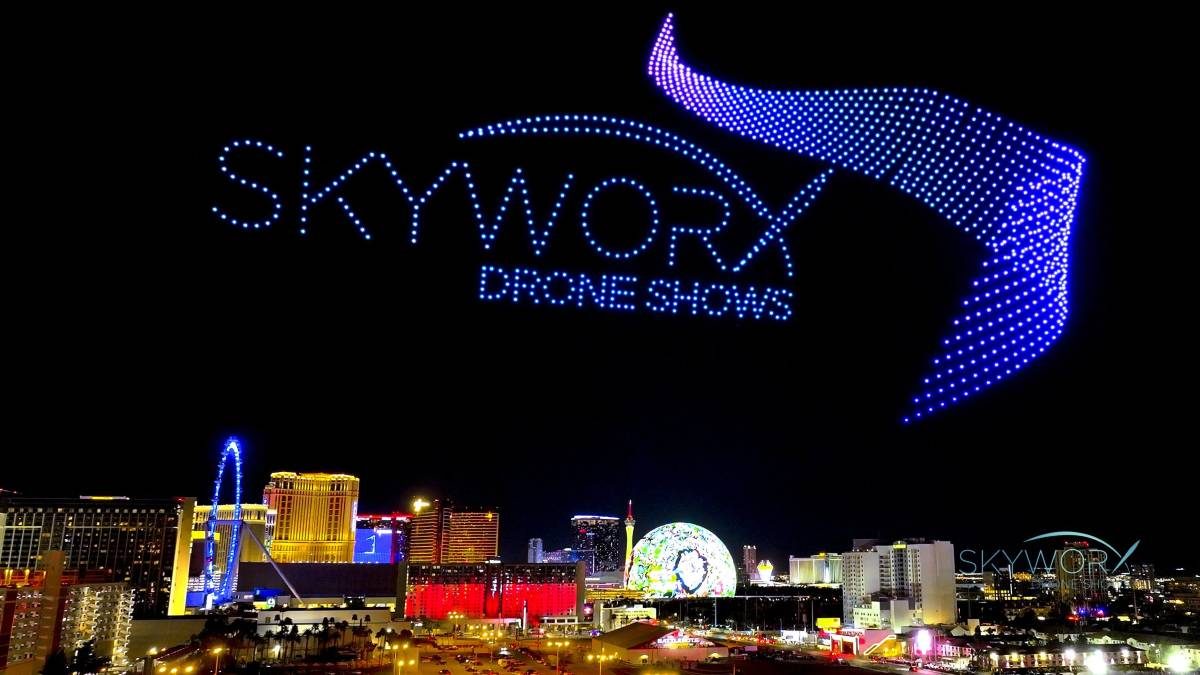
The Federal Communications Commission’s proposed crackdown on foreign-made drones is starting to look a lot bigger than a fight over DJI. A major US drone light-show operator is warning that the agency’s proposed definition of “military-grade” unmanned aircraft could sweep up the specialized drones used to create giant aerial displays, even though those aircraft have little in common with military swarming platforms.
Skyworx Drone Shows, which says it produces hundreds of shows each year for municipalities, event producers and other customers nationwide, has asked the FCC to specifically exclude purpose-built aerial entertainment drones from the proposed restrictions. The company says its equipment is designed for one job: flying preprogrammed, choreographed light shows.
That distinction matters because the FCC proposal specifically asks whether foreign-produced “swarming” UAS should be treated as military-grade equipment and therefore potentially prohibited from continued importation and marketing.
The agency’s proposal is aimed at certain foreign-made drones and critical components already on the FCC’s Covered List. It would potentially go beyond the restrictions that currently prevent new covered equipment from receiving FCC authorization, by limiting the continued importation and marketing of some equipment that was previously authorized.
And “swarming” is where the drone light-show industry sees a problem.
These drones fly together, but they aren’t military swarms
From a distance, a drone light show can certainly look like a swarm. Hundreds or even thousands of small aircraft can launch together, move through elaborate formations and create animated pictures or words in the night sky. But Skyworx argues that the technology behind those performances is fundamentally different from autonomous military swarming.
The company says each of its drones weighs no more than 3 pounds. They don’t carry cameras, thermal sensors, or LiDAR, cannot dispense chemicals, and don’t use their docking stations to transfer data or payloads. The stations are used for battery charging.
More importantly, Skyworx says its drones aren’t autonomous. Every show is flown under the continuous control of an FAA-licensed remote pilot. The flight paths are programmed ahead of time using dedicated show-design software, and the individual aircraft simply follow those predetermined routes during the performance.
The drones also don’t communicate with each other to make real-time decisions, according to the company. If a drone loses its GPS/RTK signal and moves beyond its communication range, it doesn’t decide where to go next. Instead, it automatically lands or returns to the launch area.
That, Skyworx argues, is a crucial difference between a choreographed light show and the kind of autonomous swarming capability associated with military systems.
The company also points to a series of safety restrictions built into its operations. Its shows use defined operating areas, an inner “soft” geofence that can trigger a return-to-home or landing command, and an outer “hard” geofence that cuts power to the drone’s motors if breached. A separate buffer zone protects spectators based on the aircraft’s maximum fall distance.
There are regulatory safeguards, too. Skyworx says its pilots are FAA-certificated and TSA-screened, its drones are registered with the FAA, and shows require airspace authorization, coordination with local officials, and a NOTAM. The company operates under an FAA waiver covering its multi-drone operations.
In other words, the company isn’t arguing that drone shows shouldn’t be regulated. It’s arguing that they shouldn’t be regulated as military technology simply because multiple drones fly together.
The bigger problem could be safety
Skyworx also has a practical argument for keeping foreign-made equipment available: there aren’t enough proven US alternatives yet.
The company says it wants to transition to American-made equipment, but argues that the domestic options available today don’t provide everything it needs to operate a large fleet safely.
One example is parachute recovery systems. Skyworx says foreign manufacturers currently provide equipment with parachutes, while comparable US-made systems aren’t yet broadly available. It also argues that domestic alternatives haven’t demonstrated the same reliability at the scale required for increasingly large drone shows.
That’s an important wrinkle in the FCC debate. The argument isn’t simply that replacing foreign drones would be expensive. Skyworx says replacing equipment before proven alternatives are ready could actually create a safety problem.
Drone show systems are also tightly integrated. The aircraft, firmware and show-control software are tested together, and Skyworx says mixing equipment from different manufacturers isn’t necessarily a plug-and-play proposition. Using untested combinations could compromise reliability during a show over a live audience.
And replacing an existing fleet wouldn’t be cheap. Skyworx says it operates thousands of purpose-built light-show drones and estimates that replacing those aircraft and regularly replaced components would be a multi-million-dollar undertaking for a company of its size. For smaller operators, the company says, the financial hit could be crippling.
What happens to fireworks if drone shows disappear?
There’s also a surprisingly broad public-interest argument behind Skyworx’s filing.
The company says municipalities and event organizers increasingly choose drone shows as an alternative to fireworks because they can produce large-scale spectacles with lower emissions and without the same wildfire concerns in high-risk areas.
Skyworx also says drone shows can be a more accessible option for people who find fireworks difficult because of sensory issues, including veterans and others affected by PTSD.
If access to the equipment disappears before comparable US-made systems are available, Skyworx warns that communities could lose those events or return to alternatives that present different safety and environmental concerns.
The economic impact would extend beyond drone companies, too. The operator points to contract pilots, event crews, local vendors, public-safety personnel, hospitality businesses and tourism spending connected to the shows.
So Skyworx isn’t asking the FCC to abandon its national-security goals. It’s asking for a narrower definition.
The company’s proposed solution is straightforward: exclude UAS specifically designed for aerial entertainment displays from the definition of “military-grade” systems. In its view, that would allow the FCC to target higher-risk technologies without accidentally treating a fleet of lightweight, preprogrammed light-show drones like a military weapons platform.
That’s a different argument from DJI’s challenge to the FCC proposal, but it points to the same underlying problem: how do you define a military drone when many of the technologies used by military aircraft have become ordinary commercial tools?
The FCC’s proposal is still just that — a proposal. The comment period closed September 2, and the agency has yet to issue a final rule. But if Skyworx’s warning is any indication, the eventual decision could affect far more than the drones most Americans associate with national-security concerns. It could also determine whether America’s increasingly popular drone light shows remain a practical alternative to fireworks, or become an unexpected casualty of the country’s expanding drone crackdown.
More: Police officer faces misconduct hearing after drone hits child


FTC: We use income earning auto affiliate links. More.




Comments