
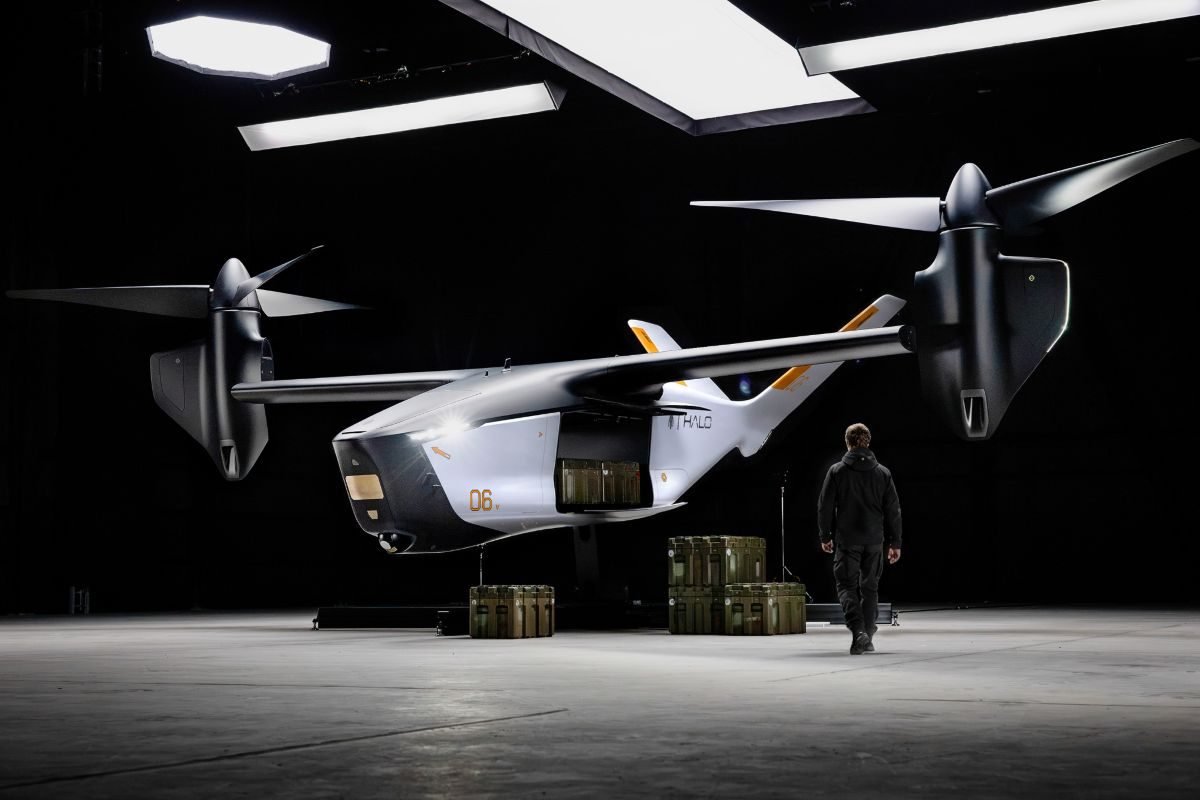
Imagine a cargo aircraft that can take off like a helicopter, fly long distances like an airplane, and do it all without a pilot onboard. That’s the idea behind Halo, Archer Aviation’s new autonomous hybrid-electric VTOL aircraft built to transport heavy payloads to places where traditional aircraft often can’t operate.
Halo is built on a dual-use aircraft platform that Archer developed with defense technology company Anduril. While Halo is designed for commercial logistics, the same underlying platform also serves as the foundation for a separate defense aircraft, allowing the two variants to share their airframe, hybrid-electric powertrain, and core systems while carrying different payloads depending on the mission.
The platform behind Halo builds on technology Archer has spent the past eight years developing for its electric aircraft program. According to the company, lessons learned in aircraft design, battery systems, electric motors, powertrain engineering, flight testing, and manufacturing were used to create a new aircraft optimized for significantly greater range, payload capacity, and endurance.
One of Halo’s defining features is its series hybrid-electric powertrain. Instead of relying solely on batteries, the aircraft combines electric propulsion with hybrid power generation to extend range while optimizing power throughout every phase of flight.
The aircraft also uses dual tiltrotors that can vary their rotor speed depending on the stage of flight. During cruise, the system improves efficiency and reduces fuel consumption. During takeoff, landing, and low-speed operations, it helps lower noise levels, making Halo better suited for suburban areas and other noise-sensitive locations.
Together, these technologies are intended to give Halo capabilities that conventional unmanned cargo aircraft often struggle to combine.
More: The DJI trick every social media creator should know
According to Archer, Halo offers long-range, high-speed autonomous flight while carrying heavy payloads inside a modular cargo bay that can be configured for different missions. Because the aircraft doesn’t require a pilot onboard, operators could reduce labor costs, avoid exposing crews to hazardous environments, and potentially fly more missions each day.
Like other VTOL aircraft, Halo can also take off and land vertically, eliminating the need for runways and allowing operations from locations that would otherwise be difficult to access.
Another practical advantage is deployment flexibility. Archer says Halo can fly long distances under its own power or be packed into a standard shipping container for transport by truck, rail, ship, or cargo aircraft before being assembled at its destination.
The platform has also been designed with manufacturing in mind. Rather than relying on highly specialized production methods, Archer says it can be built using commercial supply chains to support high-volume production as demand grows.
“Over the past eight years we’ve engineered, tested and scaled the technology this platform is built on,” says Archer founder and CEO Adam Goldstein. “We partnered with Anduril to take all of that knowledge and build something new: a clean-sheet aircraft in a completely different class of range, speed and payload.”
New: DoorDash becomes certified drone airline, signaling delivery’s next chapter
Archer also used the announcement to reveal its first strategic commercial launch partner for Halo: Marubeni Aerospace Corporation, a subsidiary of one of Japan’s largest trading companies.
The partnership will focus on researching commercial markets, identifying potential use cases, and supporting Halo’s future introduction to customers. Archer says additional launch partners are expected to be announced later this year.
The company sees strong demand across industries where moving cargo over long distances without a runway remains challenging.
Potential applications include transporting supplies to offshore oil, gas, and wind energy platforms, carrying time-sensitive freight between logistics hubs, supporting humanitarian relief and disaster response, delivering medical cargo directly to hospitals, and conducting long-range maritime operations.
Marubeni Aerospace President and CEO Satoru Nakagawa says many cargo missions that don’t require onboard crews still rely on human pilots today, increasing operating costs while limiting scheduling flexibility.
He believes Halo’s autonomous flight capabilities, combined with its long range, heavy payload capacity, and VTOL design, could provide customers with a more efficient alternative for these types of operations.
With Halo, Archer is expanding beyond its passenger eVTOL ambitions into autonomous commercial logistics. If the aircraft performs as promised, it could offer industries like offshore energy, freight, healthcare, and emergency response a new way to move heavy cargo to locations that are difficult or expensive to reach using conventional aircraft.
More: The DJI drone you’ll actually bring everywhere is on discount


FTC: We use income earning auto affiliate links. More.




Comments