DJI: The world’s leading drone company
Da-Jiang Innovations, better known as DJI, is the world leader in drone technology with about 70% of the market share worldwide. The company is best known for its Mavic and Phantom drones, which brought consumer drones into the mainstream.
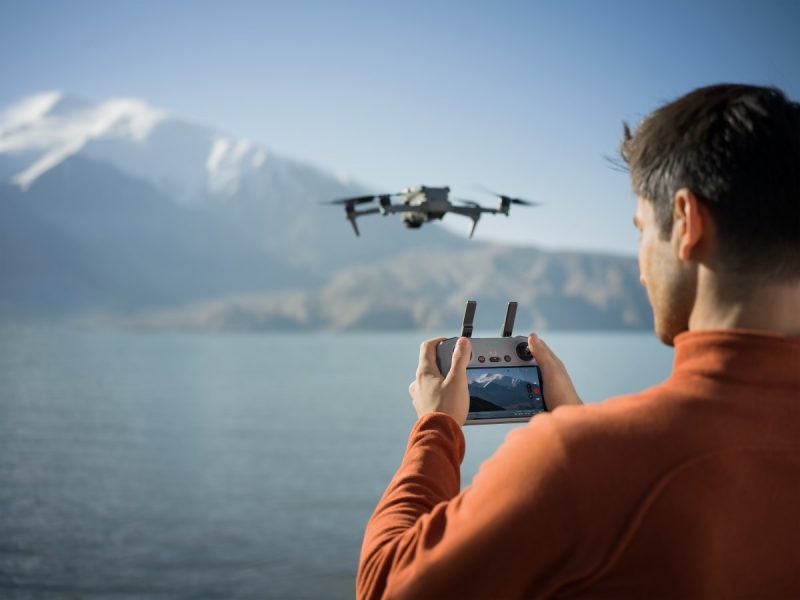
Da-Jiang Innovations, better known as DJI, is the world leader in drone technology with about 70% of the market share worldwide. The company is best known for its Mavic and Phantom drones, which brought consumer drones into the mainstream.
Table of contents
DJI History: How DJI’s Early Drones Paved the Way
If you’re visiting DJI headquarters in Shenzhen for the first time, you’ll likely receive the guest treatment. That means you’ll be taken to the main lobby and shown what looks like a small museum display. It’s a row of DJI-manufactured drones, including the iconic original Phantom that was released in 2012. It’s an astonishing record of technological accomplishment, and it makes you wonder what’s next.
The letters D-J-I stand for Dà-Jiāng Innovations. In Chinese, those first two words mean “Great Frontier.” As the industry leader in the manufacture and sales of consumer and enterprise drones (as well as technological innovations in many other areas – think Osmo, Ronin, etc.), DJI has largely set the pace for the industry. Usually, that has left competitors trying to catch up to DJI, rather than the other way around.
I had the chance to visit DJI for a week back in 2016. Most of my time was spent in a small meeting room, but that lobby display stuck with me. When you look at that product line and consider the improvements in each short generation, it’s impossible to not be impressed. This company has made huge technological leaps in a very compressed time frame. (And that’s without even touching on enterprise/industrial drones and other DJI products – an area we’ll save for another day!)
With many forms of technology, developments feel more linear and incremental. A phone released a couple of years ago will still do the job just fine, even though newer phones have more features. But it’s not like the new phone does the basics *that* much better. Same goes, arguably, for things like home theatre amplifiers, speakers – and more.
Drones, however, seem to have progressed faster – particularly the many produced by DJI. With every generation, it seems, there has been something truly new. The Flamewheel was a kit. The Phantom 1 was a complete, ready-to-fly unit with no exposed wires – but it lacked a camera. The Phantom 2 Vision+ had a camera, three-axis gimbal, and streaming video. (And that gimbal, according to DJI, was produced at 1/10th of the cost of its Zenmuse 15 – a standalone gimbal from the same era.)
Soon there would be 4k video, obstacle avoidance, object tracking, AI, and more. And while DJI’s R&D department packed on the features, there was – at least with some models – a reduction in size and weight. The original Mavic Pro took the industry by storm following its release (just a month after GoPro’s ill-fated GoPro Karma, in October of 2016), and DJI was initially unable to meet the tremendous demand for its folding drone.
Moore’s Law
Geeks and non-geeks alike often talk about the progression of technology in terms of Moore’s Law. Odds are you’ve heard of the prediction made by Gordon Moore back in 1965. He suggested then that the number of transistors on an integrated circuit would reach 65,000 by 1975. A decade later, when that proved accurate, Moore amended his prediction: The number of transistors on an IC chip would double every two years.
He was right.
“Since then, his prediction has defined the trajectory of technology and, in many ways, of progress itself,” states an excellent article published in the MIT Review. Today, nearly 50 billion transistors can be squeezed onto the most sophisticated chips.
Some believe Moore’s law has started sliding in recent years. The sizes of transistors in these chipsets are now so unbelievably small that further shrinking at historical rates is becoming more difficult. In fact, the MIT story quotes some smart people as saying Moore’s Law is essentially toast – though proponents argue it’s still on track. There seems to be some consensus, however, that computing power will not continue to grow at historical rates.
But wow, did Moore’s Law ever power the world through a lot of technology.
Almost every technology we care about, from smartphones to cheap laptops to GPS, is a direct reflection of Moore’s prediction.
Those ubiquitous Integrated Circuits are in every single drone on the planet, from the most sophisticated industrial drone all the way down to the cheapest toy micro-copter. They enable your drone to do virtually everything that it does.
Moore’s law certainly explains a significant part of the equation when it comes to the technological advances we’ve witnessed in drones in the past eight years. But that’s not all: DJI is by far the biggest player on the planet. It currently has about 14,000 employees and the firm tells DroneDJ that roughly one-quarter are either engineers or working in R&D.
An engineering powerhouse
Think about that for a second. More than 3,000 employees – perhaps even more than 4,000 – are engineers. Having worked in startups that have built incredible things (including UAVs!) with a very small engineering and fabrication team, it’s hard to imagine the kind of progress a company could achieve with that many focussed brains. (Well, actually it’s not that hard to imagine: Just look at their products.)
Like many companies that come from a startup background, there’s still a certain energy at DJI to forge ahead; it’s part of the company culture and could even be thought of as an expectation. In fact, it’s not unknown at the firm’s headquarters to leverage the competitive spirit by putting separate teams to work solving the same problem. May the best team win.
Build things that work: Repeat
But it’s worth remembering that long before it had 14,000 employees, way back in 2012, DJI already had some of the basics down: It had a stable platform that could safely be flown by a first-time pilot with common sense. It had its Zenmuse gimbal, the development of which provided a solid basis for developing a small integrated camera-gimbal attached to a drone. Having that technological foundation already under its belt gave the company a tremendous competitive advantage as the consumer drone market began to explode: It could already build things that worked.
Plus, it was largely the products DJI was producing that was the fuel for that exploding market. People wanted drones that were reliable, easy to fly, and could produce professional-quality stills and video that could be clearly monitored by the pilot during flight. DJI was happy to comply and eager to take that early market dominance and build on it. The company was becoming a juggernaut.
A bird’s eye view
Craig Issod watched these changes as closely as anyone. Craig founded the Droneflyers.com site back in 2013 and created the bulk of its core content until the site changed hands in 2018. Craig was particularly known and respected for his ‘state of the industry’ pieces, which took a clear-eyed look at the overall sector. We asked him how he regards DJI’s progress when compared with other drone manufacturers.
“The true scale here would be determined by what the rest of the field has done – which IMHO is relatively little,” says Issod. He also believes that DJI entered the market it helped create with a tremendous advantage over would-be competitors: “The biggest DJI innovations were probably early in the game: The solving of various problems with reliability and stabilization.”
You can look back on that Phantom 1, says Issod, as a proof of concept for reliability and as a testbed for the first working consumer gimbals. The Phantom 3 Advanced and Pro (remember lusting after those gold stripes?) offered a “massive step forward in integration and reliability. Even now, four or five years later, many would still look at images and videos taken with those and be impressed.”
That’s true. Those products – though now eclipsed – were excellent. Consumers and pros embraced them and offered countless bits of feedback through forums, blogs, and directly to retailers and DJI itself. Issod says the company paid attention.
“DJI is relentless in terms of improvement of their hardware and software,” he observes. “They seem to accept consumer feedback and, more importantly, have incredibly good vision and high standards for their own product. This is rare in business – so many have large blind spots which end up hurting them,” says Issod.
The software side of things is worth noting. DJI puts a tremendous effort into creating software with a positive user experience and continuously updating firmware to improve performance or address issues. DJI software arguably created the standard by which other drone interfaces are compared.
It has also paid attention to the diverse user base and the differing use-case scenarios those people have in mind. That’s the reason it has the range of consumer and prosumer drones that it has. You can trace this back to the different iterations of the Phantom 3 – which came in different flavors depending on how serious you were about visuals.
“The Standard, Advanced, and Professional models of the Phantom 3 gave users the critical aspect of choice,” explains DJI product manager Paul Pan in a post on the DJI Hub. “Instead of being just the next Phantom, these three versions allowed users to get the right drone for them, based on their needs and ambitions.”
DJI has again scored hits on the consumer side with the Mavic Mini – a relatively inexpensive but full-featured drone that fulfills a market niche: A quality product that weighs in at 249 grams, thereby avoiding some of the licensing and registration issues that kick in at 250 grams. Having flown the Mini in pilot workshops and seen the images that pop straight out of it, it’s definitely on my shopping list. (Seriously, this is an amazing piece of technology that fits in the palm of your hand.)
The other DJI product that currently has my attention is the Mavic Air 2. It feels like the perfect balance in terms of size, features, and form factor. I look forward to getting an opportunity to fly this and offer my thoughts. Craig Issod, who has flown a *lot* of drones, loves his:
“Having just purchased a Mavic Air 2, I am more than pleased with the value. DJI has always priced aggressively and this is one more example.”
There’s also, as many have noted, the Apple-like feel to the packaging and even design asthetic.
As for the future…
So what’s next?
Well, DJI will obviously continue to produce quality drones.
But that doesn’t mean DJI is without competition. The drone market remains huge, with significant positive forecasts for growth. Companies like Skydio came to market with an impressive AI that almost immediately allowed it to carve out its own little piece of the pie. Parrot has just thrown down a 500-gram gauntlet in the Enterprise market with the aggressive release of its Anafi USA, which it believes will take some of the first responder purchases away from DJI.
There are several other players, of course, some with very good products of their own. They have no plans to go away (though GoPro learned a very painful lesson about heading to market with a product that simply wasn’t ready for prime time. DJI took no small amount of pleasure in launching its Mavic Pro the following month – just as reports were surfacing of Karmas dropping from the sky due to a battery connectivity issue.)
Issod has watched this industry – as well as other technology – long enough to have a pretty good perspective. He believes we may now be in a phase where, like a sputtering Moore’s Law, the advances won’t be as significant as they used to be. Things will improve with each iteration, but that “WOW” factor will be gone.
“My take is that the consumer and even prosumer end has hit a plateau in a similar way that laptop computers did,” he says. “A four-year-old Macbook Pro or Air is almost as good – and sometimes better – than a new one.”
And what about DJI? Will it maintain its dominance?
“It’s hard to see how they wouldn’t hold onto their position as top dog in the sectors they already lead in. They have made it clear they are in the AI and Robotic industry as opposed to being limited to camera drones,” he says. “They will fail at some efforts and succeed at others – but they likely can afford this. Startups cannot.”
“That’s not to say that evolution will not continue.”
Agreed.
List of DJI drones: Consumer, Pro, and more
DJI Camera Drones
Mavic Series
- Mavic 3 Pro
- Mavic 3 Classic
Air Series
- Air 3S
- Air 3
Mini Series
- Mini 4 Pro
- Mini 3
- Mini 4K
Entry Level / Flying Cameras
- Flip
- Neo
FPV
- Avata 2
Professional
- Inspire 3
DJI Enterprise Drones
Compact
- Matrice 4T
- Matrice 4E
- Mavic 3E
- Mavic 3T
- Mavic 3M
Mid-Size
- Matrice 30
- Matrice 30T
- Matrice 3D
Large Scale
- Matrice 350 RTK
DJI Agriculture Drones
- Agras T10
- Agras T30
- Agras T40
- Agras T20P
- Agras T25
- Agras T50


